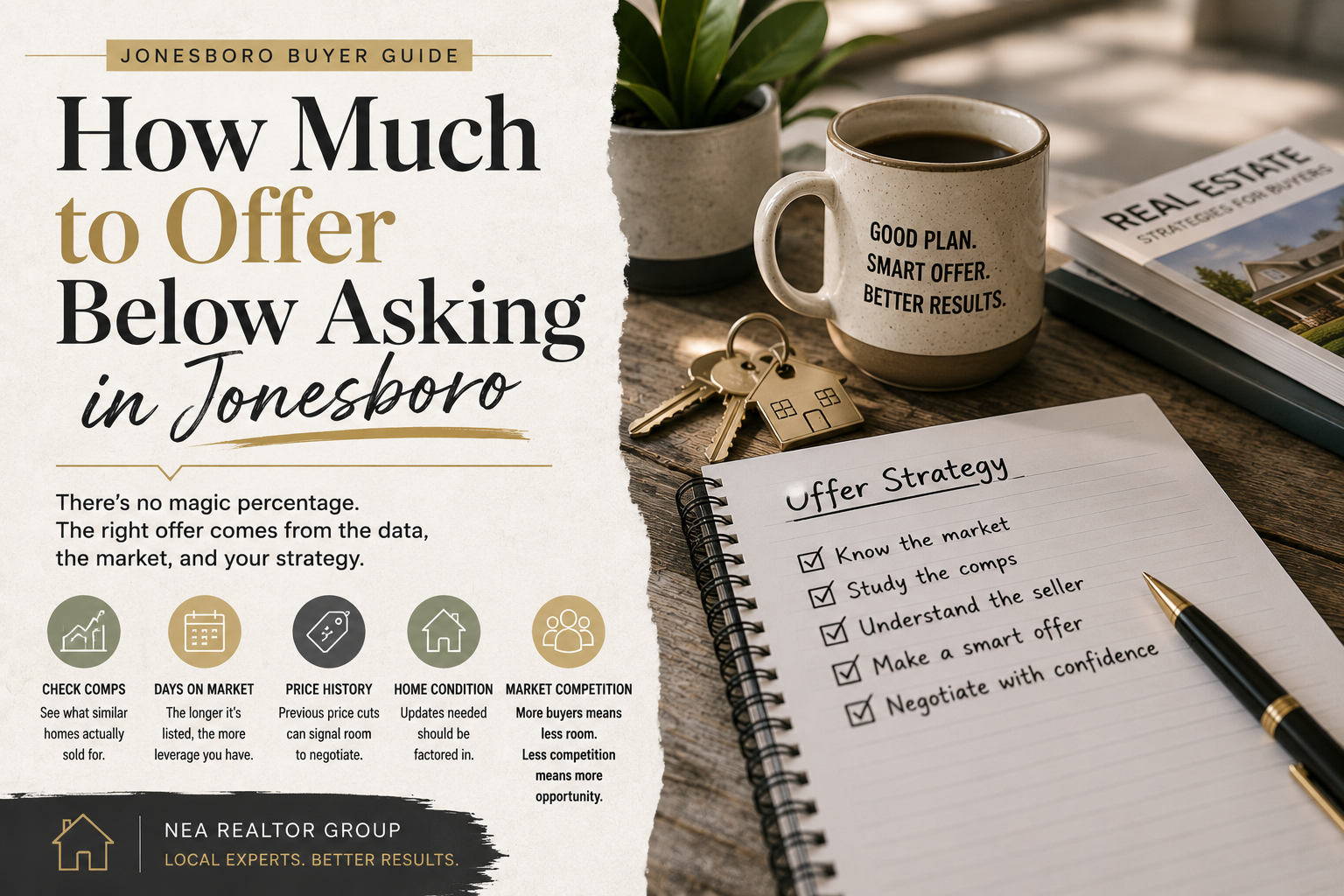
How Much to Offer Below Asking in Jonesboro
How much below asking price should you offer on a Jonesboro home?
There is no fixed percentage. In the more balanced 2026 Jonesboro market, the right number comes from how long the home has been listed, whether the price has already been cut, and what comparable homes have actually sold for, not a flat amount off the sticker.
Ask ten people how much to offer under asking price and you will hear ten different rules of thumb. Five percent. Ten percent. Whatever feels right. None of those are answers, because none of them look at the one home you actually want to buy.
At NEA Realtor Group, Trenton Hoggard and Tim Ray write offers with buyers across Jonesboro and Northeast Arkansas every week, and the real answer is always built from the specific listing in front of you. If you are early in the search, our guide to buying a home is a good place to get your footing first.
Here is how to land on a number that gives you room to negotiate without losing the house, and what the 2026 Jonesboro market means for how far you can push.
Why "Percentage Off Asking" Is the Wrong Starting Point
The list price is a seller's opinion. It might be spot on, a little high, or well above what the home is worth. Offering a flat percentage under it treats every list price as if it were accurate, and it usually is not.
Two homes on the same street can call for completely different offers. One priced correctly and freshly listed leaves little room. One priced high and sitting for two months may have a lot of give, even if both show the same asking price.
So the better question is not "how much below asking," it is "what is this home actually worth, and how motivated is this seller?" Answer those two, and your offer number falls out on its own.
What Actually Sets Your Offer Number
A strong offer price rests on a handful of concrete facts, not a gut feeling. These are the ones we walk through with every buyer:
- Recent comparable sales. What have similar homes nearby actually closed for in the last several months? In a lower-volume market like ours, those comps may reach back 90 to 180 days to find true matches. This is the anchor for everything else.
- Days on market. A home listed three days ago sits in a very different spot than one that has been available for 75 days. Time on market is one of the clearest signals of how much room a seller has.
- Price history. Has the seller already cut the price once or twice? A home that started high and has come down is telling you the market pushed back, and it may still have room.
- Condition. Deferred maintenance, an aging roof, or dated systems all pull the fair number down, and they give you honest, specific reasons to support a lower offer.
- Competition. If another buyer is circling, your leverage shrinks fast. If the home has been quiet, it grows.
Pulling those pieces together is what a comparative market analysis does. We break down how a Jonesboro home gets valued in our post on what a CMA actually tells you, and the same tool that helps sellers set a price helps buyers decide what to offer.
Reading the 2026 Jonesboro Market
Conditions matter, and 2026 has been friendlier to buyers than the frenzy of a few years back. Homes in Jonesboro have been taking around 77 days to sell, up from roughly 97 the year before, and inventory has loosened, according to market data from Redfin.
Longer market times and more choices mean sellers are negotiating more than they used to. It has become common in our area for buyers to ask for some or all of their closing costs to be covered, something that was much harder to get when homes were selling in a weekend.
Rates are part of the backdrop too. The 30-year fixed averaged 6.49 percent in late June, per Freddie Mac, and has held fairly steady for weeks. Steady rates and looser inventory give buyers a little more time and a little more room to negotiate, without the pressure of a runaway market. For the bigger national picture, the National Association of Realtors tracks these same trends.
None of that means every Jonesboro home is a bargain waiting to happen. A well-priced house in a popular area still moves, and still draws competing offers. The market sets the ceiling on your leverage; the specific listing sets where you land under it.
How Far Below Asking You Can Realistically Go
Instead of a magic percentage, think in terms of the situation you are walking into. A few common ones:
A fresh, well-priced listing
If the home is new to the market, priced in line with the comps, and shows well, plan to offer at or near asking. Lowballing a sharp listing usually just invites a counter back to full price, or a seller who decides not to work with you at all. Your leverage here is your terms, not a deep price cut.
A home that has been sitting
Once a listing passes the local average days on market with no price change, the seller is often ready to talk. This is where a supported offer below asking has real teeth, especially if the comps back up a lower number. The longer it has sat, the more open the conversation tends to be.
A home that has already been reduced
A price cut tells you the seller has accepted the market is below where they started. Depending on how the new price lines up with the comps, there may still be a bit more room, or the reduction may have brought it right to fair value. Read the comps before assuming more discount is there.
In every one of these, the offer is only credible if the number ties back to real sales. An offer supported by comps is a negotiation. A number picked from the air is just a guess the seller can wave off.
Price Is Only One Lever
Buyers fixate on the price line, but sellers weigh the whole offer. Sometimes you get further by keeping your price closer to asking and shaping the terms to fit what the seller needs:
- Closing cost help. Asking the seller to cover part of your closing costs can save you real cash up front, and it is very common in our market right now. We cover the details in our guide to seller concessions in Jonesboro.
- A closing date that fits their move. Flexibility on timing can be worth more than a few thousand dollars to a seller who needs to line up their next home.
- Clean, reasonable contingencies. A straightforward offer with sensible inspection and financing terms reads as lower risk, which can matter as much as price.
- Earnest money. Here is a local reality worth knowing: the majority of Northeast Arkansas deals do not include earnest money at all. When buyers do put it down, $1,000 is the most common figure, with higher amounts, up to roughly $5,000, typically reserved for luxury transactions. Offering earnest money you are not required to can signal you are serious.
A lower price plus aggressive terms can stack up to more than the seller will accept. A slightly higher price with terms that solve the seller's problem can quietly win. That trade-off is a big part of how we structure offers, and it connects to writing an offer that actually gets accepted.
Mistakes That Cost Jonesboro Buyers
A few missteps show up again and again when buyers try to negotiate on their own:
- Leading with an insulting number. A wildly low offer with nothing behind it can sour the seller before real talks begin, and you may not get a second chance on a home you actually want.
- Ignoring the comps. If recent sales say the home is priced right, a low offer is not clever, it is just off. Know the value before you name a price.
- Chasing the discount into a bad house. A cheap price on a home with serious problems is not a deal. A solid inspection, usually $500 to $1,000 in Northeast Arkansas, tells you what you are really buying before you fall for the number.
- Treating negotiation as a fight. The goal is an agreement both sides sign, not a win. Sellers who feel worked with tend to give more than sellers who feel cornered.
Frequently Asked Questions
Q: Is it rude to offer below asking in Jonesboro?
Not when the number is supported. Sellers expect some negotiation, and a below-asking offer backed by recent comparable sales reads as reasonable, not offensive. What sours a deal is a lowball number with nothing behind it, or an offer far under a home that is already priced correctly.
Q: How do I know if a Jonesboro home is priced too high?
Compare it to what similar homes nearby have actually sold for in the last several months, and look at how long it has been listed. A home well past the local average days on market with no price change, or one that has already been reduced, is often priced above what the market will pay.
Q: Should I offer full asking price in this market?
Sometimes, yes. On a fresh, well-priced home that is drawing interest, offering at or near asking with clean terms can be the smart move. On a home that has been sitting or been reduced, there is usually more room. The listing itself tells you which situation you are in.
A quick note: we are real estate agents, not appraisers or lenders. Every home and every seller is different, so treat these as guidance and let the specific comps and terms drive your final number.
Ready to Write a Smart Offer in Jonesboro?
Trenton Hoggard, Tim Ray, and the team at NEA Realtor Group will pull the comps, read the seller's position, and help you land on an offer number that gives you room to negotiate in Jonesboro and across Northeast Arkansas. We are proud to have earned dozens of 5-star reviews and to rank as the #1 real estate team in the Northeast Arkansas MLS by production.
Connect with NEA Realtor Group