How to Read Your Closing Disclosure in Jonesboro
What is the Closing Disclosure and when do Jonesboro buyers receive it?
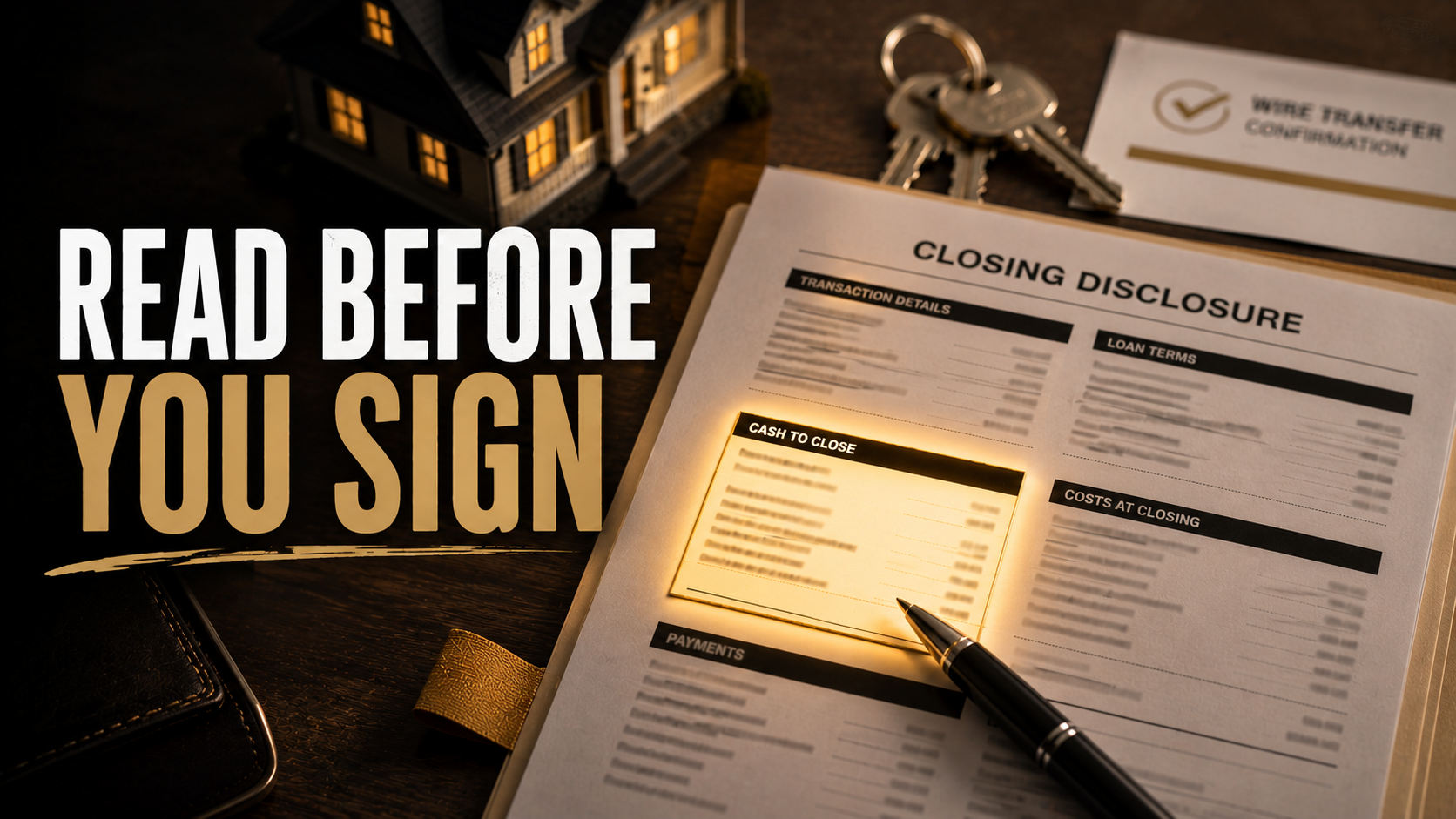
The Closing Disclosure is the final, binding summary of your loan terms and all closing costs. Federal law requires your lender to deliver it at least three business days before your closing date in Jonesboro.
Three days before closing, your lender emails you a five-page document called the Closing Disclosure. For most buyers, this is the moment the numbers finally stop feeling like estimates and start feeling very real.
Most people skim it, assume it looks fine, and move on. That's a mistake. This document controls how much you wire to the title company on closing day, and there are specific things you should verify before you show up to sign.
Here is how to read it, what to compare, and what to do if something looks off. At NEA Realtor Group, Trenton Hoggard and Tim Ray walk through this with every buyer client in Jonesboro because the three-day window is your last real opportunity to catch a problem before the keys change hands.
What Is the Closing Disclosure (and How Is It Different from the Loan Estimate)?
When you applied for your mortgage, your lender gave you a Loan Estimate (LE) within three business days of application. That document was a good-faith projection of your costs based on what the lender knew at the time.
The Closing Disclosure (CD) is the final version. It reflects the actual numbers that have been locked in: your loan amount, your interest rate, every closing cost line item, your prepaid expenses, and the exact amount you need to bring to the table on closing day.
Both documents are governed by the TRID rule (TILA-RESPA Integrated Disclosure), which came from the Consumer Financial Protection Bureau. The CFPB standardized these forms so that every lender uses the same layout, making it easier to compare and catch discrepancies.
The most important difference is this: the Loan Estimate was an estimate. The Closing Disclosure is a commitment. If your CD says you owe $6,842 at closing, that is the number your lender has locked in.
The Three-Business-Day Rule: What It Means for Your Jonesboro Closing
Your lender must send you the CD at least three business days before closing. For this rule, "business days" means every calendar day except Sundays and federal public holidays.
So if your closing is scheduled for Thursday, your lender needs to send the CD no later than Monday. If you close on a Tuesday, it must be sent by Saturday.
This window matters for buyers in Jonesboro and across Northeast Arkansas. Typical closings in this market run 30 to 45 days from accepted offer to close. When that final week arrives, the three days are your review period, not a formality. If you find an error, you need time to get it corrected before you sit down at the closing table.
Plan to read your CD the same day it arrives, not the morning of closing.
How to Read the Closing Disclosure Page by Page
The CD is five pages. Here is what each one covers and what to focus on.
Page 1: Loan Terms, Projected Payments, and Cash to Close
This is the most important page. Check three things immediately:
- Loan terms box (top right): Confirm your loan amount, interest rate, and monthly principal and interest match what you expected. If you locked your rate, the rate here should match your lock confirmation.
- Projected Payments table: This shows your estimated total monthly payment including principal, interest, mortgage insurance (if applicable), and estimated escrow for taxes and insurance. Compare this to the number your lender quoted you when you locked.
- Cash to Close box (bottom right): This is the number you need to wire. Compare it directly to your Loan Estimate. If it changed significantly, find out why before closing day.
Also scan the "Loan Terms" column on the left side of the table for "YES" indicators next to prepayment penalty and balloon payment. Most conventional and government loans in this market do not have these features, so if either box is marked "YES," ask your lender immediately.
Pages 2 and 3: Closing Costs Breakdown
Page 2 lists every closing cost organized into sections A through H. Page 3 shows the cash-to-close calculation in more detail and summarizes the transaction.
The sections you will see on Page 2:
- Section A: Origination charges. Your lender's fees (origination fee, underwriting fee, discount points if you bought down your rate). These are zero-tolerance items: they cannot increase from your Loan Estimate.
- Section B: Services you cannot shop for. Appraisal, credit report, flood determination, tax monitoring. Also zero-tolerance.
- Section C: Services you can shop for. Title insurance (lender's and owner's policies), settlement/closing fee, title search, survey. In Arkansas, it is standard for the seller to pay both the lender's and owner's title insurance policies. Verify that this shows on your CD as a seller-paid item, not a buyer charge, unless your contract says otherwise.
- Section E: Taxes and government fees. Recording fees. These carry a 10% tolerance, meaning they can increase slightly from the LE without triggering a lender violation.
- Section F: Prepaids. Homeowners insurance premium (your first year is typically collected at closing), prepaid interest for the days between closing and your first payment due date, and property tax escrow deposit.
- Section G: Initial escrow payment at closing. The up-front deposit into your escrow account for future property taxes and insurance payments.
- Section H: Other. Any additional items like a homeowner's association transfer fee or home warranty, if applicable.
Page 3 also shows the "Summaries of Transactions" section, which is where your earnest money deposit appears as a credit toward your cash to close. In Northeast Arkansas, the majority of transactions do not include earnest money at all. When earnest money is part of the deal, $1,000 is the most common amount in this market. If you paid earnest money, confirm it is listed here as a credit.
Pages 4 and 5: Loan Disclosures and Calculations
These pages are dense with required legal disclosures. Most buyers do not spend much time here, but there are a few things worth scanning.
Page 4 includes your escrow account disclosure (confirming you have one and what it covers), your assumption clause (whether your loan can be assumed by a future buyer), and your demand feature disclosure. Page 5 includes the loan calculations table (total of payments over the life of the loan, APR, finance charge) and the contact information for your lender, real estate broker, settlement agent, and title company.
Verify the contact information on Page 5 matches the parties you actually worked with. If the settlement agent's contact information is new to you, call your agent or lender to confirm this is the correct closing company before wiring any funds.
Comparing Your CD to Your Loan Estimate
Pull out your original Loan Estimate and put the two documents side by side. This is the most important review step.
Some costs are allowed to increase from the LE to the CD (within limits), and some are not allowed to increase at all. Here is a quick breakdown:
- Zero-tolerance items (cannot increase at all): Origination charges (Section A), required lender services (Section B), transfer taxes. If any of these are higher on your CD than on your LE, your lender must reimburse the difference. This is a federal requirement under TRID.
- 10% tolerance items (can increase up to 10% in aggregate): Recording fees, third-party settlement services you used from the lender's list. A small increase here is normal and legal.
- Unlimited tolerance items (can change freely): Prepaid interest (depends on your closing date), homeowners insurance premium (depends on the policy you chose), initial escrow payment (depends on current local tax and insurance rates).
If your cash-to-close figure is significantly higher on the CD than it was on the LE, look for where the increase occurred. Common reasons include a rate lock extension fee, a change in the closing date (which affects the prepaid interest calculation), a higher-than-estimated insurance premium, or a lender error.
The three-day window exists because Congress recognized that most buyers need time to process these numbers before signing. The NAR Profile of Home Buyers and Sellers consistently shows that the closing process is one of the most stressful parts of a real estate transaction. Knowing what you are looking at before you sit down to sign is the most effective way to reduce that stress.
What Can Restart the Three-Day Clock
Your lender is required to send you a new Closing Disclosure (and restart the three-business-day waiting period) if certain significant changes occur after the first CD is sent. This can delay your closing.
The three events that trigger a new waiting period are:
- The APR increases by more than 0.125% compared to the previously disclosed APR. This can happen if you make a change to your loan structure late in the process.
- The loan product changes (for example, switching from a fixed rate to an adjustable rate, or from conventional to FHA).
- A prepayment penalty is added to the loan after you received your original CD.
Other changes (like a small increase in closing costs) do not restart the clock, but they do require a revised CD to be sent. If you receive a revised CD close to your closing date, read it immediately and call your lender to understand what changed.
This is one reason why experienced agents in Jonesboro advise buyers not to make any large purchases or employment changes in the weeks before closing. A significant financial change can alter your loan terms and force a revised CD, delaying the closing.
What to Do If Something Looks Wrong
Call your lender the same day you receive the CD. Do not wait until the morning of closing to raise a concern.
If you find a charge that looks unfamiliar, an amount that is higher than your LE, or a name or address that does not match your transaction, here are your options:
- Contact your loan officer directly. Most discrepancies are administrative errors that can be corrected with a revised CD. Give your lender as much time as possible to fix and re-deliver the document.
- Loop in your real estate agent. Trenton and Tim work closely with buyers during this window and can help you identify whether a charge is standard practice in the Jonesboro market or a red flag worth escalating.
- Contact the settlement agent if the issue involves title charges, the closing fee, or the settlement agent's contact information. In Arkansas, closings are typically handled by an attorney or title company.
Do not let hesitation or a desire to avoid conflict keep you from asking questions. This is a large transaction and you are legally entitled to understand every line item on your CD before you sign.
It also helps to have reviewed your Jonesboro closing costs breakdown earlier in the process so the categories on the CD are familiar when you see them. If you know what to expect in Sections A through H before the CD arrives, the review is much faster.
Freddie Mac notes that one of the most common sources of closing-day confusion is buyers receiving final cost information for the first time when they sit down to sign. That is exactly the problem the three-day review window was designed to solve. Read your CD when it arrives, not on closing morning.
One More Thing: Verify the Wire Instructions
This deserves its own section because wire fraud is one of the most common scams targeting home buyers at closing.
Before you wire your cash-to-close funds, call the settlement agent or title company directly using a phone number you verified independently (not a number from a last-minute email).
Scammers intercept real estate transactions and send fraudulent wire instructions that look nearly identical to legitimate ones. If you receive an email with updated wire instructions at any point before closing, treat it as suspicious until you verify it by phone.
Your closing day cash-to-close number comes from the CD. The wiring mechanics are covered in more detail in our guide on what Jonesboro buyers actually wire at closing.
Frequently Asked Questions
Can I ask to see the Closing Disclosure before the three-day window?
Your lender is not required to send it early, but you can request it. Many lenders will send a preliminary CD a few days before the mandatory disclosure period begins. This gives you more time to review and reduces last-minute stress. Ask your loan officer when you can expect to receive it.
What if my cash-to-close is different from what I expected?
Start by comparing your CD to your Loan Estimate line by line. Look for changes in Section A (origination charges), your prepaid interest calculation (which changes based on your exact closing date), and your escrow deposit. If the increase is in a zero-tolerance category and exceeds the LE amount, your lender is required to cover the difference. Call your loan officer the same day you receive the CD to work through any discrepancies.
Does my closing date affect the numbers on the Closing Disclosure?
Yes. Your prepaid interest charge depends on how many days remain between your closing date and your first mortgage payment. Closing at the end of the month means fewer days of prepaid interest. Closing at the beginning of the month means more. This is one reason the cash-to-close on your CD may differ slightly from your Loan Estimate even if nothing else changed.
Questions About Your Closing Disclosure?
Trenton Hoggard and Tim Ray at NEA Realtor Group walk through the CD with every buyer client. If you are under contract and have questions about what you are seeing on your disclosure, call or text us. We work with buyers across Jonesboro and Northeast Arkansas every day and can help you understand what the numbers mean before you sign.
NEA Realtor Group holds 5-star reviews and is the number one real estate team in the Northeast Arkansas MLS by production. We are here to make sure you walk into closing informed and prepared.
You can also read what others have to say about working with our team on Google Reviews.
Connect with NEA Realtor Group
:format(webp):quality(80)/u.realgeeks.media/neahomesearch/team_sidebar.jpg)
:format(webp):quality(80)/u.realgeeks.media/contentcodes2/arrow.png)
:format(webp):quality(80)/u.realgeeks.media/neahomesearch/Market-Report-3.png)