What Jonesboro Buyers Do When the Appraisal Comes In Low
What should a Jonesboro buyer do if the appraisal comes in below the contract price?
You have four real options under an Arkansas contract with an appraisal contingency: renegotiate the price with the seller, bring extra cash to close the gap, request a Reconsideration of Value through your lender, or terminate the contract and recover your earnest money. Which one fits depends on how far the appraisal missed and how the local comps actually read.
You signed the contract. The inspection went fine. The lender ordered the appraisal. And then your loan officer calls with the sentence no buyer wants to hear: the appraisal came in low.
It is not the end of the deal. It is the start of a real decision. At NEA Realtor Group, Trenton Hoggard and Tim Ray walk Jonesboro and Northeast Arkansas buyers through this moment several times a year. The good news is that the path forward in Arkansas is structured, the math is knowable, and most low appraisals end with the deal closing, not falling apart.
Here is what "low" actually means, how often it happens in 2026, the four options you have under your contract, how the Arkansas appraisal contingency protects you, and a $250,000 Jonesboro example with the math written out.
What "Low Appraisal" Actually Means
When people say the appraisal came in low, they almost always mean one thing: the appraised value is lower than the price you agreed to pay in the contract. The appraised value is the licensed appraiser's professional estimate of what the home is worth based on recent comparable sales, the home's condition, and local market conditions on the day of the inspection.
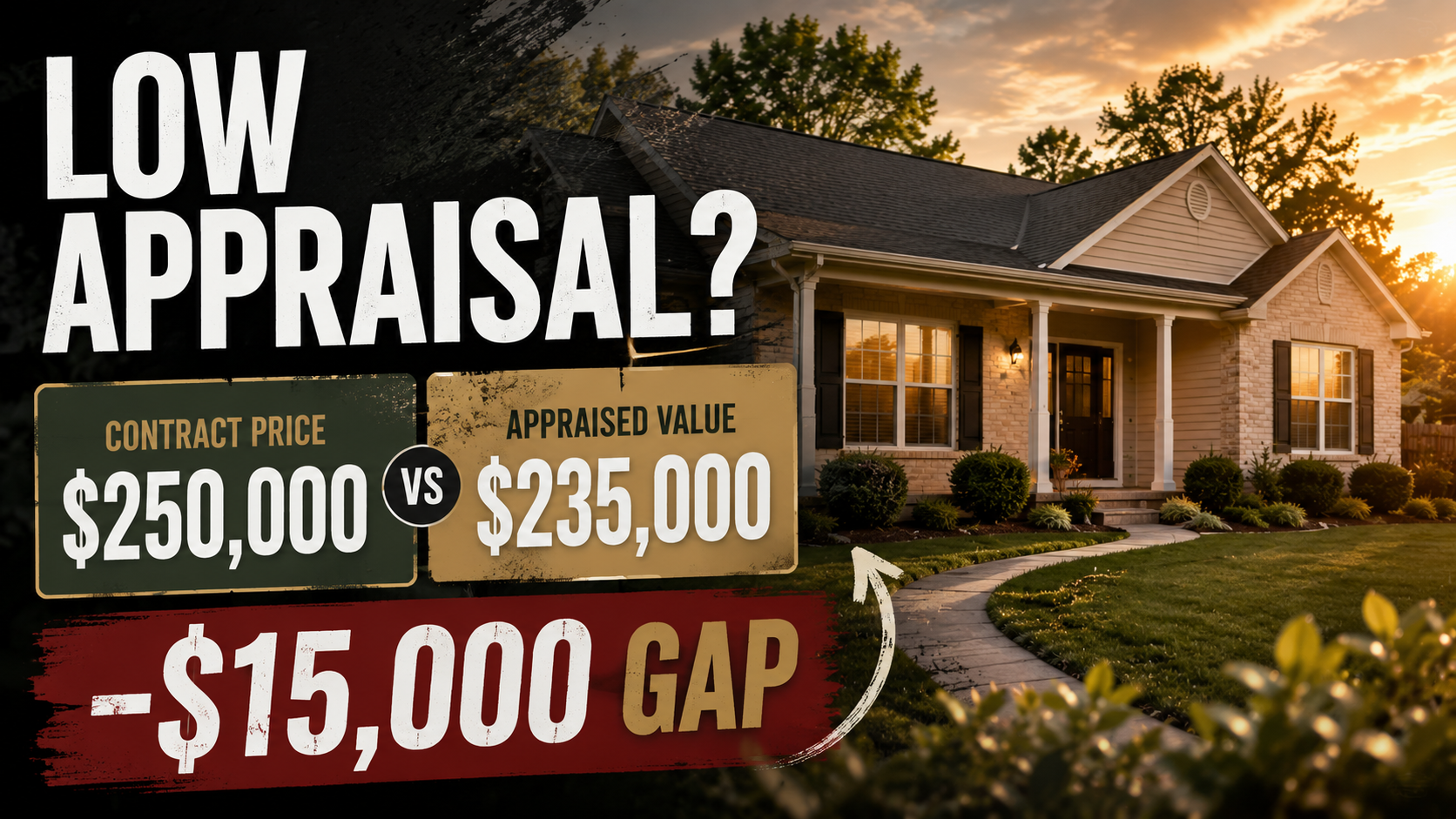
This matters because your lender does not lend on the contract price. The lender lends on the lower of the contract price or the appraised value. If the home appraises at $235,000 on a $250,000 contract, the lender's loan amount math runs against $235,000, not $250,000. The $15,000 gap has to be solved before the loan can close.
A low appraisal does not mean the home is "not worth" what you offered, and it does not mean you overpaid. It means the appraiser, working inside a regulated framework, did not find enough comparable Jonesboro sales to support the contract figure within the appraisal's tolerance. Comps, condition adjustments, and the timing of recent NEA sales all feed into that number.
How Often This Actually Happens in 2026
The honest answer for 2026 is: not as often as buyers fear, but more often than agents like to admit. Recent national 2026 reporting from HousingWire pegs the share of appraisals coming in below the contract price at around 10% of all transactions, and other lender data sets put the figure closer to 8.6%, down from 10.7% a year earlier. Most homes appraise at or above contract.
The other useful 2026 data point comes from the National Association of REALTORS® January 2026 Realtor Confidence Index: only about 15% of buyers nationally waived the appraisal contingency that month, a record low. Buyers in this market are protecting themselves more, not less, and the contingency is doing its job when the number comes in soft.
In smaller markets like Jonesboro, the appraisal-gap risk is shaped by something specific to Northeast Arkansas: lower transaction volume in some neighborhoods can mean the appraiser is working with comps that are several months old. That cuts both ways. A rising market can produce conservative appraisals because the most recent closed comps lag the current pace. A flat market usually produces accurate ones. Either way, the comp set is the story.
Your Four Real Options Under an Arkansas Contract
If you have an appraisal contingency in your contract (and almost every financed Arkansas purchase does), a low appraisal triggers a decision window. You have four real paths.
Option 1: Renegotiate the price with the seller
The most common outcome. Your agent goes back to the seller's agent with the appraisal report and asks the seller to reduce the contract price to the appraised value (or somewhere between the two). On a $15,000 gap, that often looks like a $7,500 to $15,000 reduction, depending on how strong the appraisal's comp set is and how badly the seller wants the deal to close.
Sellers in Jonesboro often accept a meaningful reduction because they know the next buyer's lender will hire a new appraiser who will likely use a similar comp set and arrive at a similar number. Re-listing does not reset the appraisal problem; it just resets the marketing.
Option 2: Bring extra cash to close the gap
If you love the home and the comps in the appraisal report look thin or stale, you can bring the difference to closing in cash. On a $250,000 contract that appraised at $235,000, the buyer brings an extra $15,000 to closing on top of the original down payment.
This is the right call when the home is rare, when you have the reserves to do it without thinning your cushion, and when you believe the long-term value supports the contract price. It is the wrong call when bringing the gap drains your emergency fund or strips down your move-in budget.
Option 3: Request a Reconsideration of Value (ROV)
A Reconsideration of Value is a formal request, submitted through your lender, that the appraiser take a second look using better or different comparable sales. Fannie Mae rolled out a more borrower-initiated ROV framework in late 2025 that gives buyers a clearer path to dispute the report when there is a clean case to make.
An ROV is not a request to "raise the value." It is a request to consider additional or more recent comps that the appraiser may not have used. Your agent puts together a short package of two or three stronger comps with notes on adjustments, the lender's appraisal desk routes it to the appraiser, and the appraiser either revises the value or explains why the original comps were the right ones. Roughly one in three well-built ROVs results in some change, but it is not a guaranteed fix.
Option 4: Walk away and recover your earnest money
If the gap is too large to renegotiate or fund, and the ROV does not change the number, your appraisal contingency lets you terminate the contract and recover your earnest money. This is the protection the contingency was written for. You lose what you paid for the appraisal itself (typically $500 to $700 in Jonesboro) and the inspection if you already ordered one, but the larger earnest deposit comes back to you per the terms of the Arkansas Real Estate Contract.
Walking is the right call when the home is replaceable in the current market, when the seller refuses to move on price, and when bringing the gap in cash would leave you financially stretched.
How the Appraisal Contingency Actually Works
The appraisal contingency is a clause inside the Arkansas Real Estate Contract that conditions your obligation to buy on the home appraising at or above the contract price. The standard window in Arkansas to receive the appraisal and respond is tied to the loan financing contingency timeline in the contract, typically a defined number of business days from the effective date.
Inside that window, if the appraisal comes in low, you and your agent submit a written response: a request to renegotiate, a request for time to pursue an ROV, an agreement to bring the cash, or a notice of termination. If you do nothing inside the window, the contingency can lapse, and you may lose the protection. The timing is the single most overlooked piece of this process by buyers who try to navigate it alone.
The full timeline from accepted offer through closing, including where the appraisal sits in that sequence, is laid out in what happens after your offer is accepted in Jonesboro. The appraisal usually lands two to three weeks after the contract is signed, depending on appraiser availability in Northeast Arkansas.
A $250,000 Jonesboro Example
Suppose you are buying a home at $250,000 with 5% down on a conventional loan. Your original loan amount was $237,500, your original down payment was $12,500, and you budgeted around $7,500 in closing costs. Now the appraisal comes back at $235,000, a $15,000 gap.
If you renegotiate to the appraised value:
New contract price: $235,000. Loan amount at 95% LTV: $223,250. Down payment at 5%: $11,750. Your cash to close drops by about $750 from the original plan because your down payment is smaller. The seller takes a $15,000 hit on net proceeds.
If you split the difference and renegotiate to $242,500:
New contract price: $242,500. Appraised value still $235,000, so the lender still uses $235,000 as the value cap. Loan amount: 95% of $235,000 = $223,250. Your down payment becomes $19,250 ($242,500 minus the $223,250 loan). You bring an extra $6,750 to closing on top of the original down payment. The seller takes a $7,500 hit instead of $15,000.
If you bring the entire gap in cash:
Contract price stays at $250,000. Lender's loan amount is capped at 95% of $235,000 = $223,250. Your down payment becomes $26,750. You bring an extra $14,250 to closing on top of the original plan. The seller's proceeds are unchanged.
These are simplified numbers (real-world cash to close also includes prepaids, escrow funding, and lender credits), but the structure is what matters. The smaller the gap and the stronger the home, the more often a split-the-difference renegotiation gets the deal closed without anyone walking away upset.
Why the Other Side Matters: The Seller's Math
Understanding how the seller is thinking about the same low appraisal helps you negotiate better. From the seller's perspective, a low appraisal is one of the harder moments in the transaction. Their take-home shrinks, the next buyer's appraiser will likely arrive at a similar number, and re-listing burns days on market.
Our companion post for the other side of the table is what Jonesboro sellers need to know about appraisals. Reading the seller's mindset makes the negotiation easier; most experienced Jonesboro listing agents already know the comp problem is real and will counsel a reduction rather than dare the buyer to walk.
What NEA Realtor Group Does for Buyers Here
When a low appraisal lands on one of our buyer deals, we do four specific things, in this order. First, we read the appraisal report carefully and identify which comps the appraiser used, which adjustments were made, and where the value-defending data lives. Second, we run our own current comp set from the NEA MLS, with attention to the last 90 to 180 days of sales (smaller markets need a wider window than the national 90-day standard) and pull anything stronger that the appraiser may have missed.
Third, we have a candid conversation with you about which of the four options actually fits your situation, your cash position, and your timeline. We do not push a renegotiation if the home is rare enough to justify the gap, and we do not push a cash bring-in if it would strip your reserves. Fourth, if we go to the seller, we bring the comp data with us. Sellers respond better to a request that shows the work.
For our own listings, we also use targeted direct mail campaigns to keep the buyer pool deep, so if a deal does fall through on a low appraisal, the home does not sit. That is part of how we keep the negotiation balanced for whichever side of the table you are on.
Frequently Asked Questions
Q: Does the appraiser know the contract price?
Yes. The contract price is provided to the appraiser by the lender as part of the appraisal order. Appraisers do not "target" the contract price, but they know what it is, which is one reason the share of appraisals that come in exactly at contract is so much higher than pure chance would suggest.
Q: Can the seller demand we move forward at the contract price?
Not if you have an appraisal contingency. The seller can refuse to renegotiate, but you can still terminate under the contingency and recover your earnest money. Sellers without an appraisal contingency in the contract have more leverage, which is one reason waiving that contingency in 2026 has fallen to record lows.
Q: How long does a Reconsideration of Value take?
Usually 5 to 10 business days from submission to a final answer, depending on the lender's appraisal desk and the appraiser's availability. Your closing date often has to be pushed by a week or so to allow the ROV to play out, which both sides have to agree to in writing.
Q: Does a low appraisal change my interest rate?
Sometimes, indirectly. If the gap is closed by a higher down payment (lower loan-to-value), some conventional pricing tiers improve and the rate can actually come down slightly. If you are bringing cash to keep the loan amount the same and the LTV unchanged, the rate generally does not change.
Q: Does this affect FHA, VA, or USDA loans differently?
Yes. Government-backed appraisals (FHA, VA, USDA) include condition standards and stay with the property for a defined window, which can affect a future buyer using the same loan program. The four options are the same, but the timing and the property condition flags can be more rigid.
If you are under contract on a Jonesboro home, the appraisal just came in low, and you want a second set of eyes on the report before you decide which option to take, NEA Realtor Group does this work every month. Trenton Hoggard and Tim Ray lead the team. We have the #1 real estate team in the Northeast Arkansas MLS by production and a long stretch of 5-star reviews from buyers and sellers across the area. There is no obligation, and we will be straight with you about whether the gap is worth fighting.
Low Appraisal on Your Jonesboro Home? Let's Read the Report Together.
Trenton Hoggard and Tim Ray with NEA Realtor Group walk Jonesboro and Northeast Arkansas buyers through the four-option decision every month, with a fresh comp set from the local MLS. Call or text us at 870-273-0633 and we will look at the appraisal with you before you decide.
Connect with NEA Realtor Group
:format(webp):quality(80)/u.realgeeks.media/neahomesearch/team_sidebar.jpg)
:format(webp):quality(80)/u.realgeeks.media/contentcodes2/arrow.png)
:format(webp):quality(80)/u.realgeeks.media/neahomesearch/Market-Report-3.png)