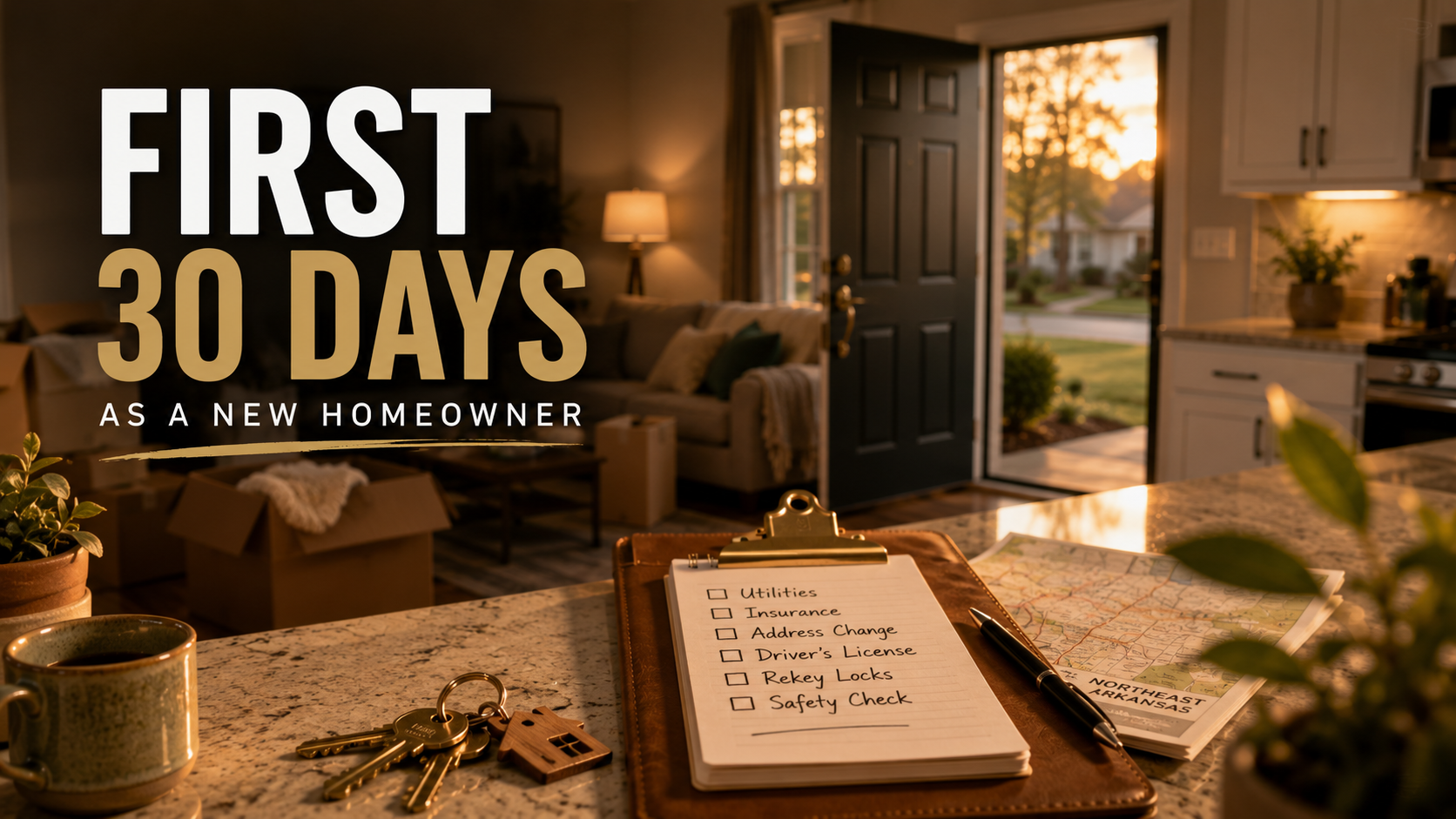
Moving to Jonesboro: Your First 30 Days as a New Homeowner
What should a new homeowner do in the first 30 days after closing in Jonesboro?
Set up City Water and Light, change your address with USPS, update your driver's license and vehicle registration within 30 days as Arkansas requires, confirm your homeowners insurance is active, rekey the locks, and walk the property for safety items. The first month is logistics, not renovation.
You have the keys. Closing is done, the wire has cleared, and the front door of your new Jonesboro home is yours to lock for the first time. Now what?
The first 30 days after closing are not glamorous. They are not the part of homeownership anyone takes pictures of. But they shape how the next two years feel, because they are the window where small decisions either get done or get pushed off so long that they quietly become problems.
At NEA Realtor Group, Trenton Hoggard and Tim Ray walk dozens of buyers across the closing table every year: first-time buyers, growing families, relocators moving in from out of state, and faculty and students coming in for NYITCOM and the new A-State College of Veterinary Medicine. The pattern is consistent. The buyers who handle the boring first-month logistics with intention settle in much faster and avoid the calls we get six months later about a forgotten address change, a missed insurance renewal, or a tax bill that landed at the previous owner's mailbox.
Here is what to handle in your first 30 days in your new Jonesboro home, in roughly the order it actually comes up.
Week 1: The Day-One Essentials
Rekey or replace the locks
The keys you received at closing have a history. Realtors, the previous owners, contractors, and possibly past tenants have held them at some point. A locksmith in Jonesboro will rekey a standard residential home for roughly $80 to $150 in materials and labor, depending on the number of doors and whether you also want to add a deadbolt or a smart lock. Do this on day one or two, before you start moving valuables in.
Test smoke and carbon monoxide detectors
Walk every floor of your new home. Press the test button on every smoke detector and CO alarm. Replace any batteries that fail. The U.S. Fire Administration recommends replacing the detector unit itself every 10 years, and you usually cannot tell the age from the front. Flip it off the bracket and check the manufacture date on the back. Cheap insurance.
Find your shutoffs
Locate three things and physically show every adult in the home where they are:
- Main water shutoff (usually near the front of the house, where the city line enters)
- Main electrical breaker panel (often in a garage, hallway, or utility room)
- Gas shutoff if your home has natural gas (Summit Utilities serves most of Jonesboro)
Five minutes today saves a flooded floor in a week.
Take a photo inventory
Walk through every room with your phone. Photograph every wall, every closet, every fixture. You will refer to these photos when you make insurance claims, dispute neighbor-fence boundaries, or try to remember the exact paint color of the trim in three years.
Week 1 and 2: Utilities, Mail, and Insurance
Confirm your utilities
In Jonesboro, City Water and Light (CWL) is the consolidated municipal utility for water, sewer, and electricity. Most buyers handle the CWL transfer at closing or in the day or two before, but verify the account is in your name. Set up an online account at jonesborocwl.org so you can monitor usage and pay your bill. Call CWL customer service at 870-930-3300 if anything is off.
Other utilities to confirm:
- Natural gas (Summit Utilities for most of Jonesboro)
- Sanitation (City of Jonesboro Sanitation, often billed through your CWL account)
- Internet and TV (Ritter Communications, Optimum, AT&T, or your preferred provider)
- Pest service if the previous owner had a recurring contract; confirm with the company whether it transfers or restarts in your name
Recent local utility-rate estimates put the average Jonesboro household combined water, sewer, electric, and trash bill at roughly $200 per month, with gas and internet billed separately. Your number will move with the season; summer cooling loads can shift it meaningfully.
Change your address
The U.S. Postal Service Mover's Guide is the cleanest one-stop change of address. Submit a forwarding request at the USPS site; it costs $1.10 for identity verification and forwards your mail for up to 12 months while you update individual senders.
Update your address directly with:
- Your bank, credit card companies, and lenders
- Your auto insurance and homeowners insurance
- Your employer (this is what gets you a correctly addressed W-2 next January)
- The Social Security Administration, if you receive any federal benefits
- Subscription services (streaming, magazines, prescription mail-order)
- Any retail loyalty cards you actually use
The IRS does not need a separate notification if you file your taxes electronically; your next return updates your address automatically.
Confirm your homeowners insurance is active and correct
Your lender required proof of insurance at closing. In your first week, confirm three things:
- The policy is in your name with the correct effective date
- The dwelling coverage amount matches your home's replacement cost, not its market value
- Personal property coverage is enough for what you actually own
Northeast Arkansas sees both severe spring storms and the occasional hard winter cold snap. The National Association of Insurance Commissioners publishes consumer guidance on homeowners insurance that is worth a 30-minute read in week one. If you have any concerns about your limits, talk to your agent before something breaks.
Week 2 and 3: Arkansas-Specific Items
Update your driver's license within 30 days
If you moved to Jonesboro from out of state, the Arkansas Department of Finance and Administration requires you to update your driver's license within 30 days of establishing residency. The Driver Services office for Craighead County is in Jonesboro. Bring your existing out-of-state license, proof of residency (your closing documents work, plus a current utility bill), and your Social Security card. Real ID compliance is worth the small extra effort if you have not already done it.
Update your vehicle registration within 30 days
The same 30-day window applies to registering your vehicle in Arkansas. You will need your title, proof of insurance (Arkansas minimum liability is 25/50/25), and proof that the vehicle has passed any required inspection. Plates are issued at the Craighead County Revenue Office. Personal property tax assessment is the other half of the Arkansas vehicle equation: you must assess your vehicles with the county assessor by May 31 each year, even if you arrived in the state earlier or later.
Register to vote
You can update your voter registration with the Craighead County Clerk's office or online through the Arkansas Secretary of State's portal. The deadline before any given election is 30 days prior to the election date.
Week 3 and 4: Setting the House Up for the Long Term
Schedule HVAC service if it has been more than a year
Northeast Arkansas summers will work your HVAC hard. If the previous owner did not service the system in the last 12 months, schedule a tune-up. A standard maintenance visit runs $90 to $160 and includes coil cleaning, a refrigerant level check, and a basic system inspection. Catching a failing capacitor or a worn contactor in May costs far less than an emergency service call in July at 95 degrees.
Find your tax documents
Your closing disclosure has a line item for prorated property tax. The seller paid their share for the part of the year they owned the home, and you will pay yours. Arkansas property tax is paid in arrears, billed in March of the year following assessment, and due October 15. Set a calendar reminder now. The Craighead County tax statement will arrive in March, and you do not want to miss it. If your loan includes an escrow account, your servicer handles this for you and you will see it as part of your monthly mortgage statement; this is also where your cash-to-close number lined up with your monthly payment (we walked through that in our recent post on what Jonesboro buyers actually wire at closing).
Walk the property line
If you bought a home with any kind of acreage or a defined lot, walk the property line. Your closing documents should include a survey or an improvement location report. Match what is in the documents to what is on the ground. If a fence is two feet inside your line, or your neighbor's storage shed is on your easement, the time to notice it is now, not three years from now when you decide to sell.
Meet your neighbors
This is not a sales item; it is a practical one. Knowing one or two neighbors by name gives you somewhere to turn when a package gets stolen, a dog gets out, or a tree comes down in a storm. Jonesboro neighborhoods (especially Valley View, Brookland, and the newer subdivisions off Highland and Stadium) tend to be friendly when you take the first step.
Week 4: Looking Ahead
Set up your home file
Buy a folder, a binder, or create a single digital folder, and put these documents in it:
- Closing disclosure (and HUD-1 if your transaction used one)
- Title insurance policy
- Survey or improvement location report
- Warranty deed
- Homeowners insurance policy
- HOA documents and covenants, if your home is in an HOA
- Manuals for major appliances and the HVAC system
- Receipts for any work you have already had done
A complete home file is one of the highest-leverage 30 minutes of your first month. We covered the document-handoff side of this from the buyer's seat in our first-time buyer checklist for Jonesboro if you want a refresher on what came home with you at closing.
Plan your first improvements with restraint
Most new homeowners want to start changing things immediately. Live in the home for 60 to 90 days before making any major decisions about layout, walls, or large renovations. You will discover where the afternoon light actually falls, which rooms get cold in the morning, and how you actually use the space. Decisions made after 90 days hold up much better than decisions made in the first 30.
Save for the unexpected
A reasonable rule of thumb from national consumer-finance sources: budget 1 to 2 percent of your home's value per year for maintenance and repairs. On a $250,000 Jonesboro home, that is roughly $2,500 to $5,000 per year. Start a separate sinking fund if you do not already have one. The hot-water heater that fails in year three is far less stressful when there is already a line item for it.
Frequently Asked Questions
Q: How quickly do I have to update my driver's license in Arkansas?
Within 30 days of establishing residency, per Arkansas DFA Driver Services. The same 30-day rule applies to vehicle registration.
Q: Do I have to assess my personal property in Arkansas?
Yes. Arkansas requires you to assess your vehicles and certain personal property with the county assessor by May 31 each year, even if you just moved in.
Q: Should I get a new homeowners insurance policy or transfer the previous owner's?
You need your own policy. Your lender required proof of your coverage at closing, and the previous owner's policy ended at closing.
Q: When is my first property tax bill due in Craighead County?
Arkansas property tax is paid in arrears, and the annual bill is due October 15 of the year after assessment. If your mortgage has an escrow account, your servicer handles the payment.
Q: Is rekeying really necessary?
It is the cheapest peace-of-mind item on the list. $80 to $150 covers full peace of mind that no one outside your household still has a key.
Q: What if I haven't closed yet?
Start the utility transfer the week before closing, request your CWL account in writing, and confirm with your closing agent which utilities are billed through the closing statement vs. set up directly in your name. The closer to keys you start, the smoother the actual move-in.
For perspective, NEA Realtor Group is the 5-star reviewed #1 real estate team in the Northeast Arkansas MLS by production, and a good chunk of those reviews come from buyers and relocators who hand us their keys-week questions and want straight answers, not sales pitches.
New to Jonesboro? We Can Help You Land Smoothly.
Whether you are closing this month or already settling in, NEA Realtor Group has helped buyers and relocators across Jonesboro, Brookland, Bono, Lake City, and Paragould for over a decade. We walk every buyer through a first-30-days checklist as part of how we close, not as an extra.
Connect with NEA Realtor Group