Price Cut vs Rate Buydown: A Jonesboro Seller's Guide
Should a Jonesboro seller cut the price or pay for a buyer's rate buydown?
Both cost you about the same. A price cut gives the buyer permanent savings; a buydown gives a lower payment. The deciding question is how long the buyer will keep the loan.
If you're selling a house in Jonesboro right now, there's a good chance a buyer will ask you for one of two things: take money off the price, or help buy their interest rate down.
Those two requests can cost you the exact same dollars and still do very different things for the buyer. I'm Trenton Hoggard, and between Tim Ray and me, NEA Realtor Group has sold over 600 homes. This question comes up in almost every negotiation we're in right now, so I made a video walking through it with real numbers.
You can watch it below, or keep reading for the full breakdown. If you're getting ready to list, our Home Selling Toolkit covers the rest of the process.
One thing up front: this isn't a post where one option wins. They both work, for different buyers. My job is to lay out the math and the trade-offs. Yours is to decide.
Why Buyers Are Asking for This Now
When I filmed this video in late October, Freddie Mac's weekly survey had the average 30-year fixed rate at 7.32%. That's high enough that buyers feel it every single month.
So buyers look for any lever that moves the payment. And as the seller, you usually have a fixed amount of room to give.
Here's the key point: a seller concession and a price cut cost you about the same dollars. What they do for the buyer is where they split.
The example we'll use the whole way through
- A $250,000 house, right around the middle of our market
- The buyer puts 5% down, so the loan is $237,500
- At 7.32%, principal and interest is about $1,631 a month (before taxes and insurance)
- The buyer asks you for $7,500, which is 3% of the price
That 3% matters. It's the most a conventional buyer with less than 10% down can get in seller help, under Fannie Mae's interested party contribution limits.
How this works in an Arkansas contract
- A price cut is just a different number on the contract.
- A concession is written in as seller-paid closing costs. It can only go toward the buyer's closing costs, which include discount points for a buydown. It can't go into the buyer's pocket.
- Both show up on the settlement statement at the title company, so nothing is hidden either way.
Option 1: Take $7,500 Off the Price
The house is now $242,500. With 5% down, the loan drops to about $230,375, and the payment drops to about $1,583.
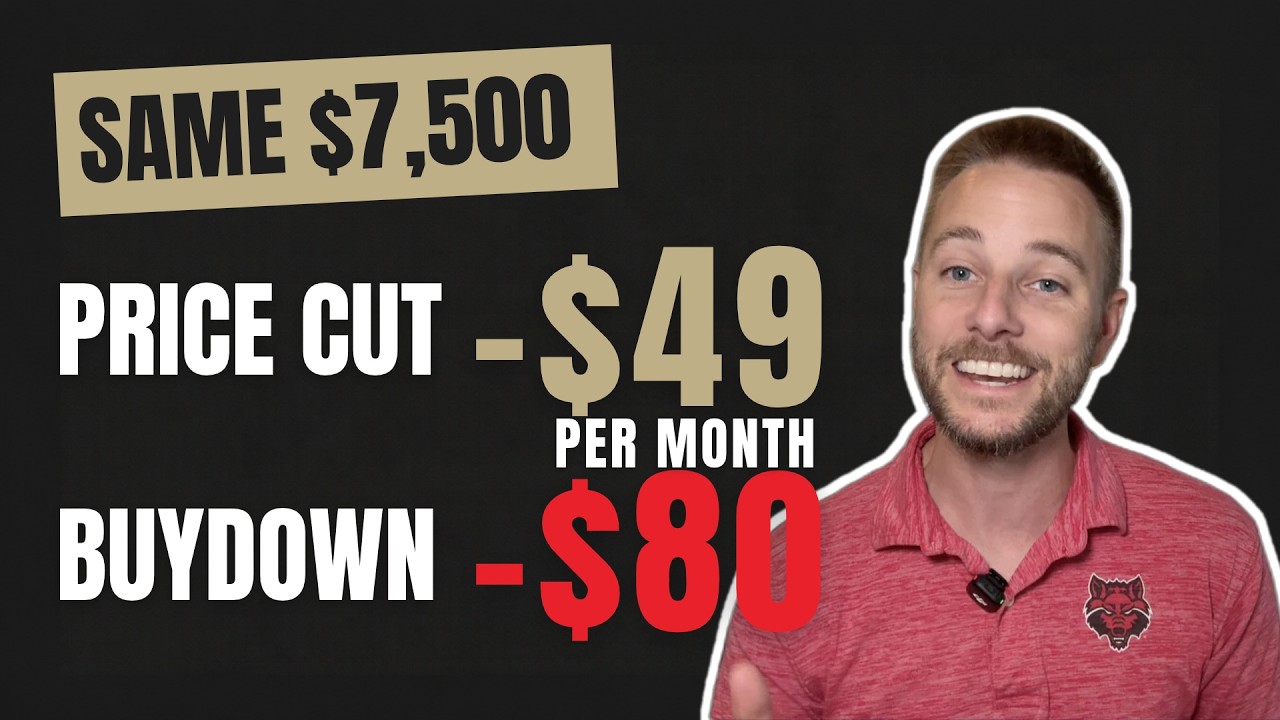
That saves the buyer roughly $49 a month. Not a big number, but it does something nothing else here does.
- It's permanent. It doesn't expire, and it doesn't depend on how long the buyer keeps the loan. If they sell in three years or refinance in two, the lower price already did its job.
- It helps with a short appraisal. A lower contract price closes that gap.
- You save a little on transfer tax. Arkansas charges about $3.30 per $1,000, so $7,500 less in price saves you about $24.75.
The trade-off: your recorded sale price is lower, and that sale becomes a comp for your neighbors and the next house on your street. And in a negotiation, $49 a month can be hard for a buyer to actually feel.
Option 2: A Permanent Rate Buydown
Here the $7,500 buys discount points, and the rate drops for the full 30 years. A point is 1% of the loan, and the usual rule of thumb is about a quarter point of rate for each point paid. The CFPB explains how points work if you want the background.
Pricing changes by lender and by day, so I'll stay conservative: $7,500 buys about half a point. That takes the rate from 7.32% to about 6.82%, and the payment from $1,631 to about $1,551.
That's roughly $80 a month, every month, for as long as the buyer keeps the loan. $80 beats $49, so the buydown wins, right?
Not so fast. This is where most people pick a winner too early.
- The points are paid once, at closing.
- If rates drop and the buyer refinances in two years, those points are gone.
- The price cut isn't.
So the comparison only holds if the buyer keeps the loan long enough to come out ahead. For more on when a buydown makes sense by itself, see should Jonesboro sellers offer a rate buydown.
Option 3: A Temporary Buydown (2-1 or 3-2-1)
The most common temporary buydown is a 2-1. The rate is two points lower in year one, one point lower in year two, and the full rate from year three on.
- Year 1: about $1,322 a month
- Year 2: about $1,473 a month
- Year 3 and after: about $1,631 a month
Funding it takes about $5,600, which goes into an escrow account at closing. That fits inside the $7,500.
A few things to know:
- The note rate never changes, so the buyer still qualifies at the full 7.32%. A buydown doesn't help them borrow more.
- If the buyer sells or refinances early, what's left in that escrow account generally goes to the lender. It doesn't come back to the buyer or to you.
A 3-2-1 stretches it another year: about $1,178, then $1,322, then $1,473, then the full $1,631 from year four. On our example it costs about $11,000, more than the $7,500 and more than a conventional buyer with 5% down can get in seller help. That's why you mostly see 3-2-1s in new construction, where builders have more room.
The honest case for and against
For: in a 2-1, the first-year payment is about $309 a month lower. That helps when the buyer has moving costs, furniture, and surprises. If their income is growing or they plan to refinance when rates come down, the step-up isn't a problem.
Against: the payment climbs by about $150 a month each year until it hits the full amount. If the buyer was stretching to qualify, year three can be tight.
I tell every buyer the same thing about any temporary buydown: write down the full payment, not the year-one payment. If you're comfortable with the full payment, the buydown is a gift. If you're not, it's a delay.
One practical tip: pricing on points and buydowns isn't the same at every lender. Before anyone signs, ask the buyer's lender for an actual quote on each option on the actual loan. My numbers use a rule of thumb, and real quotes can move the answer either way.
The 4 Questions That Decide It
1. How long will the buyer keep this loan?
If they plan to stay many years, the permanent buydown tends to win. If they might sell or refinance in a few years, which a lot of buyers might right now, the price cut tends to win because it can't be taken away.
2. What kind of loan is it?
The seller-help limit changes the menu:
- Conventional with under 10% down: 3%
- FHA: 6%
- VA: 4%
- USDA: 6%
USDA loans are available outside Jonesboro city limits, in places like Brookland, Bono, Lake City, and Valley View. Sellers out there may see more room to work with, and those buyers can get a zero-down option.
3. Is there any appraisal risk?
If the house might appraise short, a price cut changes the number the appraiser is looking at. A concession doesn't.
4. What does the buyer's cash flow need?
Some buyers need the lowest payment right now. Others need the lowest total cost over time. Those are different people with different answers.
- A buyer who just started a new job, expects a raise, and is tight on cash for the move: a 2-1 might fit perfectly.
- A buyer putting every dollar into the house, with no room for a payment increase and plans to stay 10 years: probably a permanent buydown.
- A buyer who might outgrow the house in four or five years: likely better off with the lower price and no points to lose.
What This Means for Your Net
Here's the part sellers often miss: your net is almost identical either way. The only differences are small ones, like transfer tax or anything in your listing agreement that's figured off the sale price.
So the real question for you isn't which one costs less. It's which one gets this buyer to the closing table.
- Price cut: lasting equity for the buyer, and it can't be undone.
- Permanent buydown: the lowest payment for as long as they keep the loan.
- Temporary buydown: early relief, then a payment that steps up.
Same dollars, three different jobs. Pick the one your buyer actually needs done. If you're still getting your house ready, our Jonesboro home selling checklist is a good place to start.
Frequently Asked Questions
Q: Does a seller concession cost me more than a price cut?
Usually not. Dollar for dollar, your net is almost the same. The small differences come from transfer tax and anything in your listing agreement based on the sale price.
Q: Can a buyer use a seller concession as cash?
No. A concession can only go toward the buyer's closing costs, including discount points or a buydown. It can't be paid out to the buyer.
Q: Does a 2-1 buydown help a buyer qualify for a bigger loan?
No. The buyer still qualifies at the full note rate. A temporary buydown lowers the first two years of payments, but it doesn't increase what they can borrow.
See Both Options on Your Own House
If you're selling in Jonesboro or anywhere in Northeast Arkansas and a buyer is asking for a price cut or a buydown, ask me for a net sheet. I'll run both side by side with your real numbers, so you're not doing the math on the fly with a buyer waiting. I'm Trenton Hoggard, Executive Broker with NEA Realtor Group, and our team has 5-star reviews and is the #1 real estate team in the Northeast Arkansas MLS by production.
Connect with NEA Realtor Group