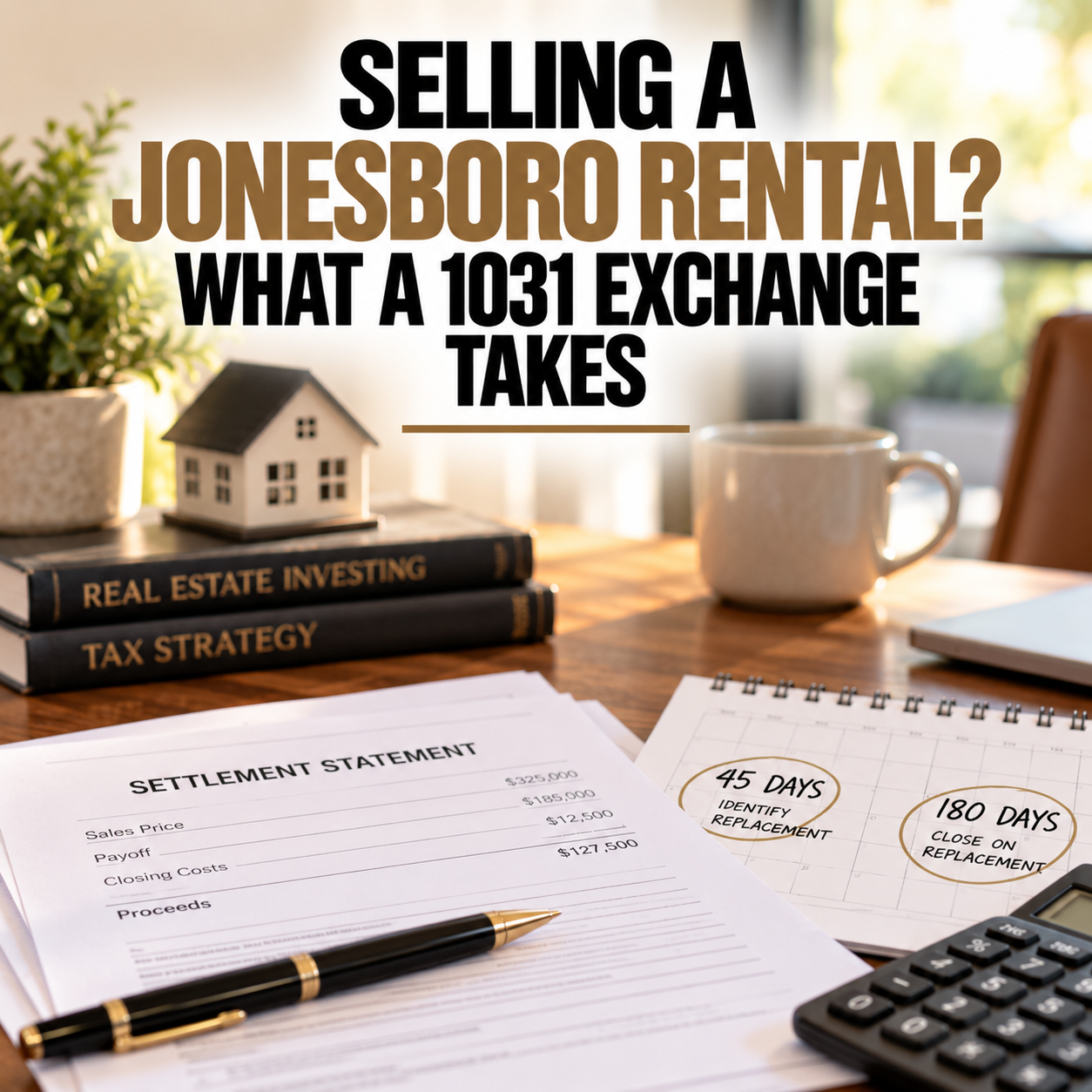
Selling a Jonesboro Rental? What a 1031 Exchange Takes
Can you defer capital gains tax when selling an investment property in Jonesboro?
Often, yes. A 1031 exchange lets you defer the tax by reinvesting the proceeds into another qualifying property, but the IRS gives you only 45 days to identify a replacement and 180 days to close.
A lot of Jonesboro landlords sell a rental, see the profit on paper, and only then start asking whether there's a way to avoid handing a big chunk of it straight to the IRS.
Trenton Hoggard and Tim Ray with NEA Realtor Group field this question from local investors on a regular basis, and the honest answer is that the tool exists, a 1031 exchange, but it only works if you plan for it before you list, not after you're already under contract.
Here's what a 1031 exchange actually requires, and what it doesn't do.
What a 1031 Exchange Actually Does
A Section 1031 exchange lets you sell real estate held for investment or business use and roll the proceeds into another qualifying property without paying capital gains tax on the sale right now. The tax isn't eliminated, it's deferred until you eventually sell without doing another exchange.
- It applies to investment and business-use real estate, not the house you live in. A primary residence sale falls under a separate home-sale profit exclusion instead.
- Since the 2017 Tax Cuts and Jobs Act, only real property qualifies. Equipment, vehicles, and other personal property used to be eligible for exchange treatment and no longer are.
- "Like-kind" is broad for real estate. A Jonesboro single-family rental can generally exchange into another rental house, a duplex, raw land, or commercial property, as long as both sides are real property held for investment or business use.
If you're weighing this against a straightforward sale, it's worth talking through your listing timeline and pricing strategy at the same time you're talking to a tax professional, since the two decisions affect each other.
The Clock Starts the Day You Close
This is where most exchanges actually fail, not on the tax rules, but on the calendar. Per the IRS, once you close on the property you're selling, you have exactly 45 days to identify potential replacement properties in writing, and the entire exchange has to be completed, meaning you close on the replacement, within 180 days of the original sale.
- The 45-day window and the 180-day window both start on the same date, the day your Jonesboro property sells. The 180 days isn't added on top of the 45.
- IRS rules generally let you identify up to three potential replacement properties regardless of their value (often called the three-property rule), or more than three if their combined value doesn't exceed twice what you sold your property for.
- These deadlines don't bend. Outside of a presidentially declared disaster, there's no extension for being busy, being out of town, or not finding the right property in time.
Given the NEA market's lower sales volume and a comp window that often runs 90 to 180 days rather than 30 to 60, the practical lesson is to start lining up replacement property candidates before your current property goes under contract, not after.
You Need a Qualified Intermediary, and It Can't Be Your Agent
A 1031 exchange has to be handled through a qualified intermediary, sometimes called a facilitator or accommodator, who holds your sale proceeds so you never actually touch the money between closings. If the cash lands in your hands, even briefly, the exchange is disqualified and the sale is taxed as a normal sale.
The IRS is specific about who can't serve in that role: you can't act as your own facilitator, and neither can your real estate agent, attorney, accountant, or anyone else who has worked for you in one of those capacities within the past two years.
That means Trenton and Tim can walk you through timing, pricing, and finding a replacement property, but we can't hold your exchange funds or serve as your intermediary ourselves. You'll want an independent qualified intermediary lined up before you close on the sale, not after.
Finding a Replacement Property in Northeast Arkansas
A 45-day identification window is tight anywhere. In a market like ours, where inventory moves slower and good rental-grade properties don't sit long once they're priced right, it's tighter still.
- Start looking at replacement candidates while your current property is still on the market, so you're not starting from zero once the clock begins.
- Decide up front whether you want to stay in investment property in Jonesboro specifically, or whether you're open to a different property type or location, since that changes how wide your search needs to be.
- A dedicated direct mail campaign on the property you're selling, which NEA Realtor Group runs on every listing, helps move your sale along faster and gives you more runway inside the 180-day window.
Working with an agent who already knows the Jonesboro rental market, not one meeting you for the first time after your 45 days start, is the difference between an exchange that closes on time and one that doesn't.
Common Mistakes Sellers Make With a 1031
Most failed exchanges we hear about didn't fall apart over a technicality. They fell apart because the seller treated the exchange as an afterthought instead of part of the sale plan from day one.
- Deciding to exchange after closing. The paperwork with your qualified intermediary has to be in place before your sale closes, not after you already have a check in hand.
- Assuming any real estate purchase counts as the replacement. A second home you plan to use yourself, or a lot you buy to eventually build a personal residence on, generally won't qualify.
- Buying a cheaper replacement property and pocketing the difference. To defer the full gain, you typically need to reinvest all of the net proceeds and replace at least as much debt as you paid off, or the leftover amount, the boot, becomes taxable.
- Waiting until closer to day 45 to start touring replacement properties, which leaves almost no room to negotiate or handle a deal that falls through.
Reporting the Exchange on Your Taxes
Even though no tax is due in the year of a successful exchange, the transaction still has to be reported. Your CPA will file Form 8824 with your federal return for the year the original property sold, laying out the relinquished property, the replacement property, and the numbers behind the deferral.
Keep every closing statement, identification letter, and piece of correspondence with your qualified intermediary. If the IRS ever asks questions about the exchange, that paper trail is what backs up the deferral.
Deciding If a 1031 Exchange Is Worth It
An exchange makes the most sense if you want to stay invested in real estate and are simply looking to move equity from one property to a better-fitting one. It makes less sense if you're ready to be done being a landlord and would rather pay the tax and walk away with cash in hand. The National Association of Realtors tracks how often exchanges like this get used by everyday investors, not just large commercial players, which is worth knowing if it feels like a tool meant for someone else's portfolio.
A few things worth knowing before you decide:
- Depreciation recapture is deferred along with the capital gain, not erased. It generally catches up eventually unless the property passes to heirs, who typically receive a stepped-up basis.
- Taking any cash out of the deal, known as boot, can trigger a partial taxable gain even inside an otherwise valid exchange.
- Arkansas generally follows the federal approach and doesn't add a separate state-level tax grab on a properly structured exchange, but a CPA can confirm how it applies to your specific numbers.
This is a decision to make with a CPA or tax attorney before you list, since the property you sell, the timeline you commit to, and the replacement property you eventually buy are all locked together once the clock starts.
Frequently Asked Questions
Q: Does a 1031 exchange work on my primary residence in Jonesboro?
No. A 1031 exchange only applies to property held for investment or business use. Selling the home you actually live in falls under a separate home-sale profit exclusion instead, with its own rules.
Q: What happens if I don't find a replacement property within 45 days?
If you miss the identification window or the 180-day closing deadline, the exchange fails. Your sale gets taxed like any other sale, and the deferred gain becomes due for that tax year.
Q: Do I have to buy my replacement property in Northeast Arkansas?
No. Replacement property can be anywhere in the United States. U.S. real property generally can't be exchanged for property outside the country, but there's no requirement to stay local.
For perspective, NEA Realtor Group carries 5-star reviews and stands as the number one real estate team in the Northeast Arkansas MLS by production, so we've helped plenty of investors work through this exact timeline.
Thinking About a 1031 Exchange on Your Jonesboro Property?
Trenton Hoggard and Tim Ray with NEA Realtor Group can help you plan the listing timeline and start lining up replacement properties before your clock starts running.
Connect with NEA Realtor Group