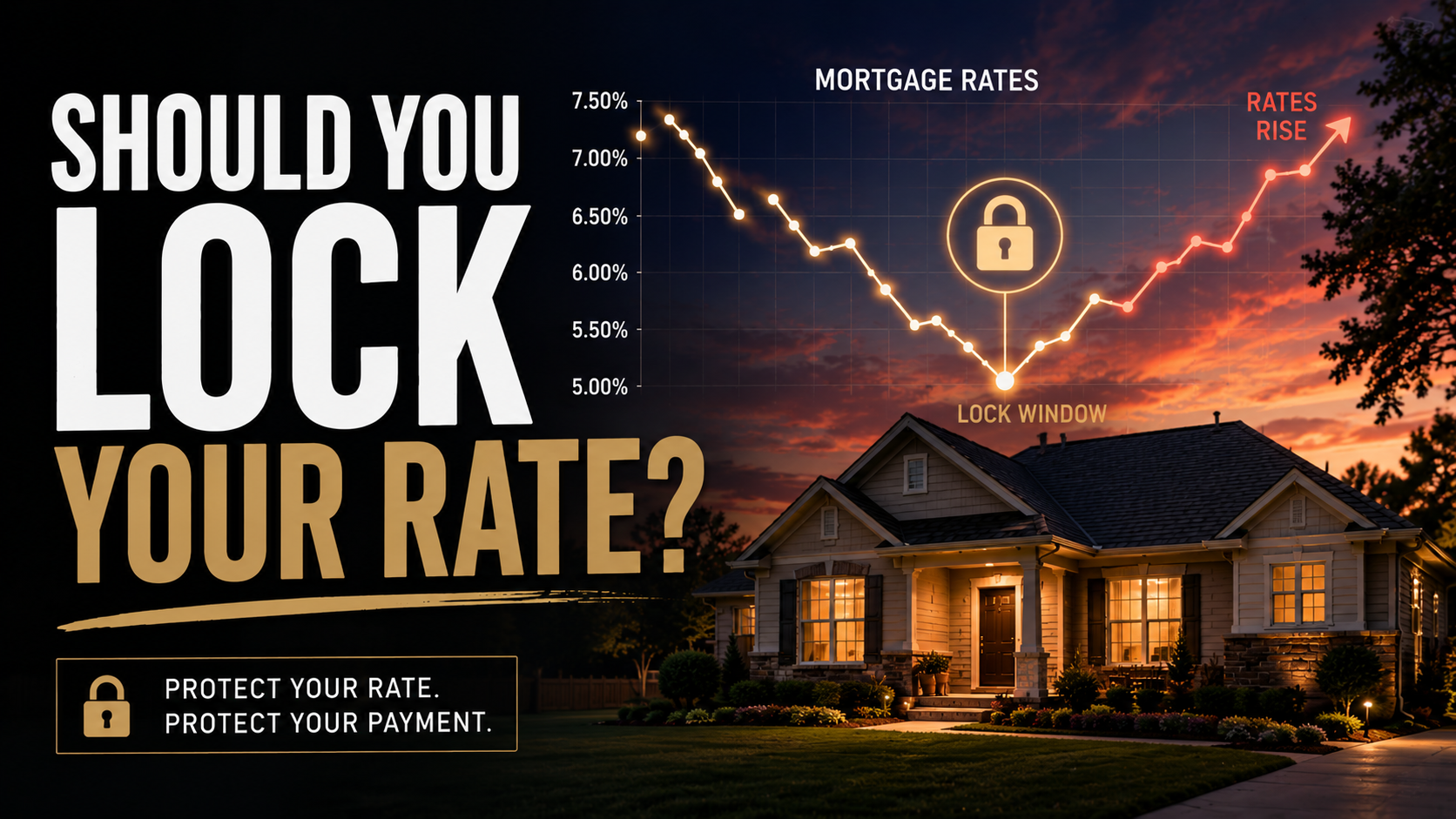
When to Lock Your Mortgage Rate as a Jonesboro Buyer
When should a Jonesboro buyer lock their mortgage rate?
Most buyers lock once their offer is accepted and the closing date is set 30 to 45 days out. Locking sooner makes sense when rates are climbing; floating makes sense when you do not yet have a contract or your closing date is more than 60 days away.
Mortgage rates have been a moving target through spring 2026. The Freddie Mac Primary Mortgage Market Survey put the 30-year fixed at 6.36% on May 14, 2026, and that number has bounced inside a tight band every few weeks as inflation reports and Fed minutes cross the wire.
If you are buying a home in Jonesboro right now, your lender is going to ask you a simple question at some point: do you want to lock your rate, or float it? It is one of the most important decisions you make as a buyer, and most people are not sure how to answer it.
We are Trenton Hoggard and Tim Ray with NEA Realtor Group, and we walk Jonesboro buyers through the rate lock conversation every week. Here is how to think about it, what your options actually are, and the questions to ask your lender before you say yes.
What a Mortgage Rate Lock Actually Does
A rate lock is a written agreement between you and your lender that holds your interest rate steady for a defined number of days. If rates go up during the lock period, you keep the lower locked rate. If rates fall, you generally do not benefit, unless you paid for a float-down option (more on that below).
The lock protects against rate movement during the part of the transaction you can least afford a surprise: the stretch between your accepted offer and your closing day. In Northeast Arkansas, that window is usually 30 to 45 days from the day your offer is accepted, depending on your loan program and the lender's pipeline.
A few things a rate lock is NOT:
- It is not a guarantee that you get a loan. Underwriting still has to approve you, the property has to appraise, and your file has to clear conditions.
- It is not free if you need to extend it.
- It does not protect you from rate movement before you actually lock.
For the official, plain-English version of how rate locks work from a federal regulator, the CFPB's overview is a good companion to read alongside whatever your lender hands you.
Lock Period Lengths and What Each One Costs
Lenders typically offer locks in 30, 45, 60, 75, and 90-day increments. The longer you lock, the more you usually pay.
- 30-day lock: Usually free. Works for buyers who already have a clean file and are using a fast loan program with a short closing timeline.
- 45-day lock: Usually free, and the most common length for Jonesboro buyers. This matches the typical NEA closing timeline of about 30 to 45 days.
- 60-day lock: Often free or a small cost. Useful if you are early in the process or your loan program is slower (USDA Rural Development, for example, can run longer in busy seasons).
- 75 to 90-day lock: Almost always carries a fee. Industry guidance puts the cost of extended locks at roughly 0.125 to 0.375 of a discount point on the loan amount, though the exact number depends on the lender and the current rate environment.
If you are buying with a conventional or FHA loan in Jonesboro and you have an accepted offer with a 30 to 45-day close, a standard lock at no cost is usually the right starting point.
When to Lock and When to Float
There is no universal right answer. It depends on three things: how far you are from closing, where rates are heading, and how much risk you can stomach.
Lock now if:
- Your offer is accepted and your closing date is firm and inside your lock window (30 to 45 days).
- Rates have been climbing and your monthly payment is already close to the top of what you can afford.
- A key economic report is about to drop that could push rates up. Major lenders and the CFPB consistently note that rates can move sharply the morning after Consumer Price Index releases and Federal Reserve meetings.
- You want certainty more than you want a possible discount.
Consider floating if:
- You do not yet have an accepted offer, or you are still house-hunting. Locking before you have a contract is risky because you can lose the lock if you do not close in time.
- Your closing date is more than 60 days away, and you do not want to pay for an extended lock.
- Rates have been trending down and you have room in your budget if they happen to bounce.
- Your loan program (USDA in particular) sometimes runs long, and a short lock could expire before underwriting clears.
The honest answer for most Jonesboro buyers is this: once you are under contract with a defined closing date, lock. Trying to time the market with a six-figure decision is a stressful way to save what might end up being nothing.
What a Float-Down Option Buys You
Some lenders sell a feature called a float-down. If you lock and rates then fall by a defined threshold (usually 0.25% to 0.5%) before you close, you get the lower rate. If rates rise, your original lock holds.
It sounds like a free upgrade. It is not. Float-downs are typically priced into your rate or charged as a separate fee, often somewhere between 0.50% and 1% of the loan amount. On a $250,000 loan that is $1,250 to $2,500.
A float-down can make sense if:
- Rates are in a clearly elevated band and there is a credible reason to think they will fall before your closing date.
- You are doing a longer lock (60 to 90 days) where more can happen.
- The cost is small relative to the potential savings on your monthly payment over the life of the loan.
If rates are flat or already low, paying for a float-down can be money out the door for nothing.
What Happens If Your Lock Expires Before You Close
This is the part that catches buyers off guard. If the appraisal comes back late, the title work runs long, or underwriting kicks back a conditional approval that needs more documentation, your closing date can slip. If your lock expires before you close, you generally have three choices:
- Extend the lock. Most lenders allow a 7, 15, or 30-day extension. Extensions usually cost a fee, often 0.125 to 0.25 of a point per week of extension. The exact cost depends on your lender and the current market.
- Re-lock at current market. If rates have fallen since your original lock, this can work in your favor. If rates have risen, you eat the higher rate.
- Worst-case mix. Some lenders re-lock at the worse of the original locked rate or the current market rate. Read your lock agreement carefully.
The cleanest way to avoid this is to lock a window that fits your real timeline, not the optimistic one. If your contract says 30 days but your loan program typically runs 35 to 40 days, a 45-day lock is the safer move.
How the Lock Decision Fits Into Your Buying Timeline
For a typical Jonesboro buyer with an accepted offer, the rate conversation usually goes something like this:
- Day 1: Offer accepted. Earnest money delivered if the contract calls for it (in NEA, the majority of deals do not include earnest money; when buyers do put money down, $1,000 is the most common figure, with higher amounts up to roughly $5,000 typically reserved for luxury transactions).
- Day 1 to 3: Your lender pulls your file, reviews your income and assets, and issues the Loan Estimate. This is when the rate-lock conversation usually starts.
- Day 2 to 10: Inspection period under the Arkansas Real Estate Contract. The standard window is 10 business days, though it is negotiated on every deal.
- Day 10 to 25: Appraisal ordered and completed. Title work runs in parallel.
- Day 25 to 35: Underwriting clears conditions. You receive the Closing Disclosure at least three business days before closing.
- Closing day: You wire your cash to close and sign.
Most buyers in Jonesboro lock somewhere between day 1 and day 7. That gives the lock window enough cushion to absorb a few days of slippage without expiring.
If you are still figuring out what your total cash needs look like, our guide on what Jonesboro buyers actually wire at closing walks through the difference between down payment, cash to close, and reserves.
Questions to Ask Your Lender Before You Lock
Bring this list to your lock conversation. We have heard every version of these from buyers in Brookland, Paragould, Bono, and across Northeast Arkansas over the last decade.
- What is the rate and the annual percentage rate (APR) being quoted right now?
- How long does the lock last, and what date does it expire?
- Is there a fee for the lock, and is it refundable if I do not close?
- Do you offer a float-down option, and what does it cost?
- What happens if I need to extend the lock?
- What happens if rates drop significantly before closing?
- If my closing date moves, how much notice do you need to extend?
- Will any of this be in writing before I commit?
If any answer is vague or rushed, slow the conversation down. The lock terms get written into your Loan Estimate and (eventually) your Closing Disclosure, so it pays to understand them before you sign anything. For broader context on how lock decisions interact with current rate movement, the Realtor.com rate trend tracker is a useful reference outside your lender's own pitch.
Frequently Asked Questions
Q: Can I switch lenders after I lock my rate?
Yes, but it can cost you. If you lock with Lender A and then switch to Lender B with a better rate, you typically forfeit any non-refundable lock fees you paid, and you have to start the loan process over (new application, new disclosures, sometimes a new appraisal). For most Jonesboro buyers, the cleanest move is to comparison-shop on the Loan Estimate before you lock, not after.
Q: Will my rate lock change if my credit score changes during the loan process?
It can. Your locked rate is based on the credit profile your lender used at the time of the lock. If you take on new debt, miss a payment, or open new credit lines between the lock and closing, your lender can re-price the loan or even pull the lock. Keep your credit profile static from application through closing.
Q: What if rates fall significantly after I lock and I do not have a float-down?
You have a few options. You can ask your lender if they will renegotiate (some will, some will not, and most will only do so if rates have fallen by a meaningful threshold). You can talk to your loan officer about whether a switch to a different program might make sense. Or you can refinance later, once your loan has had time to season and the rate environment has stabilized. None of these are guaranteed wins, which is why the lock decision is real and not theoretical.
Ready to Talk Through Your Lock Decision?
A rate lock is one of the few moments in a home purchase where five minutes of clarity can save you thousands of dollars over the life of the loan. The right answer is almost always specific to your contract, your timeline, and your loan program. If you are buying in Jonesboro or anywhere in Northeast Arkansas and you want a second set of eyes on your lock decision, we are happy to walk through it with you. For perspective, NEA Realtor Group has 5-star reviews from buyers and sellers across the region and is the #1 real estate team in the Northeast Arkansas MLS by production. We see this conversation every week, and we will give you a straight answer.
Connect with NEA Realtor Group
:format(webp):quality(80)/u.realgeeks.media/neahomesearch/team_sidebar.jpg)
:format(webp):quality(80)/u.realgeeks.media/contentcodes2/arrow.png)
:format(webp):quality(80)/u.realgeeks.media/neahomesearch/Market-Report-3.png)