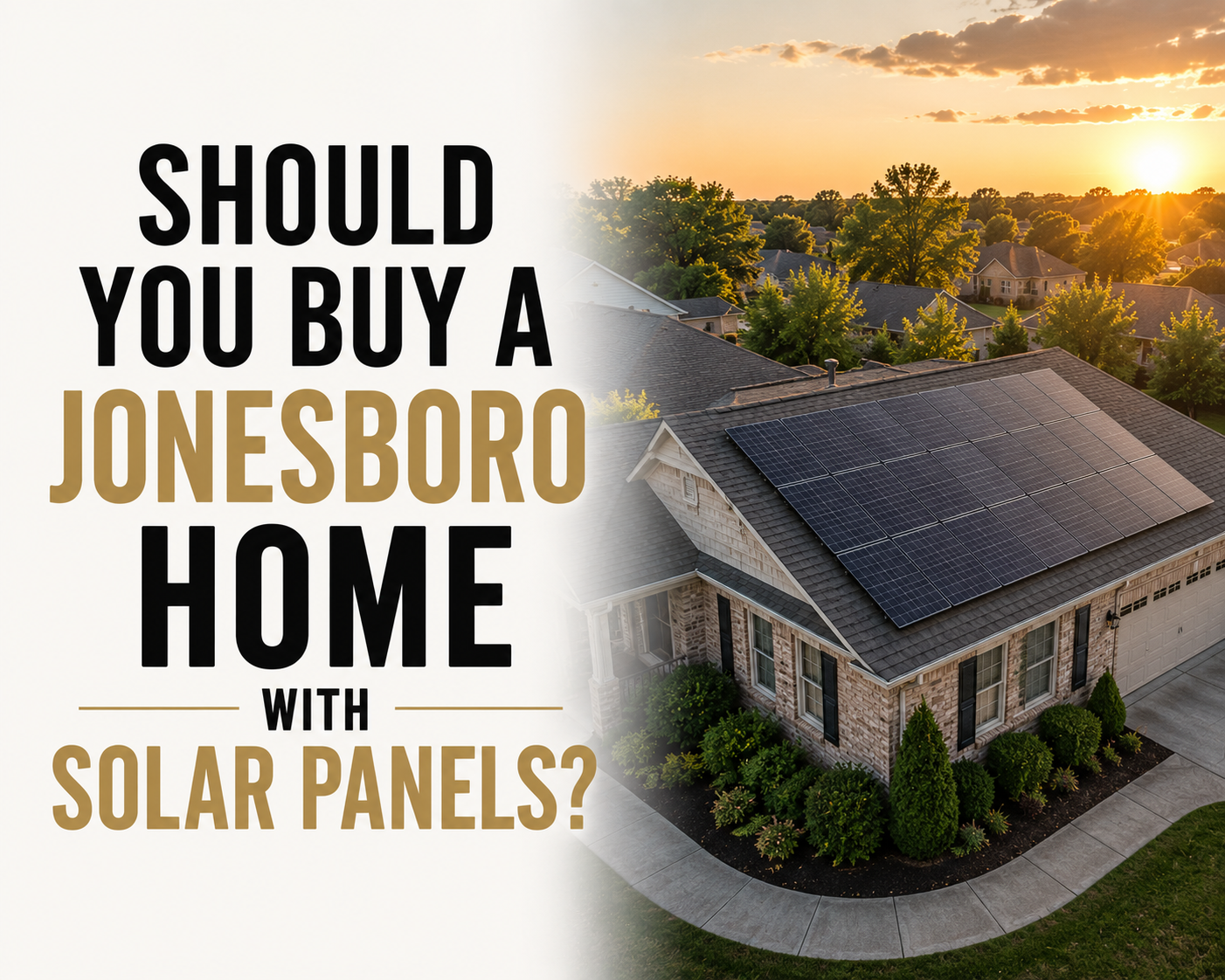
Should You Buy a Jonesboro Home With Solar Panels?
Can you buy a Jonesboro home that has solar panels on the roof?
Yes, and thousands of buyers do every year. The deciding factor is not the panels. It is whether they are owned, leased, or on a power purchase agreement, because that single answer changes your loan approval, your title work, and your closing date.
You walk a house in Jonesboro, you like it, and then you notice the roof. Solar panels. Maybe the listing mentioned it, maybe it did not. Either way, the question hits immediately: is this a bonus or a problem?
The honest answer is that it depends entirely on paperwork you have not seen yet. Rooftop solar is not rare in Northeast Arkansas anymore, and we see it on listings from Brookland to Bono to the older neighborhoods inside Jonesboro. Most of these deals close without drama. The ones that fall apart almost always fall apart for the same reason: nobody asked about the solar agreement until two weeks before closing.
If you are buying a home in Northeast Arkansas and solar is on the table, here is what we ask for, in what order, and why it matters. This is the same conversation Trenton Hoggard and Tim Ray have with buyers before they write the offer, not after.
The First Question: Owned, Leased, or PPA?
There are three ways a homeowner ends up with panels on the roof, and they behave completely differently in a transaction.
Owned outright
The seller paid cash, or paid off the loan that bought the system. The panels are part of the real property and they transfer with the house like a water heater or a roof. This is the cleanest version. No lease to assume, no third-party company involved, no extra title work. You inherit the equipment, the warranty (if it is transferable), and whatever the system produces.
Ask for the original invoice, the installation date, the manufacturer and inverter warranties, and any monitoring login. Ask whether the roof was replaced before the panels went on. A twelve-year-old roof under a two-year-old solar array is a real cost you should know about before you write your number.
Leased or on a power purchase agreement
A solar company owns the panels. The homeowner either pays a fixed monthly lease payment, or pays per kilowatt-hour for the power the system produces (that is the power purchase agreement, usually shortened to PPA). Terms commonly run twenty to twenty-five years, and many contracts include an annual escalator that raises the payment a set percentage every year.
This is where deals get complicated. You are not just buying a house. You are being asked to take over somebody else's long-term contract with a company you have never dealt with. That requires the solar company's approval, a credit check on you, and a signed assignment or transfer agreement. It is not automatic and it is not instant.
Financed with a solar loan
The seller borrowed money to buy the system and still owes a balance. In most cases that loan has to be paid off at closing out of the seller's proceeds, the same way their mortgage is. The complication is that some solar loans are secured by a filing against the property, which means the title work has to clear it before your lender will fund. If the seller is thin on equity, that payoff can eat the deal.
Why the Title Search Matters More Than the Panels
Here is the piece most buyers never hear about until it stalls their closing. Leased and financed solar systems usually come with a UCC-1 fixture filing recorded in the county land records. It is a notice that a third party claims an interest in equipment attached to the property.
When the title company runs the search, that filing shows up as an exception. Your lender needs its mortgage in first lien position, so the filing has to be handled: subordinated, released, or documented as an equipment lease rather than a lien against the real estate. That means somebody has to contact the solar company and get paperwork back.
Solar companies are not known for fast turnaround on transfer requests. We have seen these take a week and we have seen them take a month. If you are on a thirty-day contract, that is the difference between closing on time and asking for an extension. This is exactly the kind of item that belongs in your title work conversation on day one, not week three.
Our rule: if the panels are not owned free and clear, we start the transfer request the same week the contract is signed. Not after inspections. Not after the appraisal. Immediately.
What Solar Does to Your Loan Approval
This is the part that surprises people. A leased system can shrink how much house you qualify for.
Fannie Mae's rules on this are published in its Selling Guide section on special property eligibility, and the other agencies take a similar posture. Two points matter most:
- The monthly lease or PPA payment generally counts as a monthly obligation in your debt-to-income ratio, unless specific lease provisions allow it to be excluded. Every dollar of that payment is a dollar that is no longer available for your mortgage payment.
- Panels leased from or owned by a third party are treated as personal property. They cannot be included in the appraised value of the home.
Read those two together and the picture gets sharp. With a leased system, you carry the payment but the appraisal gives you nothing for the equipment. If the seller has priced the home as though the solar adds value, you have a pricing conversation on your hands, and the appraisal is going to back you up.
Owned systems are different. An appraiser can consider an owned, permanently affixed solar system as part of the improvements, though the value assigned depends on local market evidence, and in a market our size there may not be many comparable sales with solar to draw from. Do not assume dollar-for-dollar credit for what the seller spent.
One more requirement worth knowing: the major loan programs expect the home to remain connected to the utility grid. A house running entirely off a standalone system is a financing problem.
The Jonesboro Utility Question Nobody Asks Early Enough
Sellers love to hand buyers a stack of low electric bills. Those bills are evidence of what the system did for that household, under that utility arrangement, in those specific years. They are not a promise of what it will do for you.
Net metering in Arkansas has moved around. The Solar Access Act of 2019 (Act 464) expanded rooftop solar, and a later Arkansas Public Service Commission order set out grandfathering protections for systems that came online within certain windows. The University of Arkansas Cooperative Extension maintains a plain-language overview of Arkansas net metering policy if you want the background.
The local wrinkle: much of Jonesboro is served by City Water and Light, a municipally owned utility, and the surrounding communities in our region are served by a mix of investor-owned utilities and rural electric cooperatives. Those providers do not all operate under identical net metering terms, and whether a grandfathered arrangement survives a change of ownership is a question for the specific utility, not for a general article.
So the action item is simple and it is on you: before you remove contingencies, call the utility that serves the address, give them the service address and the system details, and ask in writing what the interconnection and buyback terms will be for a new account holder. Get the answer in an email you can save. That one phone call prevents the most common solar disappointment we see, which is a buyer who budgeted for the seller's electric bill and got a very different one.
The Federal Tax Credit Changed in 2026
For years, the standard advice on solar included the 30 percent federal residential clean energy credit under Section 25D. That credit ended for expenditures made after December 31, 2025 under the law enacted in July 2025, and the Congressional Research Service has published a short explainer on the expiration and carryforward rules.
Two things follow from that for a buyer in our market. First, if you were counting on a tax credit to help justify adding solar to a home yourself, that math has changed and you should re-run it. Second, a home that already has an owned, paid-off system has a slightly different value story than it did two years ago, because the cost of replicating it new is no longer offset by a federal credit. Whether the local market actually pays for that is a separate question, and one we look at case by case.
Tax treatment is a conversation for your CPA, not your Realtor. We are flagging the change so it is on your radar, not advising you on your return.
What We Ask the Listing Side For, Before You Write
When a Jonesboro listing has panels, we request this list up front. If the seller cannot produce it, that itself is information.
- The full solar agreement, all pages, including exhibits and any amendments
- Whether the system is owned, leased, on a PPA, or financed, and the current payoff balance if any
- The monthly payment, the remaining term, and whether there is an annual escalator
- The transfer or assignment process, the solar company's contact for it, and their typical processing time
- Whether a UCC-1 fixture filing has been recorded against the property
- Twelve months of electric bills, plus the system's production data from the monitoring portal
- The install date, the installer, and whether that company is still in business
- The roof's age and condition under and around the array, plus who pays to remove and reset the panels if the roof needs replacement
- Confirmation the seller disclosed the system to their homeowners insurance carrier
That last item on the roof deserves emphasis. Removing and resetting an array so a roofer can work underneath is a real expense, and the responsibility for it is often buried in the lease. Find out before closing, not when a spring storm takes your shingles.
Three Ways These Deals Usually Get Resolved
When the panels are not owned free and clear, there are basically three landing spots, and you should decide which one you want before you negotiate.
You assume the agreement. The solar company approves you, you sign the assignment, and you take over the payment. Straightforward when your debt-to-income ratio has room. Not workable if that payment pushes your ratio past what your loan program allows.
The seller buys out the contract before closing. The remaining balance is paid off, the filing is released, and the panels convey to you free and clear. This is the outcome buyers want and lenders prefer. It costs the seller real money, so it is a negotiation, and it works best when it is part of your original offer rather than a demand made after inspections.
The system is removed. The solar company takes the panels back. Rare, slow, and it leaves you with roof penetrations that need to be properly repaired. Confirm in writing who is responsible for that repair and get the roof re-inspected afterward.
Whichever path you pick, price it. A twenty-year escalating obligation is not a rounding error, and it belongs in your offer math alongside your cash to close and your monthly payment.
Timing Reality in Northeast Arkansas
Our market moves at a moderate pace, which is usually an advantage here. Buyers generally have room to do this homework without losing the house to three competing offers in a weekend. Rates have also given buyers a little breathing room lately: Freddie Mac's weekly mortgage market survey put the 30-year fixed average at 6.65 percent for the week of August 20, 2026, down for a second straight week.
Use that room. Build the solar review into your inspection period the same way you would a septic or well test. Ask for a contract timeline that accounts for the solar company's response time, because that clock is not under your agent's control or your lender's.
If a listing agent tells you the transfer is "just a form," ask them how long the last one took. A good answer sounds like a specific number of business days. A vague answer means nobody has started.
So, Should You Buy It?
If the panels are owned outright, the roof is sound, and the system is producing, solar is a fine reason to like a house and a poor reason to overpay for one. Verify, then value it based on what the local market actually supports.
If the panels are leased or on a PPA, the house has to be worth it to you with that obligation attached and with the appraisal giving you nothing for the equipment. Plenty of buyers say yes to that. The ones who regret it are the ones who never read the contract.
Either way, do not let solar be the thing you sort out in the last two weeks. It is a first-week item.
Frequently Asked Questions
Q: Will leased solar panels stop me from getting a mortgage in Jonesboro?
Not by themselves. Lenders finance homes with leased panels regularly. What can stop a loan is an unresolved fixture filing sitting on the title, a lease that will not transfer, or a lease payment that pushes your debt-to-income ratio past program limits. All three are knowable in the first week if somebody asks.
Q: Do solar panels increase the appraised value of a home?
Leased and PPA systems cannot be included in the appraised value at all, because they are treated as personal property owned by a third party. Owned systems can be considered, but the credit depends on comparable sales evidence, and in a market our size there may be very few sales with solar to compare against.
Q: Who pays to remove the panels if the roof needs to be replaced?
It depends on the agreement, and the answer is often the homeowner rather than the solar company. Removal and reset is a real line item, so get the terms in writing before closing and factor the roof's remaining life into your offer.
Q: How long does a solar lease transfer take?
There is no standard. We have seen approvals come back in under a week and we have seen them stretch past a month, depending on the company and how complete the submitted paperwork is. Because it is outside everyone's control, start it the week the contract is signed and build the possibility of an extension into your expectations.
Q: Should I still get a regular home inspection on a house with solar?
Yes, and pay attention to the roof and attic sections. A standard single-family inspection in Northeast Arkansas typically runs about $500 to $1,000, more for larger homes or added services. Most general inspectors do not evaluate the solar equipment itself, so ask up front what is and is not included and whether a specialist is worth adding.
Q: Can I just ask the seller to pay off the solar loan?
You can ask, and it is a common request. Whether it happens depends on the seller's equity and how your offer is structured overall. Raise it in the original offer rather than after inspections, because a payoff request that shows up late reads as a repair demand and gets a colder reception.
For perspective, NEA Realtor Group holds 5-star reviews from buyers and sellers across the region and is the #1 real estate team in the Northeast Arkansas MLS by production. Trenton Hoggard and Tim Ray have worked through solar transfers, fixture filings, and utility questions on both sides of the closing table, and the pattern is consistent: the buyers who start early almost never have a problem.
Looking at a Jonesboro Home With Solar?
Send us the address before you write the offer and we will pull the solar agreement, check for a fixture filing, and tell you what it does to your numbers. Trenton Hoggard and Tim Ray lead NEA Realtor Group in Jonesboro and across Northeast Arkansas.
Connect with NEA Realtor Group
:format(webp):quality(80)/u.realgeeks.media/neahomesearch/team_sidebar.jpg)
:format(webp):quality(80)/u.realgeeks.media/contentcodes2/arrow.png)
:format(webp):quality(80)/u.realgeeks.media/neahomesearch/Market-Report-3.png)