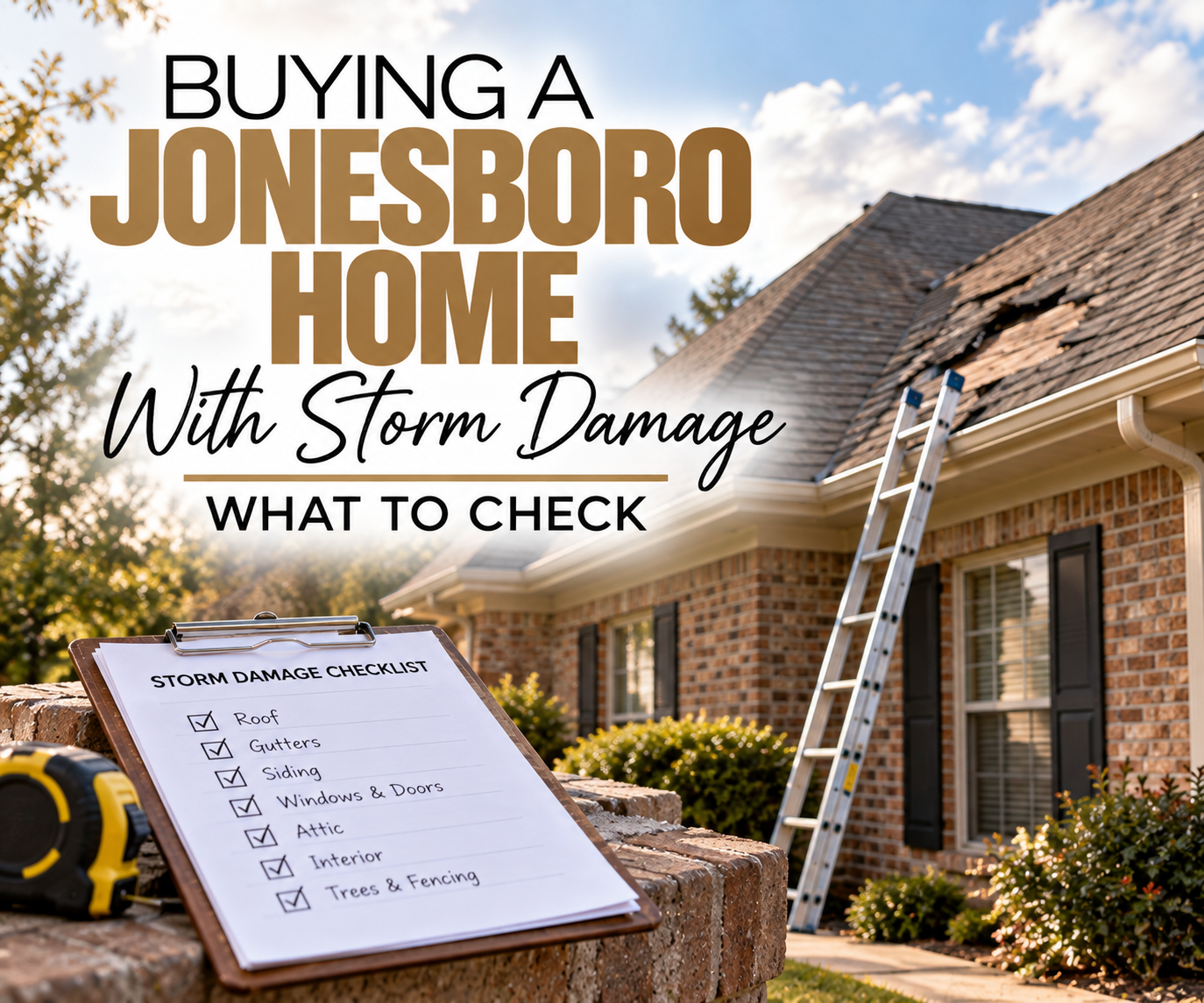
Buying a Jonesboro Home With Storm Damage: What to Check
Should you buy a Jonesboro home that has storm damage?
Yes, if you price the repairs, learn the insurance claim status, and use your inspection window. Storm damage can be a negotiating tool in Jonesboro or a reason to walk away.
A house with hail dents, a patched roof, or a fallen limb through the fence can look like a bargain. Freddie Mac's weekly survey put the 30-year fixed rate at 7.40% on October 8, up from 6.30% a year ago, so every repair dollar you absorb now carries a bigger monthly cost.
At NEA Realtor Group, Trenton Hoggard and Tim Ray help buyers weigh condition against price all the time. If you are buying a home in Northeast Arkansas and the home you like has storm damage, the right move depends on what was damaged, whether an insurance claim is open, and what your lender will require.
This guide covers what to ask the seller, how to inspect for storm damage, how insurance and lenders fit in, and how to negotiate the repair.
Start With What Actually Happened
Storm damage in Northeast Arkansas usually means wind, hail, a fallen tree, or water that got in after one of those. Ice and freezing temperatures in winter can add burst pipes and ice dams to the list. Each one leaves a different trail.
Before you write an offer, ask your agent to find out the basics from the listing side:
- What was damaged, and when did the storm happen?
- Has the damage been repaired, partly repaired, or left as is?
- Was an insurance claim filed, and is it open, paid, or denied?
- If it was repaired, who did the work, and do records or permits exist?
- Does the seller have photos from before and after?
Ask for the answers in writing. A seller who knows the history can answer in a few minutes. A seller who does not know is giving you information too.
Why Insurance Is the First Call
Insurance shapes the whole deal, because a lender will not close on a house you cannot insure. Call an insurance agent before your inspection period ends, not after.
- Tell the agent about the storm damage and the roof age. Some carriers will not write a policy on a damaged roof until it is repaired.
- Ask whether the policy carries a separate wind and hail deductible. Some policies use a percentage of the home's insured value instead of a flat dollar amount, which can be much larger than buyers expect.
- Ask whether the carrier will cover a roof at replacement cost or at actual cash value, since older roofs are often paid at a reduced value.
- Ask the seller whether a claim is open. An unpaid claim may not transfer to you, and a paid claim where the repair was never made is a red flag.
We cannot give insurance advice, so work with a licensed agent for specifics. What we can do is help you time the questions so you have answers before your deadlines.
Inspecting for Storm Damage
A general home inspection will note visible damage, but it has limits. For storm damage, think of the inspector as the first step, not the last.
What to look at
- Roof surfaces, flashing, and vents for missing, cracked, or bruised shingles.
- Gutters, downspouts, and siding for dents or displacement.
- Ceilings and attic decking for water stains, damp insulation, or daylight coming through.
- Windows, skylights, and exterior doors for cracks, failed seals, or moisture between panes.
- Trees near the house, and the condition of fences, sheds, and outbuildings.
- The crawlspace or foundation area for standing water or signs of repeated moisture.
When to bring in a specialist
If the inspector flags the roof, a roofing contractor can give a repair or replacement estimate and tell you whether the problem is hail, age, or poor workmanship. For structural concerns, a structural engineer can say whether movement or damage is a repair or a deal-breaker.
If the roof is metal, the questions change. Our guide on metal-roof homes explains how to check fasteners, history, and warranty.
In Jonesboro, a standard single-family inspection usually runs roughly $500 to $1,000. Larger homes, crawlspaces, and add-ons can push that to $800 to $1,200 or more, and a roofer's estimate is a separate cost. In Arkansas, plan on a termite letter for almost any financed purchase in Jonesboro, since the exceptions are an in-house bank loan or a cash purchase.
How Your Loan Type Affects the Deal
Lenders care about two things: the home must be safe and livable, and it must hold its value. Storm damage can run into both.
- FHA and VA appraisers look at condition and can require repairs before closing when something affects safety, security, or soundness.
- USDA loans have their own condition standards, and many rural properties around Northeast Arkansas use this program.
- Conventional loans are less rigid on repairs, but the appraisal and the insurance requirement still have to clear.
- A cash purchase has the most flexibility, but you still need insurance to protect your investment.
Because rules differ by lender and program, ask your lender early what they will want repaired, and by when. If repairs are required, find out whether the seller must complete them before closing or whether your loan allows funds to be held back until work is done.
Putting a Price on the Repairs
Get real numbers before you negotiate. A rough guess can cost you thousands in either direction.
- Ask a licensed contractor for a written estimate that covers materials and labor.
- Include related items, such as decking under the shingles, interior drywall, paint, and insulation.
- Add a cushion for surprises, since damage often shows more once the work starts.
- Remember that a repair done cheaply can fail the next storm.
If a house was patched quickly to hit the market, read our guide on buying a flipped house. Many of the same questions apply: what was done, by whom, and whether it was permitted.
Negotiating When Damage Is Unrepaired
In Northeast Arkansas, comps often pull from the last 90 to 180 days because sales volume is lower than in a metro market. We use those closed sales to show what a repaired home is worth and subtract the cost of the repair.
For context, Redfin reports that Jonesboro homes sold at about 97.7% of list price over the three months ending August 2026, with a median of roughly 55 days on the market. Nationally, the National Association of REALTORS reported existing-home sales rose 1.5% in September but remain below last year in every region. A damaged home that sits on the market is a home sellers may be ready to negotiate on, but only if the numbers support it.
- Ask the seller to repair before closing with licensed contractors and give you the receipts.
- Ask for a price reduction or a credit that reflects the contractor's estimate.
- Ask the seller to assign the insurance claim, if one is open and the lender and carrier allow it. This needs careful handling, so talk to your agent first.
- If the seller will not move and the lender will not close, you may need to walk away. Your inspection window protects that choice.
In Northeast Arkansas, many deals do not include earnest money at all, and $1,000 is the most common figure when it is used. That can make a decision to walk away easier, but read your contract so you know exactly what protects you.
Watch for Contractor and Claim Red Flags
- Be cautious about door-to-door roofing crews who show up after a storm. Ask for license information and references, and read any contract before signing.
- Never agree to let a contractor negotiate an insurance claim on your behalf without understanding what you are signing.
- If a seller used a contractor, ask for the warranty and whether it transfers to you.
- If a deal feels rushed, slow down and confirm the details with your agent.
Storm Damage Buyer Checklist
- Get the damage history and claim status in writing.
- Call an insurance agent before your inspection period ends.
- Hire a general inspector and a roofer or specialist when needed.
- Ask your lender what repairs they will require and when.
- Get a written repair estimate before you negotiate.
- Compare the repaired value to recent sales from the last 90 to 180 days.
- Decide whether to request repairs, a credit, a price change, or walk away.
Frequently Asked Questions
Q: Can I buy a Jonesboro home with unrepaired storm damage?
Often, yes, if your lender and insurance carrier allow it. Cash buyers have the most flexibility. Financed buyers should check loan and insurance requirements before they commit.
Q: Does an open insurance claim transfer to the buyer?
Not automatically. Claims depend on the policy, the carrier, and the contract, so ask your agent and a licensed insurance professional before you count on it.
Q: How do I know if a roof was damaged by hail?
A roofing contractor or inspector can look for patterns of impact marks and compare them with the roof's age and wear. Ask for photos and a written report, not just a verbal opinion.
Ready to Look at a Home With Storm Damage?
We can pull recent Jonesboro sales, help you gather the questions for the seller, and build an offer that reflects the real cost of repair. For perspective, NEA Realtor Group has earned 5-star reviews and is the #1 real estate team in the Northeast Arkansas MLS by production.
Ready to Take the Next Step?
Call or text us at 870-273-0633. Trenton Hoggard and Tim Ray of NEA Realtor Group will guide you through buying a home in Jonesboro and Northeast Arkansas, including homes with storm damage.
Connect with NEA Realtor Group
:format(webp):quality(80)/u.realgeeks.media/neahomesearch/team_sidebar.jpg)
:format(webp):quality(80)/u.realgeeks.media/contentcodes2/arrow.png)
:format(webp):quality(80)/u.realgeeks.media/neahomesearch/Market-Report-3.png)