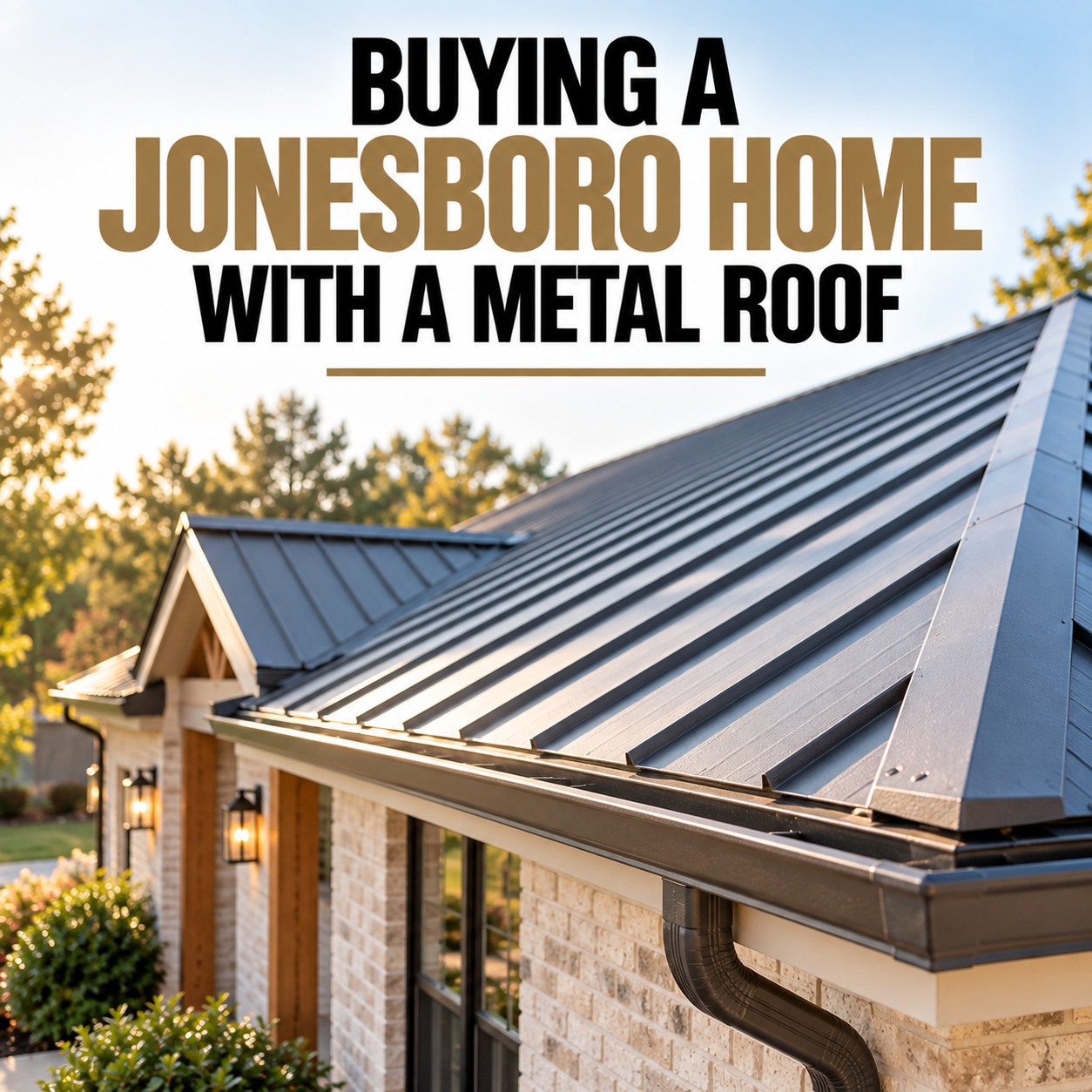
Buying a Jonesboro Home With a Metal Roof
Should a metal roof change how you buy a home in Jonesboro?
A metal roof is usually an asset on a Jonesboro home, but the value depends on the type, the install, and the age. Verify all three during your inspection period, and call your insurance agent before your contingency deadline.
You found the house. You wrote the offer. Then somebody asked you about the roof.
Metal roofs show up constantly in Northeast Arkansas, on new builds, on remodeled homes in older neighborhoods, and on almost anything with acreage. Most of the time that is good news for you as the buyer. But "metal roof" is not one thing, and the difference between a well-installed standing seam roof and a panel job somebody screwed down over old shingles is the difference between a 40-year asset and a problem you inherit at closing.
Trenton Hoggard and Tim Ray have walked a lot of these houses with buyers, and the pattern is consistent: the roof itself is almost never the deal breaker. What causes trouble is finding out too late that nobody verified the age, the install, or what it does to the insurance quote. If you are still early in the process, our guide to buying a home in Northeast Arkansas walks through the full timeline. This post is about the roof specifically, and what to do about it while you still have leverage.
First, Figure Out What Kind of Metal Roof You Are Buying
Ask the listing agent this before you do anything else. The answer changes everything that follows.
There are three types you will run into around Jonesboro:
- Exposed fastener panels. Corrugated or ribbed panels screwed straight through the face of the metal, with a rubber washer under each screw head. Common, affordable, and everywhere on rural NEA properties. The metal itself lasts a long time. The washers do not.
- Standing seam. Panels joined by raised seams with the fasteners hidden underneath. More expensive to install, fewer holes in the roof surface, and generally the longest service life of the three.
- Metal shingles or stone-coated steel. Designed to look like shingle or tile from the street. Less common here, but they turn up on higher-end builds.
If the answer is exposed fastener, you are not buying a bad roof. You are buying a roof with a maintenance item: every screw is a penetration, and the washers dry out and shrink over time. On a roof in the 10 to 15 year range, that is worth budgeting for. On a roof at 25 years, it is worth a hard look before your inspection period runs out.
The Four Questions to Ask Before Your Inspection Deadline
Most of what matters about a metal roof is history, not condition, and history has to come from the seller. Ask for it in writing through your agent.
- How old is it, and who installed it? A licensed roofing contractor and a receipt is a very different situation than "the previous owner and his brother-in-law put it on."
- Was it installed over existing shingles? This is legal in a lot of situations and it is also common. It is not automatically a problem, but it hides the decking, so nobody can tell you what condition the wood underneath is in. It also matters later if the roof ever has to come off.
- Is there a warranty, and does it transfer? Metal roof warranties often cover the finish and the panel separately from the workmanship. Many transfer to a new owner, some require a transfer fee and a written request inside a time window after closing, and some do not transfer at all. Get the paperwork, not a verbal answer.
- Has it been through a hail or wind claim? Metal dents. A dented panel usually still sheds water fine, but a prior claim tells you the roof took a hit, and it can matter to the next insurance carrier.
If the seller cannot answer these, that is information too. It does not mean you walk. It means you lean harder on the inspection and on your insurance quote before you release your contingencies.
What a Home Inspector Will and Will Not Tell You
This is where buyers get surprised, so it is worth being blunt about it.
Under the widely used InterNACHI Standards of Practice, a home inspector inspects the roof covering from ground level or the eaves, and describes the type of material. The same standards explicitly say the inspector is not required to walk on the roof surface, is not required to predict service life expectancy, is not required to confirm proper fastening or installation of roof covering material, and is not required to warrant or certify the roof.
Read that again, because it is the whole point. A standard home inspection is not a roof certification. On a metal roof, where the entire question is usually "how were the fasteners, flashing, and penetrations done," a ground-level look with binoculars can only take you so far.
In Jonesboro and the surrounding NEA towns, plan on $500 to $1,000 for a standard single-family home inspection. Larger homes, crawlspaces, and add-on services like a sewer scope or a well and septic evaluation push that toward $800 to $1,200 and up. National guides quote lower numbers than that. They are not accurate for this market.
If the roof is exposed fastener, is over roughly 15 years old, or shows anything the inspector flags, spend the extra money on a roofing contractor to look at it separately. That is a second appointment and a second fee, and on a house you are about to buy it is cheap. Our post on preparing for your buyer inspection in Jonesboro covers how to sequence that inside a normal contract timeline.
What a roofer looks at that an inspector may not
- Fastener condition and whether screws are backing out, overdriven, or missing washers
- Flashing at valleys, sidewalls, chimneys, and plumbing boots, which is where metal roofs almost always leak first
- Whether panels were cut and lapped correctly, and whether the slope is appropriate for the panel profile
- Ridge and eave detailing, closure strips, and whether the attic is actually being ventilated
- Signs of movement or oil-canning that suggest the panels were fastened without room to expand
One more Arkansas note while you are scheduling inspections. Plan on a termite letter for almost any financed purchase here. The national framing that a wood-destroying insect report is optional on conventional and FHA loans unless the appraiser flags something is simply wrong for this market. In Arkansas, expect it on essentially every financed deal. The realistic exceptions are an in-house portfolio loan at a local bank that keeps the note on its own books, or paying cash.
Metal Roofs and Your Loan: What the Appraiser Is Actually Checking
Buyers ask us constantly whether a metal roof causes loan problems. On its own, no. Metal is a normal, accepted roof covering.
What the appraiser cares about is condition and remaining life, not material. On an FHA loan, HUD's Single Family Housing Policy Handbook 4000.1 directs the appraiser to notify the lender if the roof covering does not prevent the entrance of moisture, does not provide reasonable future utility, or does not have a remaining physical life of at least two years. USDA and VA appraisals apply similar property condition standards. Conventional lenders generally defer to the appraiser's judgment on condition.
Here is the practical translation. A 30-year-old metal roof in good shape clears that bar easily. A 12-year-old metal roof with active leaks does not. Age alone is rarely the issue. Visible water intrusion is.
If the appraisal does come back with a roof condition call-out, it usually becomes a repair item that has to be addressed before closing, which means a negotiation between you and the seller about who pays and who schedules it. That is a much easier conversation to have at day 8 of your contract than at day 26.
Call Your Insurance Agent Before Your Contingency Deadline
This is the step buyers skip, and it is the one that has surprised the most people we have worked with.
Metal generally does well on wind and fire, and some carriers price that favorably. But roof coverage is where homeowners policies vary the most, and the variation is not about the material so much as the roof's age and how the carrier settles a roof loss. Two things to ask directly, by phone, with the address in hand:
- How will this carrier settle a roof claim on this roof? Replacement cost coverage pays to replace. Actual cash value coverage subtracts depreciation, and some policies apply a payment schedule tied to roof age. The answer can change what a hail event actually costs you out of pocket.
- What is the wind and hail deductible? In this part of Arkansas it is often a percentage of the dwelling coverage rather than a flat dollar figure, and that is a meaningfully different number.
Get an actual quote, in writing, on the actual house. Not a ballpark. A dented but functional metal roof can quote very differently from carrier to carrier, and if the roof is old enough that a carrier declines it outright, you want to learn that while you still have an out. Our post on getting homeowners insurance lined up before closing walks through the timing and the binder.
We are not permitted to steer you to a particular carrier or agent, and we would not want to. Call two or three and compare.
What a Metal Roof Does to Resale in Northeast Arkansas
You are buying today, but you will sell eventually, so it is worth knowing how this reads on the other end.
In our experience across Jonesboro and the surrounding towns, a well-installed metal roof is a selling point. Buyers here understand it. It removes the "how old is the roof" objection that costs a lot of shingle homes a negotiation, and it reads as one fewer thing to replace.
What it does not reliably do is add a dollar-for-dollar bump to the appraised value. An appraiser works from comparable sales, and in a market this size the comps may need to reach back 90 to 180 days to find enough similar properties. Our sales volume is thinner than a metro market, so a 30-day comp window often does not produce enough data. If a metal roof is unusual for that particular street or subdivision, there may be no comparable sale that isolates what it is worth.
So treat the roof as a cost you will not have to carry rather than as equity you are buying. That is a healthier way to price your offer.
Negotiating When the Roof Comes Back With a Problem
The market matters here, and right now it is giving buyers more room than it did a year ago.
Nationally, the National Association of REALTORS reported existing-home sales down 2.0% in August 2026, with inventory at 4.9 months of supply. NAR Chief Economist Lawrence Yun described that as the highest level in over ten years and noted that the ample supply is giving buyers better opportunities to negotiate. Locally, Redfin puts the Jonesboro median sale price at roughly $235,000 for the three months ending August 2026, up 2.1% year over year, with homes going under contract in a median of 54 days compared to 66 days last year.
Financing costs are also moving. Freddie Mac reported the 30-year fixed-rate mortgage averaged 6.95% as of September 17, 2026, up from 6.76% the week before, and up from 6.26% a year ago. That jump is worth noticing if you are still shopping rates, and it is another reason not to let an inspection negotiation drag on for two extra weeks.
When a roof issue turns up, you usually have four moves:
- Ask the seller to repair it before closing, with a licensed contractor and a receipt. Best when the fix is specific and small, like re-screwing a section or replacing boot flashings.
- Ask for a price reduction and handle it yourself after closing. Gives you control over who does the work.
- Ask for a closing cost credit instead. Often the cleanest option if you are tight on cash to close, though your lender caps how much seller-paid credit is allowed.
- Walk, if you are inside your inspection period and the number is bigger than the house is worth to you.
A note on earnest money, because buyers worry about what is at risk. In Northeast Arkansas, the large majority of deals do not include earnest money at all. When buyers do put earnest money down, $1,000 is the most common figure, and the highest we typically see is around $5,000, usually on luxury transactions at $500,000 and up. Those are patterns we observe, not rules, and any deal can be negotiated differently. The practical point is that on most NEA contracts, your protection during an inspection dispute is a clean contingency deadline and a well-documented repair request, not the size of a deposit.
Where These Deals Usually Land
Honestly, most of them close, and most buyers are glad about the roof afterward.
The pattern we see repeat:
- Standing seam, professionally installed, under 20 years old: verify the warranty transfer, get your insurance quote, move on.
- Exposed fastener, 10 to 20 years old, no active leaks: budget for a fastener and sealant service in the next few years, and price your offer accordingly.
- Metal over old shingles, unknown installer, no paperwork: get a roofer up there before your contingency expires. You are buying the unknown underneath, and that is worth one appointment to reduce.
- Active leaks or visible interior water staining: this becomes a repair negotiation or an appraisal condition, so start that conversation immediately rather than at the end.
The buyers who have trouble are almost always the ones who assumed a metal roof meant they could skip a step. It does not. It just means the steps are slightly different from a shingle house.
Frequently Asked Questions
Q: Does a metal roof make a home harder to insure in Arkansas?
Not usually. Metal generally performs well on wind and fire, and many carriers write it without issue. What drives the quote is the roof's age and condition, plus how that specific carrier settles a roof loss. Get a written quote on the actual address before your contingency deadline rather than assuming.
Q: Can you get an FHA or USDA loan on a house with an older metal roof?
Yes, as long as the roof is doing its job. The standard is condition and remaining life, not material or age by itself. HUD's handbook directs the FHA appraiser to flag a roof that lets moisture in or has less than roughly two years of remaining physical life. A sound 30-year-old metal roof typically clears that; a leaking newer one may not.
Q: Should I pay for a separate roof inspection if the home inspector already looked at it?
If the roof is exposed fastener, is roughly 15 years or older, was installed over shingles, or got flagged at all, yes. A general home inspection is not a roof certification, and the inspection standards specifically exclude walking the roof, confirming fastening, and predicting remaining life. A roofing contractor's separate look is a small cost against the purchase price.
For perspective on who you are working with: NEA Realtor Group is the 5-star reviews team ranked #1 real estate team in the Northeast Arkansas MLS by production, which mostly means we have seen a lot of roofs and a lot of inspection negotiations.
Looking at a Jonesboro Home With a Metal Roof?
Send us the address and we will tell you what we see, what to ask the listing side for, and how to structure the inspection period so you keep your options open. Trenton Hoggard and Tim Ray, NEA Realtor Group, serving Jonesboro and Northeast Arkansas. Call or text us at 870-273-0633.
Connect with NEA Realtor Group