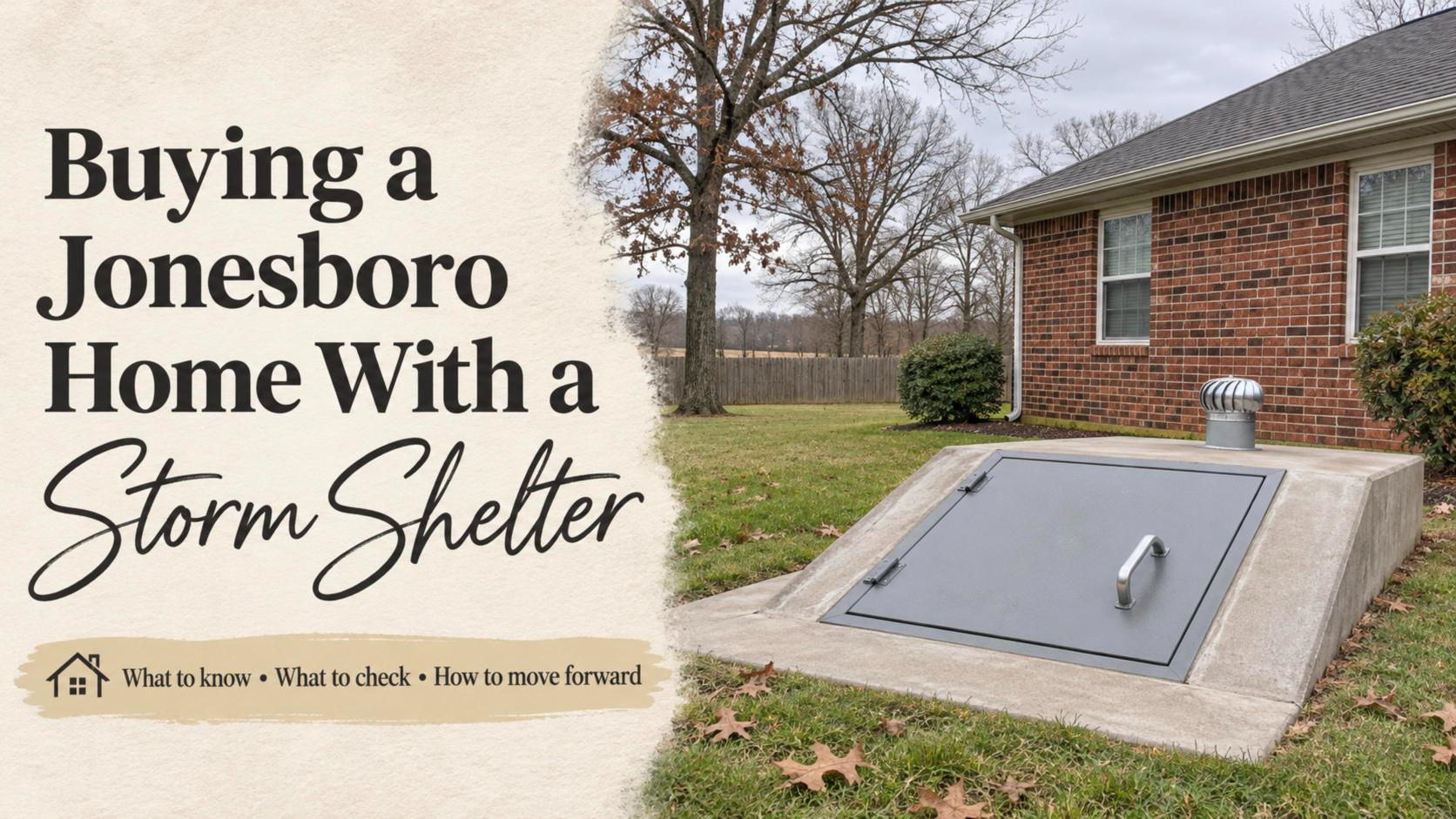
Buying a Jonesboro Home With a Storm Shelter
What should you check when buying a Jonesboro home with a storm shelter?
Confirm the shelter type, how it was built and anchored, whether it stays dry, and that the door works. Put it in the contract so it conveys, then register it with Jonesboro E911 after closing.
Storm shelters show up on a lot of Jonesboro listings. You will see them in backyards, under garage floors, and bolted to garage slabs, and buyers tend to light up when they see one in the photos.
But a shelter is only worth something if it works. At NEA Realtor Group, Trenton Hoggard and Tim Ray help buyers check the shelter as part of our home buying process, because a rusted door, a flooded pit, or a unit that was never anchored correctly is a problem you want to find before closing, not during a tornado warning.
This is also not just a spring question. The National Weather Service in Little Rock notes that Arkansas typically has a secondary severe weather season in the fall or early winter about two years out of three, and that 38% of the state's tornadoes from 2000 to 2022 happened between September and February.
Here is what to look at, what to ask, and how to handle the shelter in your offer.
The Types of Storm Shelters You Will See in Jonesboro
Not every shelter is built the same way, and each type comes with its own things to check.
- In-ground yard shelter: A concrete, steel, or fiberglass unit buried in the yard with steps leading down to a hatch or door. Common on older homes and country lots.
- In-garage floor shelter: A steel box set into the garage slab with a sliding lid. You can reach it without going outside, but a parked car can block it.
- Above-ground safe room: A steel room bolted to the garage floor or another concrete slab. Easy to get into, and no stairs.
- Site-built interior safe room: A closet, pantry, or bathroom built with reinforced concrete or block walls and a rated door. Often found in newer construction.
None of these is automatically better. What matters is how it was built, how it was installed, and whether it has been maintained.
What to Check Before You Commit
Plan to look at the shelter closely during your showing and again during your inspection period. These are the areas that matter most.
Paperwork and how it was built
Here is something many buyers do not know: FEMA does not test, approve, or certify shelters. FEMA's safe room guidance sets design criteria (FEMA P-320 for homes), and it specifically says companies should not claim they are "FEMA approved" or "FEMA certified."
So ask the seller for whatever records they have:
- The installer's name and the shelter's make and model
- Engineer-stamped drawings or a statement that the design meets FEMA P-320 or the ICC 500 storm shelter standard
- A debris impact test report or a National Storm Shelter Association seal, if the unit has one
- Any building permit and the installation date
- Any warranty, and whether it transfers to a new owner
Missing paperwork is common on older shelters and does not mean the shelter is bad. It just means you should look harder at the physical condition and set your expectations on value accordingly.
Anchoring and structure
An above-ground safe room is only as strong as its connection to the slab. Look for anchor bolts all the way around the base, with none missing, loose, or rusted through.
- For bolted units, check that the slab around the bolts is not cracked or crumbling.
- For in-ground units, look for cracked concrete, shifting, or a lid that no longer sits flat.
- For site-built rooms, ask what is inside the walls. A regular closet with a heavy door is not a safe room.
Water, ventilation, and rust
Water is the most common issue we see with below-ground shelters in Northeast Arkansas. Clay soils and wet seasons can push water into a buried unit, and a shelter with standing water in it is not one your family will want to use.
- Look for standing water, water lines on the walls, mud, or mildew smell.
- Check the vents. They should be open and clear, not packed with leaves or wasp nests.
- Look at steel doors, hinges, and lids for rust, especially at the bottom edges.
- If you can, look at it after a good rain. A dry shelter in a dry week tells you less.
The door and getting in and out
Open and close the door yourself. It should move freely, latch securely from the inside, and not require two people to lift.
- Sliding garage-floor lids should run smoothly on their track without grinding.
- Steps into in-ground shelters should be solid, with a handrail if possible.
- Think about who in your household would be using it at 2 a.m. in the rain, and whether that type of entry works for you.
How the Shelter Fits Into Inspection, Appraisal, and the Contract
Inspection
Most general home inspectors will look at a shelter visually, but they are not engineers and will not certify that it meets a wind standard. Ask your inspector up front to open it, check for water and rust, and note the anchoring in the report.
If problems show up, they go into the same repair conversation as anything else. Our guide on how to negotiate inspection repairs in Jonesboro walks through asking for a repair versus a credit.
Make sure it conveys
A buried shelter or a site-built safe room is part of the house. A bolted-down steel unit is usually treated as a fixture too, but "usually" is not good enough when the shelter is a reason you picked the home.
We recommend naming the storm shelter in your offer as an item that stays with the property. It takes one line and removes any question at the final walkthrough.
Appraisal and value
A shelter helps a home stand out, but it rarely adds its full cost to the appraised value. Oklahoma State University Extension reported shelters running roughly $3,000 to $30,000 installed, with one real estate agent there estimating an appraisal might add about $1,000 to $4,000. That is Oklahoma, not Jonesboro, but it matches the general pattern we see: buyers like shelters, and appraisers give them modest credit.
So do not overpay for a home just because it has one. Compare it against similar homes without a shelter and think of the shelter as a solid bonus, not the main reason for the price.
Insurance
Tell your insurance agent the home has a shelter when you shop for coverage, and ask whether it is covered as part of the dwelling and whether it changes your rate. Our post on getting homeowners insurance before closing in Jonesboro covers timing so this does not hold up your closing date.
What the Current Market Means for Your Offer
Late fall and winter are a slower stretch in Jonesboro, and that gives buyers room to ask good questions.
- Based on NEABOR MLS closed sales over the past 12 months, Jonesboro homes took a median of about 34 days to sell, and winter months ran slower than spring and summer.
- The same data shows homes typically sold for roughly 97% of their original list price, so there is usually some room to negotiate.
- The 30-year fixed rate averaged 7.11% as of November 12, 2026, according to Freddie Mac's weekly survey, down for the fourth week in a row.
In practical terms, if the shelter needs a new door seal, a sump, or rust repair, you are in a reasonable position to ask for a fix or a credit rather than just accepting it.
After Closing: Register Your Shelter
This step gets skipped all the time. The City of Jonesboro keeps a Storm Shelter Registry through its E911 office so that first responders can find people who may be in a shelter after a disaster. The city says the information is kept confidential and shared only with public safety personnel.
- Register the shelter in your name soon after you move in. Do not assume the seller's old registration covers you.
- Ask the seller to update or remove their registration for the address.
- If you buy outside Jonesboro city limits, ask your county 911 or emergency management office whether they keep a similar list.
- Stock a flashlight, water, and a weather radio, and test the door before the spring season starts.
If the Home You Love Does Not Have One
Plenty of buyers find the right house and simply add a shelter later. If that is your plan:
- Check whether the garage slab or yard has room for the type you want.
- Get quotes from more than one installer you choose yourself, and ask each one for their testing and design documentation.
- Ask the City of Jonesboro or your county about permit requirements before installation.
Quick Storm Shelter Checklist for Jonesboro Buyers
- Identify the shelter type and ask the seller for installer, model, permit, and warranty info.
- Check anchoring, concrete, and the condition of the door and hardware.
- Look for water, blocked vents, and rust.
- Ask your inspector to open it and include it in the report.
- Name the shelter in your offer as staying with the home.
- Tell your insurance agent about it.
- Confirm it at the final walkthrough, then register it with E911 after closing.
Frequently Asked Questions
Q: Does a storm shelter add value to a Jonesboro home?
It helps a home stand out to buyers, but appraisers usually give it modest credit rather than its full installed cost. Treat it as a bonus when comparing homes, and focus on whether it is in good working condition.
Q: Is a storm shelter "FEMA approved"?
No shelter is. FEMA publishes design guidance but does not test or certify products. Ask for engineer documentation, impact testing, or a National Storm Shelter Association seal instead.
Q: Do I need to register a storm shelter after buying a home in Jonesboro?
It is not something your closing requires, but it is a smart step. The City of Jonesboro's E911 Storm Shelter Registry helps first responders locate people who may be in a shelter after a storm, and the information is kept confidential.
Looking at a Jonesboro Home With a Storm Shelter?
For perspective, NEA Realtor Group has 5-star reviews and is the #1 real estate team in the Northeast Arkansas MLS by production. Trenton Hoggard and Tim Ray can help you check the shelter, write it into your offer, and get to closing without surprises. Call or text us at 870-273-0633.
Connect with NEA Realtor Group