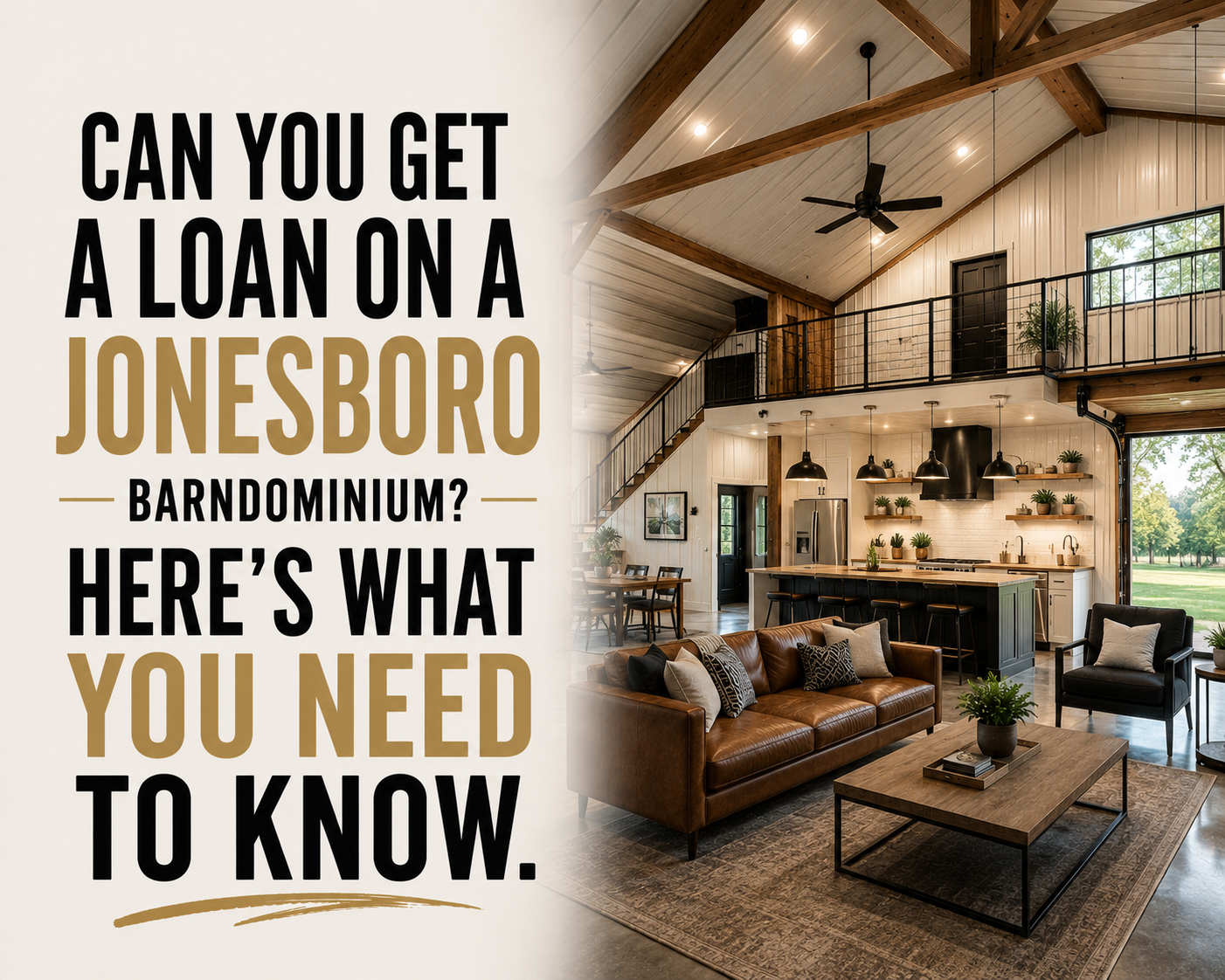
Can You Get a Loan on a Jonesboro Barndominium?
Can you get a mortgage on a barndominium near Jonesboro?
Usually yes, but the loan lives or dies on the appraisal. Lenders will finance a post-frame home if the appraiser can prove the market accepts it and the property reads as residential, not agricultural or commercial.
You found one. Metal siding, a covered porch on one end, a shop with a fourteen-foot door on the other, sitting on four acres off a county road outside town. The inside is finished better than half the houses you have walked this year. The price per square foot looks like a mistake in your favor.
Then your lender says something noncommittal about "the appraisal" and your stomach drops.
This comes up constantly in our market. Post-frame homes have gone from a rural novelty to a real segment of what buyers look at around Brookland, Bono, Bay, and out toward Paragould, and Trenton Hoggard and Tim Ray have watched deals on them close cleanly and watched others die three days before funding. The difference almost never comes down to the buyer. It comes down to how the property was built, how it is classified, and whether an appraiser can defend the number. If you are early in the process, our buyer resources walk through the rest of the timeline, but this page is about the one question that decides whether there is a timeline at all.
What lenders actually mean by "barndominium"
There is no loan product called a barndominium loan. Underwriters do not have a box for it. What they have is a category called unique or nontraditional housing, and a post-frame home lands in it alongside log homes, dome homes, and earth-sheltered houses.
That matters because the rules for that category are not "no." They are "prove it."
Fannie Mae's Selling Guide section on the improvements portion of an appraisal says loans on unique or nontraditional housing are eligible for sale as long as the appraiser has enough information to develop a reliable opinion of market value. It goes further and says the comparable sales do not all have to be the same design and appeal as the home being appraised. So the absence of three other barndominiums down the road is not automatically fatal.
The same guide draws the line clearly, though. If the appraiser cannot find any evidence of market acceptance, and the property is different enough that no reliable value can be established, the property is not acceptable collateral. Both the appraiser and the underwriter have to reach that conclusion independently.
Translated into plain language: the loan works when someone can show that people in Craighead County buy and sell homes like this one. It fails when nobody can.
The appraisal is the whole ballgame
Every other issue on this page is downstream of the appraisal. Get that right and most barndominium purchases in our area close like any other transaction.
Three things make an appraisal on a post-frame home harder than a standard subdivision house.
Thin comparable data. In a market the size of Jonesboro, comps on any property type can be scarce enough that appraisers reach back further than they would in a metro area. On a conventional home we routinely pull comparable sales from the last 90 to 180 days rather than the last 30, simply because of volume. On a barndominium the window can stretch further still, and the appraiser may pull from Greene, Poinsett, or Lawrence County to find anything comparable. That is allowed. Fannie Mae's guidance specifically permits older comparable sales, sales in competing neighborhoods, and other reliable market data to demonstrate marketability.
The shop counts differently than you think. Appraisers measure finished area under the ANSI standard, and finished space that is attached to the dwelling but has no direct interior access gets reported on its own line in the grid rather than folded into the living area. If your barndominium's shop opens only to the outside, that square footage is not going to carry the same weight as the heated, finished side of the building. Buyers routinely do the math on total square footage under roof and come out thousands of dollars above where the appraisal lands.
The cost approach can undershoot. When sales comparisons are thin, appraisers lean harder on land value plus construction cost minus depreciation. That method tends to miss the extra dollars buyers actually pay for finished barndominium living space, which is exactly what the seller is asking you to pay.
None of this means walk away. It means you should expect a value discussion, and you should know before you write the offer how much appraisal gap you can absorb, if any.
Residential or agricultural? The classification question
This is the second place these deals fall apart, and it is the one buyers never see coming.
Fannie Mae's guidance tells lenders to give special consideration to properties with outbuildings and to confirm the property is residential in nature. Small barns or stables of insignificant value are fine. Significant outbuildings, such as silos, large barns, big storage areas, or facilities for farm animals, may indicate the property is agricultural, and the lender has to make its own determination either way, regardless of whether the appraiser assigned any value to those structures.
On a lot of NEA properties, the barndominium is the outbuilding, or it sits beside two more of them. A home with a modest attached shop reads residential. The same home on twenty acres with a machine shed, grain storage, and a set of working pens reads agricultural to an underwriter who has never driven past it.
Practical things to check before you write:
- How the county assessor currently classifies the parcel. Residential is what you want to see.
- Whether any part of the property is leased out or generating income. Income-producing land and buildings create problems on several loan programs.
- How much of the total value sits in the house versus the outbuildings and the land.
- Whether the acreage is dramatically larger than typical residential parcels nearby.
- Whether the structure was permitted and inspected as a dwelling or only as a farm or storage building.
That last one is worth a phone call to the county before the inspection period closes. A building that was permitted as a shop and later finished out as a residence is a very different underwriting conversation than one built as a home from day one.
How each loan type handles it
We cannot recommend a lender and we will not, but here is how the major programs generally approach these properties so you can ask your loan officer the right questions.
Conventional
The most common path for a finished barndominium in our area. The unique-housing rules above are conventional rules. If the appraiser can support the value and the property is residential in nature, the loan is eligible. Expect the underwriter to read the appraisal narrative closely rather than skim it.
USDA
Genuinely useful here, because a lot of these homes sit in eligible rural areas around Jonesboro and USDA allows zero down. The property has to be your primary residence, has to be residential in use and character rather than commercial or farm income-producing, has to sit on a permanent foundation, and has to have safe, adequate water and wastewater service. A workshop area is generally acceptable. A working operation is not. USDA's property and appraisal standards live in Chapter 12 of the HB-1-3555 handbook if you want to read the source.
VA
Also workable, with the same two hurdles. The home must meet VA minimum property requirements, including safe water, working utilities, and all-weather road access, and it must be classified and appraised as a single-family residence rather than agricultural or commercial. VA appraisers face the same comparable-sales problem everyone else does.
FHA
Possible, but FHA's property condition standards are the least forgiving of the four, and any deferred maintenance on a metal building will get flagged. If the home is fully finished and well maintained, it can work.
In-house bank financing
Local banks that keep a loan on their own books set their own rules and can look at a property the secondary market would decline. That flexibility usually costs something in rate, term, or down payment. It is a real option worth knowing about, not a first resort.
One Arkansas note that applies to almost all of the above: plan on a termite letter for basically any financed purchase here, not just VA and USDA. The two exceptions are an in-house bank loan and a cash purchase.
Inspection items that matter more on a post-frame home
Order the inspection. Budget $500 to $1,000 for a standard single-family inspection in this market, and plan toward the higher end or above it if the building is large or you add services like a septic evaluation or a well test.
Tell your inspector up front that it is a post-frame home. Ask them to pay attention to:
- The slab and the post embedment, including any sign of settling, cracking, or moisture wicking at the base of the posts.
- Insulation and vapor barrier detail. Metal buildings sweat, and condensation problems inside walls are expensive and invisible from a showing.
- Whether the finished living area has its own conditioned envelope separate from the shop, or whether you will be heating and cooling the whole building.
- Electrical service and panel capacity, especially if the shop side has a compressor, welder, or lift.
- Fastener and screw condition on the roof panels, plus any sealant at the ridge and eaves.
- Whether the plumbing runs through unconditioned space, which becomes a January problem here.
If the property is on a well or septic system, which many of these are, get those evaluated separately. Our guide to well and septic inspections for Jonesboro buyers covers what those look like and what the results mean for your offer.
Insurance: get a quote before you release contingencies
Do this early. Not the week of closing.
Metal construction is not inherently a problem for carriers, and in some respects it holds up well to the hail and wind we get. But an insurer underwrites a mixed-use structure differently than a standard house, and the questions they ask (how much of the building is living space, what happens in the shop, is there a business operating out of it, is there a wood stove) can change what you pay or whether a policy is available at all.
Your lender will not fund without a bound policy. Find out in week one whether you can get one at a number you can live with, and confirm the coverage treats the whole structure the way you expect it to.
What this means for your offer
Rates are not the variable here. The 30-year fixed averaged 6.66% in Freddie Mac's survey for the week of August 27, 2026, up a hair from 6.65% the week before and roughly where it sat a year ago. Nationally, NAR reported existing-home sales at a 4.06 million annual pace in July, with a 4.6-month supply and a median price of $434,100. Those are broader trends rather than Jonesboro numbers, and our market runs well below that national median, but the direction is the same: buyers have a little more room to negotiate than they did two years ago.
On a barndominium specifically, that room is worth using on structure rather than price. A few things we push for:
- A financing contingency written with enough runway for a slower appraisal. These take longer to schedule and longer to review.
- An appraisal contingency you actually intend to use, with a clear number in your head for how much gap you would cover.
- Enough inspection period to get the well, septic, and insurance answers back, not just the general inspection.
- Any available documentation from the seller: build plans, permits, engineering letters, the builder's name, and receipts for the finish work. This material genuinely helps the appraiser and helps the underwriter, and it is far easier to get during the contract than after.
On earnest money, the local pattern is not what national articles will tell you. The large majority of deals in Northeast Arkansas do not include earnest money at all. When buyers do put it down, $1,000 is the most common figure, with higher amounts, up to roughly $5,000, generally reserved for luxury transactions. Those are patterns we have observed, not rules, and every deal is negotiated.
The resale question nobody asks until later
Buy the home you want. But go in knowing that the same thin comp pool that complicates your appraisal will complicate your sale in seven years, and that the buyer pool for a post-frame home on acreage is narrower than for a three-bedroom in a subdivision. Narrower is not bad. It is just narrower, and it usually means a longer marketing period.
That is a solvable problem with the right approach. When we list properties like this we run dedicated direct mail alongside the MLS and online syndication, because the buyer for an acreage property with a shop often is not sitting on a home search app, and reaching them takes deliberate work. You can see the kind of homes on acreage currently moving in our area if you want a feel for the segment before you commit.
This is also worth comparing against the other nontraditional path buyers in our market consider. Our post on buying a manufactured home in Jonesboro covers a different set of financing and appraisal rules, and some buyers find one fits their situation better than the other.
Frequently Asked Questions
Q: Do I need a bigger down payment on a barndominium?
Not automatically. Conventional, USDA, VA, and FHA down payment rules do not change based on the building style. Where you may need more cash is at the appraisal, if the value comes in under the contract price and you decide to cover the gap.
Q: What if the appraisal comes in low?
You have the same options as on any home: renegotiate the price, cover the difference in cash, split it with the seller, request a reconsideration of value with better supporting sales, or terminate under your appraisal contingency. On a unique property, a well-supported reconsideration with additional comparable sales is worth attempting before you assume the deal is dead.
Q: Can I get a loan on a barndominium that is not finished yet?
A standard purchase mortgage requires a completed, habitable dwelling. An unfinished shell is a construction or renovation financing conversation, which is a different product with different requirements. Tell your loan officer the true condition before you write.
Q: Does the shop hurt the appraised value?
It usually adds contributory value, but not at the same rate as finished living space, and often not at the rate reflected in the asking price. Attached finished area with no direct interior access to the home gets reported separately from the living area rather than counted with it.
Q: Are barndominiums harder to insure in Northeast Arkansas?
Not necessarily harder, but different. Carriers evaluate the mixed residential and shop use, the construction type, and any business activity on site. Get a real quote during your inspection period rather than assuming it will be routine.
Q: Should I still make an offer if my lender sounds unsure?
Get a straight answer first. Ask specifically whether they have closed a post-frame home in this area and how their appraisal panel handles unique properties. An unsure lender three weeks in is far more expensive than an honest no on day one.
The buyers who do well on these properties are not the ones who move fastest. They are the ones who ask the appraisal and classification questions before the offer instead of after, and who build enough room into the contract to get real answers back.
For perspective on who you are asking: NEA Realtor Group holds 5-star reviews across Northeast Arkansas and is the #1 real estate team in the Northeast Arkansas MLS by production. We have walked these properties, and we will tell you straight whether the one you found is likely to appraise.
Found a Barndominium You Want?
Send us the address before you write the offer. We will look at the classification, the comp situation, and what your financing options actually are on that specific property. Trenton Hoggard and Tim Ray, NEA Realtor Group, serving Jonesboro and Northeast Arkansas.
Connect with NEA Realtor Group
:format(webp):quality(80)/u.realgeeks.media/neahomesearch/team_sidebar.jpg)
:format(webp):quality(80)/u.realgeeks.media/contentcodes2/arrow.png)
:format(webp):quality(80)/u.realgeeks.media/neahomesearch/Market-Report-3.png)