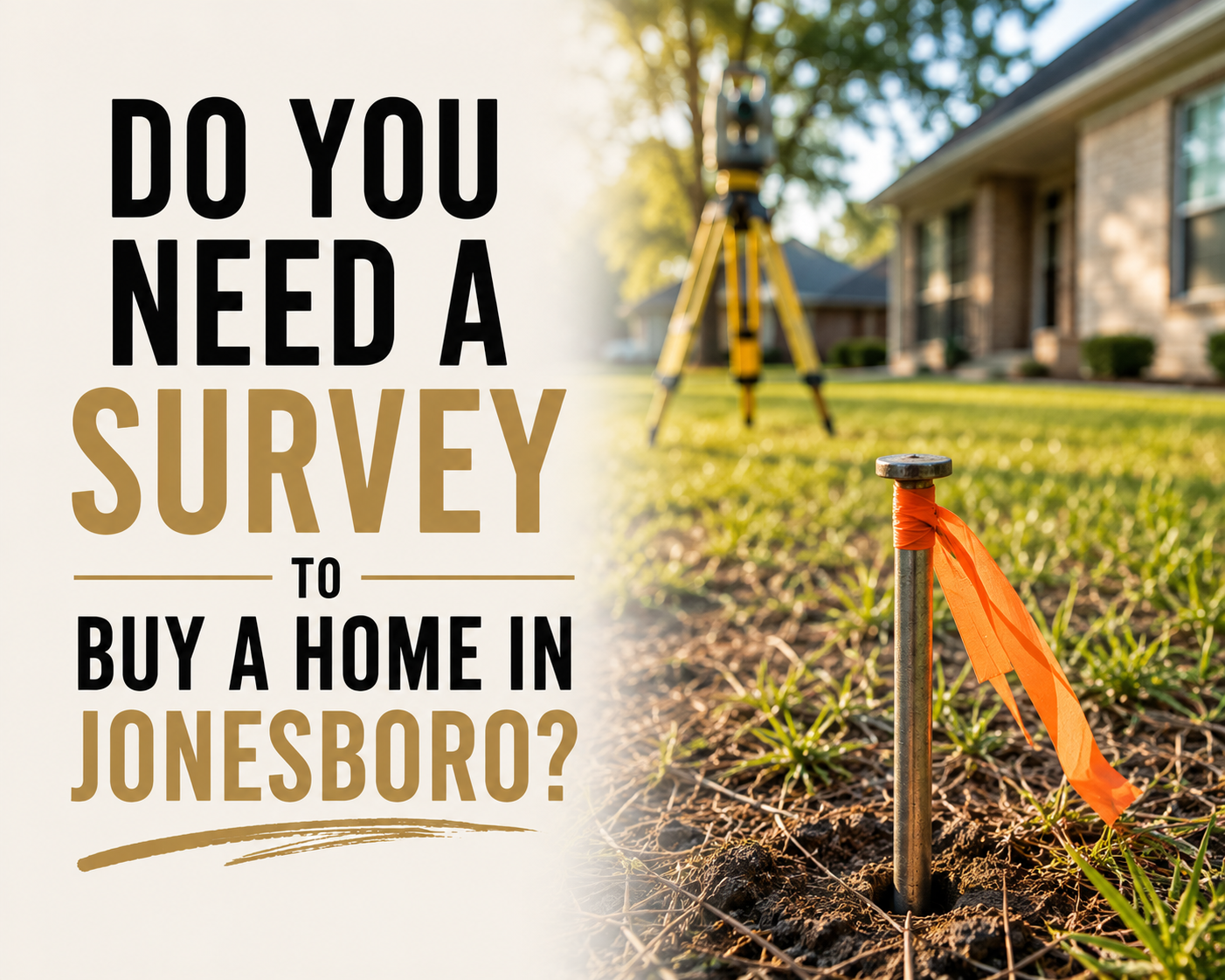
Do You Need a Survey to Buy a Home in Jonesboro?
Do you need a survey to buy a home in Jonesboro?
Usually no. Most Jonesboro buyers on a platted subdivision lot close without one. A survey becomes worth paying for on acreage, older tracts, fence disputes, or when you want the survey exception removed from your title policy.
This question almost always comes up in the same week: you are under contract, the inspection is scheduled, and somebody (the closing attorney, the lender, your uncle) mentions a survey. Nobody tells you whether you actually need one.
Here is the short version we give clients at NEA Realtor Group, where Trenton Hoggard and Tim Ray walk buyers through this decision several times a month: in Northeast Arkansas, a survey is almost never required, and it is sometimes one of the smartest few hundred dollars you will spend. Which one applies to you depends entirely on the property.
This post breaks down when to skip it, when to order it, and what it actually protects you from. If you are earlier in the process and still deciding how to approach an offer, our Jonesboro home buying resources cover the steps that come before this one.
What a property survey actually is
A boundary survey is not a map printout and it is not the parcel outline on the county GIS website. Those are helpful references, but they are not legal evidence of where your property line sits.
A real survey is fieldwork performed by a licensed Arkansas professional surveyor, governed by Standards of Practice No. 1, the state's minimum standards for property boundary surveys and plats. Those standards are specific about what has to happen.
Under the Arkansas standards, the surveyor must:
- Research the deeds, prior plats, and original government survey records before ever setting foot on the lot
- Locate or confirm a permanent monument at every corner of the parcel, and mark each one with the surveyor's license number
- Meet a positional accuracy standard tied to the property class, which is a quarter of a foot for urban and subdivision property and three quarters of a foot for rural agricultural land
- Show any reasonably observed encroachments and possession lines on the plat
- Seal, sign, and date the plat, state the acreage, and file a copy with the State Surveyor's office within 30 days
That last point matters more than people realize. A completed survey becomes part of the public record. It is a durable answer to a question that otherwise stays fuzzy for decades.
When Jonesboro buyers usually skip it
If you are buying a house on a platted lot inside a recorded Jonesboro subdivision, built in the last thirty or forty years, with a fence that lines up with the neighbors and no visible oddities, most buyers close without a survey and never think about it again.
There are practical reasons for that:
- No loan program requires it. Conventional, FHA, VA, and USDA underwriting all rely on the appraisal and the title work, not a boundary survey.
- The subdivision was already surveyed once, at platting, and those lot lines are recorded.
- Corner pins are frequently still in the ground and can often be located with a metal detector.
- On a rectangular quarter-acre lot with a house centered on it, there is not much room for the line to be somewhere surprising.
Compare that to the things Arkansas lenders genuinely will not skip. A termite letter, for example, is required on essentially every financed purchase here. The only common exceptions are an in-house portfolio loan from a local bank keeping the note on its own books, or a cash purchase with no lender involved. A survey is nothing like that. It is optional in almost every Jonesboro transaction.
So if nobody is requiring it, why would you pay for one?
When you should strongly consider one
These are the situations where we tell clients to spend the money. Any one of them is enough.
You are buying acreage or a metes and bounds tract
This is the big one in Northeast Arkansas. Once you leave the city lot grid and get out toward Bono, Brookland, or the county roads around Craighead County, property is often described by metes and bounds instead of a lot and block number.
Those descriptions were sometimes written generations ago and carried forward deed to deed. Acreage stated in a deed and acreage on the ground are not always the same number. If you are paying by the acre, that gap is your money. Buyers shopping homes on acreage in Northeast Arkansas should treat a survey as part of the budget, not an upgrade.
Something on the property does not line up
Walk the lot before you decide. Look for:
- A fence that jogs, or two fences running near each other
- A shed, carport, pool, or shop that sits close to a line
- A driveway or gravel drive that appears to cross onto the neighbor's ground
- A neighbor's outbuilding, garden, or parking area that seems to be on this side of the fence
- An old tree line or ditch being treated as the boundary
Any of those is a reason to get a professional opinion before closing, not after.
You have plans for the property
If you intend to build a shop, add a fence, put in a pool, split the tract, or add an addition, you need to know where the lines and easements are before you spend money on any of it. Setback rules and utility easements only matter when you find out about them too late.
The seller cannot tell you where the corners are
Ask. It costs nothing. If the seller has a prior survey, ask for the plat, and check the date and the surveyor's seal. A recent, sealed plat may be enough to answer your questions without ordering new fieldwork.
The title insurance connection most buyers miss
This is the part that surprises people, and it is the strongest argument for a survey in a normal transaction.
A standard owner's title policy carries what is called a survey exception. It excludes coverage for anything an accurate survey and inspection of the property would have revealed: encroachments, overlaps, boundary line disputes, setback violations, and unrecorded easements.
Read that again. Your title policy protects you against problems in the record. It generally does not protect you against problems on the ground.
Providing a current survey is how that exception gets narrowed or removed. The title underwriter reviews the plat and, if nothing problematic shows up, the blanket exception can come off and specific items get listed instead. If you want the broadest coverage your policy can offer, the survey is the price of admission.
We wrote a full walkthrough of how coverage works locally in our post on title insurance for Jonesboro buyers, and the survey exception is the single most misunderstood line in the whole commitment.
Fence lines, neighbors, and the seven-year question
Buyers often assume the fence is the line. In Arkansas, that assumption can get expensive in either direction.
Arkansas has an adverse possession statute, Arkansas Code 18-11-106, that generally requires actual or constructive possession plus color of title for at least seven years, with payment of the property taxes during that time. The statute is supplemental to existing Arkansas case law, and these claims are fact-specific and genuinely complicated.
We are Realtors, not attorneys, so we do not give legal opinions on boundary claims. What we can tell you is the practical takeaway: a long-standing fence in the wrong place is not automatically your problem or automatically your gain. It is a question, and the survey is what turns the question into a fact. If a survey does reveal a real conflict, that is the point to bring in a real estate attorney, while you still have contract rights.
Doing this before closing is worth emphasizing. Once you own it, the dispute is yours, and your leverage is gone.
What it costs and who pays
Cost depends on the property, not on a national average. A straightforward city lot inside a recorded Jonesboro subdivision, with pins still findable, is a fairly quick job. A twenty-acre tract described by metes and bounds, with heavy brush and corners nobody has touched in fifty years, is a completely different piece of work.
Plan for a several-hundred-dollar professional fee on a typical subdivision lot, and expect meaningfully more as acreage, terrain, and research complexity go up. We would rather give you a real quote for your specific address than publish a number that is wrong for your situation.
Who pays is negotiable, and worth negotiating:
- Most often, the buyer pays, because the buyer is the one who wants the information
- It can be written into the offer as a seller-paid item or folded into seller concessions
- On acreage where the acreage figure drives the price, a seller sometimes has as much reason to want it as you do
- If a survey is going to change what the property is worth, it is better to know before the appraisal, not after
That last point connects to pricing generally. Because sales volume in Jonesboro and the surrounding NEA market is lower than in metro areas, meaningful comparable sales often have to be pulled from the last 90 to 180 days rather than the last 30. Acreage and lot size are part of that comparison, so an accurate acreage figure genuinely affects value here.
What a survey will not do
A boundary survey answers boundary questions. It is not a substitute for anything else in your due diligence.
- It is not a home inspection. A standard single-family inspection in Northeast Arkansas typically runs $500 to $1,000, and more with crawlspace access, larger square footage, or add-on services.
- It is not a title search. The surveyor works from the record; the title work is what confirms the chain and finds liens.
- It is not an appraisal, and it does not set value.
- On a rural property, it does not evaluate the well or the septic system. That is separate work, and we covered it in our guide to well and septic inspections for Jonesboro buyers.
- It is not a flood determination, though a survey with elevation work is a different product that can help with one.
How to order one without wrecking your timeline
Surveyors in this region stay busy, and turnaround can stretch during good weather when construction demand is high. The mistake we see is buyers deciding they want a survey a week before closing.
Do it in this order:
- Decide during your inspection period, not after it. That is when you still have contract rights if something turns up.
- Ask the seller for any existing plat first. A recent sealed survey may save you the whole expense.
- Call for scheduling before you commit to a closing date you cannot move.
- Tell the closing attorney and the title company you are getting one, so the commitment can be reviewed against it.
- Read the plat when it arrives. Look at the encroachments and possession lines, not just the outline.
A survey ordered on day four of a thirty-day contract is a routine expense. The same survey ordered on day twenty-six is a closing delay.
Where the market fits into this decision
Buyers have more room to ask for things than they did a few years ago, and that includes due diligence items like this one.
Nationally, NAR reported that existing-home sales slipped 1.7% in July 2026 to a seasonally adjusted annual rate of 4.06 million, with 1.54 million units of inventory and a 4.6-month supply. That is a market where sellers are generally willing to negotiate rather than watch a buyer walk.
Financing costs have eased slightly as well. Freddie Mac's Primary Mortgage Market Survey put the 30-year fixed average at 6.65% as of August 20, 2026, down for a second straight week. Those are national figures and reflect broader trends, but the balance of negotiating power they describe holds up in Jonesboro too.
Practically, that means asking for a survey, or asking the seller to pay for one, is a reasonable request right now. It is not the kind of ask that costs you the house in this market.
Frequently Asked Questions
Q: Is a survey required to close on a home in Jonesboro?
No. No standard loan program (conventional, FHA, VA, or USDA) requires a boundary survey to close. It is a buyer decision, driven by the property and by how much title coverage you want, not by an underwriting rule.
Q: Can I just use the county parcel map instead?
The county GIS parcel viewer is a useful reference for shape and general location, but it is not a legal boundary determination and it is not accurate to the standards Arkansas requires of a surveyor. It will not remove the survey exception from your title policy.
Q: How long is an old survey good for?
There is no expiration date on a plat, but its usefulness depends on what has changed since. If no fences, structures, or splits have happened since it was sealed, an older survey may still answer your questions. Your title company will tell you whether it will accept it.
Q: What if the survey shows a neighbor's fence on my side of the line?
Bring it to your agent immediately, while you are still inside your contract timelines. Depending on how long the fence has been there, this can range from an easy conversation to a legal question best answered by a real estate attorney. The important part is finding out before you own it.
Every property is different, and the honest answer to "do I need a survey" almost always comes down to what we see when we walk the lot with you. NEA Realtor Group has earned 5-star reviews from buyers and sellers across the region and is the #1 real estate team in the Northeast Arkansas MLS by production, which means we have walked a lot of lot lines.
Not Sure If Your Property Needs a Survey?
Send us the address. Trenton Hoggard and Tim Ray of NEA Realtor Group will look at the plat, the deed description, and the lot itself and tell you straight whether it is worth the money on your Jonesboro or Northeast Arkansas purchase.
Connect with NEA Realtor Group
:format(webp):quality(80)/u.realgeeks.media/neahomesearch/team_sidebar.jpg)
:format(webp):quality(80)/u.realgeeks.media/contentcodes2/arrow.png)
:format(webp):quality(80)/u.realgeeks.media/neahomesearch/Market-Report-3.png)