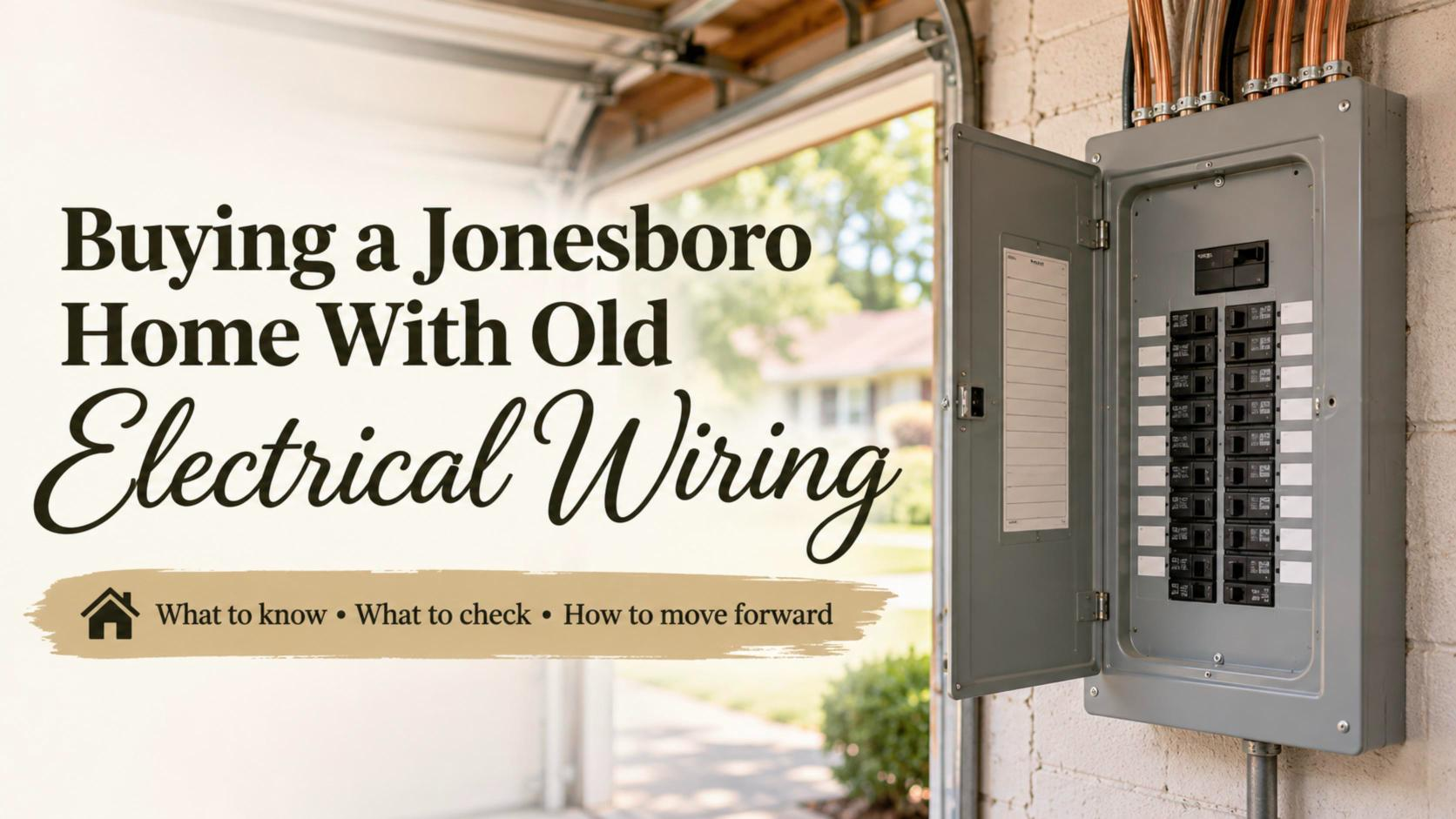
Buying a Jonesboro Home With Old Electrical Wiring
Should you buy a Jonesboro home with old electrical wiring or an outdated panel?
Often yes, if a licensed electrician evaluates it during your inspection period and you negotiate repairs, a credit, or price. Check the wiring type, panel, and insurance first.
Old wiring shows up in more Jonesboro showings than most buyers expect, and it rarely announces itself. The house looks fine, the lights turn on, and then the inspector opens the panel.
At NEA Realtor Group, Trenton Hoggard and Tim Ray help Jonesboro buyers sort out which electrical findings are routine and which ones deserve a real conversation with the seller. If you are also weighing other age-related issues, our guide to buying an older Jonesboro home covers the rest of the checklist.
Here is how to handle outdated electrical systems once you are serious about a house, from the showing to the closing table.
What “Old Wiring” Actually Means
“Old wiring” is not one problem. It is a handful of different ones, and each calls for a different response. These are the ones inspectors and electricians talk about most:
- Knob-and-tube wiring: An early system that, according to a home-inspection expert quoted by Redfin, was used from about 1880 into the 1940s. It can pose fire risks if it has been altered or buried in insulation.
- Single-strand aluminum branch wiring: The same Redfin source notes this was sometimes used from 1965 to 1973. The concern is at the connections (outlets, switches, and splices), not the wire itself.
- Fuse boxes and undersized panels: A panel that was sized for a smaller house with fewer appliances can struggle with modern electrical demand.
- Certain older panel brands: Inspectors often flag specific older panel brands and recommend an electrician take a closer look. Your inspector will tell you if the panel in your house is one of them.
- Two-prong, ungrounded outlets: Common in older homes and sometimes “fixed” with three-prong adapters that do not actually provide a ground.
- Add-on work: Garage outlets, finished basements, and room additions wired by someone other than a licensed electrician.
Not every one of these is a deal-breaker. Some are a quote and a negotiation. A few are a reason to walk away. The goal is to find out which one you are dealing with while you still have options.
What You Can Notice Before You Even Make an Offer
You are not expected to diagnose wiring at a showing. But a few observations are worth writing down and mentioning to your agent.
- Outlets with only two slots, or a mix of two-prong and three-prong outlets in the same room
- Switch plates or outlets that feel warm, look discolored, or buzz
- Extension cords and power strips doing the job outlets should be doing
- A panel cover that is dented, rusted, scorched, or missing screws
- Handwritten, missing, or confusing labels inside the panel door
- Lights that flicker or dim when a major appliance kicks on, if the seller mentions it or you notice it
The Electrical Safety Foundation International recommends an electrical inspection when a home is 40 or more years old, when it has had major renovations or new major appliances, and for anyone who is the new owner of a previously owned home. It also lists warning signs such as frequently tripping breakers, flickering lights, sparks, and unusual buzzing or sizzling sounds.
That list is a good filter. If the seller says the breakers trip all the time, treat that as information, not as a quirk.
Your Game Plan After the Offer Is Accepted
Once you are under contract, the clock matters more than anything else. The inspection period in your contract is when you have the most leverage, so use it on purpose.
1. Book the inspection early
A standard single-family inspection in Northeast Arkansas typically runs about $500 to $1,000, with larger homes and add-on services pushing higher. That is small compared to the cost of finding out about a panel problem after closing.
2. Ask for an electrician’s evaluation if anything electrical is flagged
A general home inspector looks at the whole house. When the report says “recommend evaluation by a licensed electrician,” take that literally and schedule it right away. Ask the electrician for a written scope of work and a price, not just a verbal opinion. A written quote is what you will use to negotiate.
3. Call your insurance agent now, not later
Do this before your inspection period ends. Tell your agent what the inspector found and ask whether the company has questions or requirements about the wiring or panel. Some insurers may ask about the age of the electrical system or request updates, and you want that answer while you can still negotiate. Our post on homeowners insurance before closing in Jonesboro explains the timing.
4. Ask your lender if the loan type matters
Appraisers working on certain government-backed loans may note safety hazards such as exposed wiring or open panel openings, and lenders can have their own requirements. Whether your file is affected depends on the loan program and the lender, so ask your loan officer directly and in writing.
What to Ask the Seller For
When the inspection or electrician finds a real problem, you generally have four paths. None is automatically right. The best one depends on the size of the problem, your budget, and how much you like the house.
- Repairs before closing: The seller hires a licensed electrician to fix the issue. Ask for the invoice, any permit paperwork where it applies, and a contract line that says the work is completed to the electrician’s standard.
- A credit at closing: The seller gives you money toward closing costs so you can handle the work yourself after you own the house.
- A price reduction: The price comes down to reflect what the work will cost. Because the loan amount drops, this can also lower your monthly payment.
- A combination: For example, the seller fixes the urgent items and gives a credit for the rest.
If the seller refuses to engage, you still have the option to walk away within your inspection period. That option is why scheduling matters. Put your request in writing, tie it to the electrician's quote, and send it inside the inspection period.
A note on repair versus credit
With the average 30-year fixed rate at 7.18% as of November 5, 2026, according to Freddie Mac, the way you structure a concession affects your monthly payment. Ask your lender to run both versions, a repair or credit and a price reduction, so you compare real numbers instead of guessing.
How Much Negotiating Room Is There in Jonesboro?
No data tells you what any single seller will accept. But the broad picture is useful. Based on NEABOR MLS closed sales over the past 12 months, Jonesboro homes sold at about 97% of the original list price, with a median of roughly 34 days on market. About two out of three sold below their original list price.
That tells us negotiation is a normal part of Jonesboro deals, and that sellers who have already watched a house sit are often open to a fair, well-documented request. It does not promise a discount on your house. A request backed by an electrician’s written quote is stronger than one that just says “the wiring is old.”
Mistakes We See Buyers Make
- Skipping the electrician follow-up. The inspector flags it, the buyer assumes it is fine, and the question never gets answered.
- Waiting on insurance. Finding out after the inspection period that coverage is complicated leaves you with fewer choices.
- Accepting “it has been fine for 50 years.” A long history without a problem is not the same as a safe system.
- Taking on DIY fixes. Panel and branch-circuit work belongs with a licensed electrician.
- Treating the seller’s verbal promises as the deal. If a repair or credit is agreed, it should be in writing in the contract amendment.
- Making the request too late. Repair requests have to land inside the inspection period to carry weight.
When Old Wiring Is a Reasonable Buy, and When to Walk Away
Plenty of buyers purchase houses with older electrical systems and are happy with them. It tends to work out when:
- A licensed electrician has evaluated the system and put the scope and cost in writing
- The seller agrees to repairs, a credit, or a price change that fits the findings
- Your insurance agent has confirmed coverage terms you can live with
- Your lender has no problem with the findings for your loan type
It is worth stepping back when the problem is bigger than the house is worth to you, when the seller will not negotiate at all, or when the insurance answer is a dealbreaker. Walking away from a house you love is hard, but it is much easier before closing than after.
Frequently Asked Questions
Q: Is it safe to buy a Jonesboro home with aluminum wiring?
It can be, but it needs attention. The concern is typically at the connection points, so ask a licensed electrician to evaluate the home and tell you what repairs are appropriate before your inspection period ends.
Q: Can I ask the seller to replace an old electrical panel?
Yes, you can ask. Panel replacement is a common request when an inspector or electrician recommends it, and the seller can agree to a repair, a credit, or a price change. Everything agreed should be written into the contract.
Q: Will old wiring affect homeowners insurance in Jonesboro?
It might. Some insurers ask about wiring and panel details or may require updates. The safest move is to give your agent the inspection findings and get an answer before your inspection period ends.
Q: Do I need an electrician if the inspection report only mentions it briefly?
If the report recommends further evaluation, plan on it. A short note in a long report can still describe a significant repair, and you need the written scope before you negotiate.
Found Wiring Questions in Your Inspection?
If you are buying in Jonesboro or anywhere in Northeast Arkansas, Trenton Hoggard and Tim Ray can help you decide what to ask for and how to word it before your inspection period runs out. Our team has earned 5-star reviews and is the #1 real estate team in the Northeast Arkansas MLS by production. Start with our buying a home guide or call us directly. Call or text us at 870-273-0633.
Connect with NEA Realtor Group