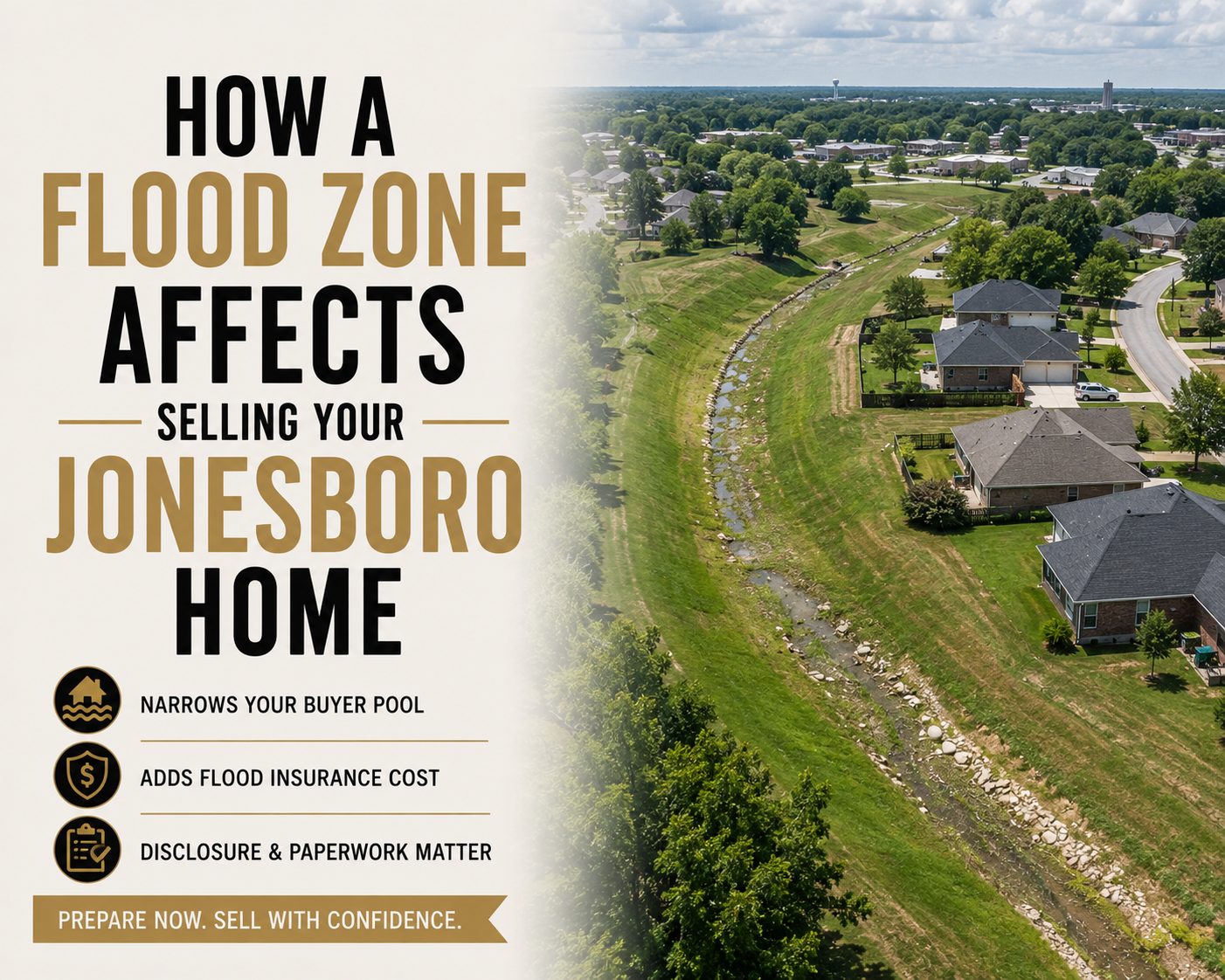
How a Flood Zone Affects Selling Your Jonesboro Home
Can you sell a home in a flood zone in Jonesboro?
Yes. A flood zone does not stop a sale in Jonesboro, but it narrows your buyer pool, adds a required insurance cost to every financed offer, and rewards sellers who gather the paperwork before listing instead of after.
You pulled your address up on a flood map, or your insurance agent mentioned it, or a neighbor told you their lender made them buy a policy. Now you are about to list and you want to know how much this is going to cost you.
Here is the short version. Being in a mapped flood zone is a real factor in a Jonesboro sale, but it is a manageable one, and most of the damage sellers take from it is self-inflicted. It comes from finding out too late, having no answers ready, and letting a buyer discover it on their own two weeks before closing.
Trenton Hoggard and Tim Ray have listed homes on both sides of this line across Craighead County, and the pattern is consistent: the sellers who handle the flood question up front lose very little, and the ones who ignore it lose a buyer. This is what you need to know before your home goes on the market.
First, Find Out Exactly Which Zone You Are In
"Flood zone" is not one thing. The difference between the labels is the difference between an annoying disclosure and a required insurance policy on every financed offer you get.
FEMA maps sort property into a few broad buckets:
- Zones A, AE, AH, AO, and AR. These make up the Special Flood Hazard Area, the high-risk designation. If your buyer uses a federally backed loan, their lender is required to make them carry flood insurance. This is the zone that actually changes your sale.
- Zones X (shaded) and B. Moderate risk. No insurance requirement from the lender, and coverage is usually inexpensive if the buyer wants it anyway.
- Zones X (unshaded) and C. Minimal risk. Nothing required, nothing to work around.
You can look your address up for free at the FEMA Flood Map Service Center. The City of Jonesboro also runs a floodplain management office, and Craighead County has a floodplain manager, both of whom can tell you what the current effective map shows for a specific parcel.
One thing that surprises people here: the zone applies to the structure, not just the lot. It is common in Northeast Arkansas for a back corner of a property to sit in a mapped floodplain while the house itself sits well above it. That distinction is worth confirming before you assume the worst, because it changes the answer for lenders.
Why Jonesboro has this issue at all
Jonesboro sits on Crowley's Ridge, which drains east and west into the flat Mississippi Alluvial Plain. Water leaves the ridge fast and then has nowhere to go once it hits the low ground.
That is why flood mapping in Craighead County can look scattered. You will see two houses on the same street with different answers, and a subdivision built in the 1970s that carries a designation the one behind it does not. It tracks drainage and elevation, not neighborhood lines.
What It Actually Does to Your Buyer Pool
This is the part that matters to your bottom line. A high-risk designation does three things to the people looking at your house.
It adds a monthly cost to their loan approval. Required flood coverage gets folded into the payment the lender qualifies them on, right alongside taxes and homeowners insurance. A buyer stretching to the top of their approval can get pushed out of your price range by that line item alone. Some do not find out until underwriting.
It removes buyers who simply will not consider it. A share of the market screens out anything in a mapped floodplain regardless of the numbers. You will not convince them, and it is not worth trying.
It adds a step that can delay closing. Flood coverage has to be bound before closing, and a buyer who starts shopping for it late can push your date. Our post on what flood insurance costs Jonesboro buyers covers what your buyer will be walking through on their end.
What it does not do is kill your sale. Homes in mapped zones sell in Craighead County every month. They sell to buyers who understand the cost, and increasingly to cash buyers who skip the lender requirement entirely.
Your Existing Flood Policy Might Be Worth Real Money
This is the single most overlooked seller advantage in a flood zone sale, and almost nobody brings it up.
If you already carry a National Flood Insurance Program policy, that policy can usually be transferred to your buyer at closing. The industry term is a policy assumption. The buyer takes over your existing policy instead of writing a brand new one.
Why that matters: under FEMA's current Risk Rating 2.0 pricing approach, older policies are moving toward their full-risk cost gradually, capped at an annual increase, rather than jumping there all at once. A new policy written from scratch starts at the full-risk number. An assumed policy keeps the seller's place on that gradual path.
On some properties the gap between those two figures is large enough to change whether a buyer qualifies. Handing a buyer a transferable policy is a genuine concession that costs you nothing.
A few things to check before you promise it:
- The policy has to be an active NFIP policy that has not lapsed. Let it lapse and the advantage is gone permanently.
- Private flood policies generally do not transfer the same way. Confirm which kind you have.
- Your insurance agent handles the paperwork, and it needs to be started well before closing, not the week of.
If you have a policy, pull the declarations page now and have it ready. It is one of the strongest pieces of paper you can hand a buyer's agent.
What You Have to Tell Buyers in Arkansas
Arkansas does not require sellers to fill out a standard condition disclosure form. That surprises people who have sold in other states.
What Arkansas does not allow is fraud, misrepresentation, or actively concealing a known problem. If a buyer asks whether the house has ever taken water and you say no when it has, that is a different situation entirely, and it does not go away at closing.
There is also a rule on our side of the table. Arkansas Real Estate Commission Regulation 10.6 requires a licensed agent to make reasonable efforts to learn facts material to a property's value so the agent does not misrepresent it. In practice, that means your listing agent is going to ask you about water history, and should.
Our advice is simpler than the legal framework: disclose it in writing, early, in your own words. A seller who says "the lot's back third is in Zone AE, the house has never taken water in the nineteen years we have owned it, and here is the flood policy" is in a far better position than one who says nothing and gets asked in week three.
Buyers do not walk away from flood zones nearly as often as they walk away from feeling misled.
Two Ways to Change the Answer Before You List
Sometimes the map is simply wrong about your house. There are two established ways to deal with that, and both take time, which is why they belong in your pre-listing plan and not in your under-contract scramble.
An elevation certificate
A licensed surveyor documents the elevation of your lowest floor relative to the base flood elevation for your area. If your house sits above that line, the certificate proves it.
That document can substantially lower what a buyer pays for required coverage, which directly helps their loan approval. Plan on a several-hundred-dollar surveying fee and a few weeks of lead time depending on how busy local surveyors are.
A Letter of Map Amendment
If the elevation certificate shows your structure is naturally above the base flood elevation, you can apply to FEMA for a Letter of Map Amendment, usually called a LOMA. If FEMA grants it, the structure is formally removed from the high-risk area and the lender's insurance requirement goes away.
FEMA does not charge a fee to review the application. You pay for the survey work that supports it. Processing takes time, so this is a several-month project, not a two-week one.
A LOMA in hand is the strongest possible answer to the flood question. If you have any reason to think your house sits high on the lot, it is worth pricing out a survey before you list rather than accepting a discount you did not have to take.
How to Price It Honestly
There is no fixed percentage to subtract for a flood zone. Anyone who gives you one is guessing.
What actually determines the number is narrower than that: what required coverage costs on your specific structure, whether the house has a flood history, and how many comparable homes outside the zone a buyer could choose instead at your price.
Pricing this well takes real comparable sales, and in Jonesboro that usually means pulling from the last 90 to 180 days rather than 30 to 60. Our sales volume is lower than a metro market, and the pool of recent flood-zone sales is smaller still. A short comp window here produces a confident-looking number built on almost nothing. Our walkthrough of how we price a Jonesboro home covers how that analysis is built.
Two adjustments we would push back on:
- Discounting for the lot when the house is clear. If only the rear acreage is mapped and the structure is not, the lender requirement may not even apply. Confirm before you price around it.
- Discounting twice. If you cut the price and offer closing cost help toward the buyer's first year of coverage, you have paid for the same objection two ways. Pick the one that moves your buyer.
Rates matter here too. With the 30-year fixed sitting in the mid sixes according to Freddie Mac's weekly survey, buyers are already at the edge of their payment comfort. An added insurance line item lands harder in this rate environment than it did five years ago. That argues for solving the cost problem with documentation instead of price wherever you can.
How We List a Flood Zone Home
Our approach is to answer the question before it gets asked. When we take a flood zone listing in Jonesboro, we do the following before it goes live:
- Confirm the current effective zone for the structure, not just the parcel, and get it in writing.
- Pull your existing flood policy declarations page and confirm with your agent whether it can be assumed.
- Decide together whether an elevation certificate or a LOMA is worth pursuing before listing.
- Write the flood facts into the listing and the disclosure package so every showing agent has them on day one.
- Run our dedicated direct mail campaign for the listing, which we do for every home we take on, to reach buyers and neighbors the portals will not.
- Screen incoming offers for whether the buyer's lender has already accounted for the insurance cost in their approval.
That last one saves more deals than anything else on the list. An offer from a buyer whose pre-approval never included flood coverage is an offer that falls apart in underwriting, and it is better to catch that on day one than on day twenty-five.
Frequently Asked Questions
Q: Do I have to buy flood insurance to sell my Jonesboro home?
No. The requirement falls on the buyer's lender, not on you as the seller. That said, if you already carry an NFIP policy, keeping it active through closing is usually worth it, because a lapsed policy cannot be transferred to your buyer.
Q: Will an appraiser lower my value because of the flood zone?
An appraiser notes the flood zone but does not apply an automatic deduction. Any adjustment has to be supported by comparable sales showing the market actually pays less. In Craighead County, where flood zone sales are relatively few, that support is often thin, so the adjustment is frequently smaller than sellers fear.
Q: My house has never flooded. Does that help?
It helps with buyers and it is worth documenting, but it does not change the lender requirement. Insurance is tied to the mapped zone, not to your claim history. If you want the requirement itself removed, the path is an elevation certificate and a Letter of Map Amendment.
A flood zone is a solvable problem when you start early. It becomes an expensive one when a buyer finds it before you address it.
For perspective on who you are asking: NEA Realtor Group holds 5-star reviews across Northeast Arkansas and is the #1 real estate team in the Northeast Arkansas MLS by production. We have sold homes in these zones, and we will tell you straight what yours is likely to cost you and what it is not.
Not Sure What Zone Your Home Is In?
Trenton Hoggard and Tim Ray with NEA Realtor Group will pull your flood zone, review your existing policy, and tell you whether an elevation certificate is worth the money before you list anywhere in Jonesboro or Northeast Arkansas.
Connect with NEA Realtor Group
:format(webp):quality(80)/u.realgeeks.media/neahomesearch/team_sidebar.jpg)
:format(webp):quality(80)/u.realgeeks.media/contentcodes2/arrow.png)
:format(webp):quality(80)/u.realgeeks.media/neahomesearch/Market-Report-3.png)