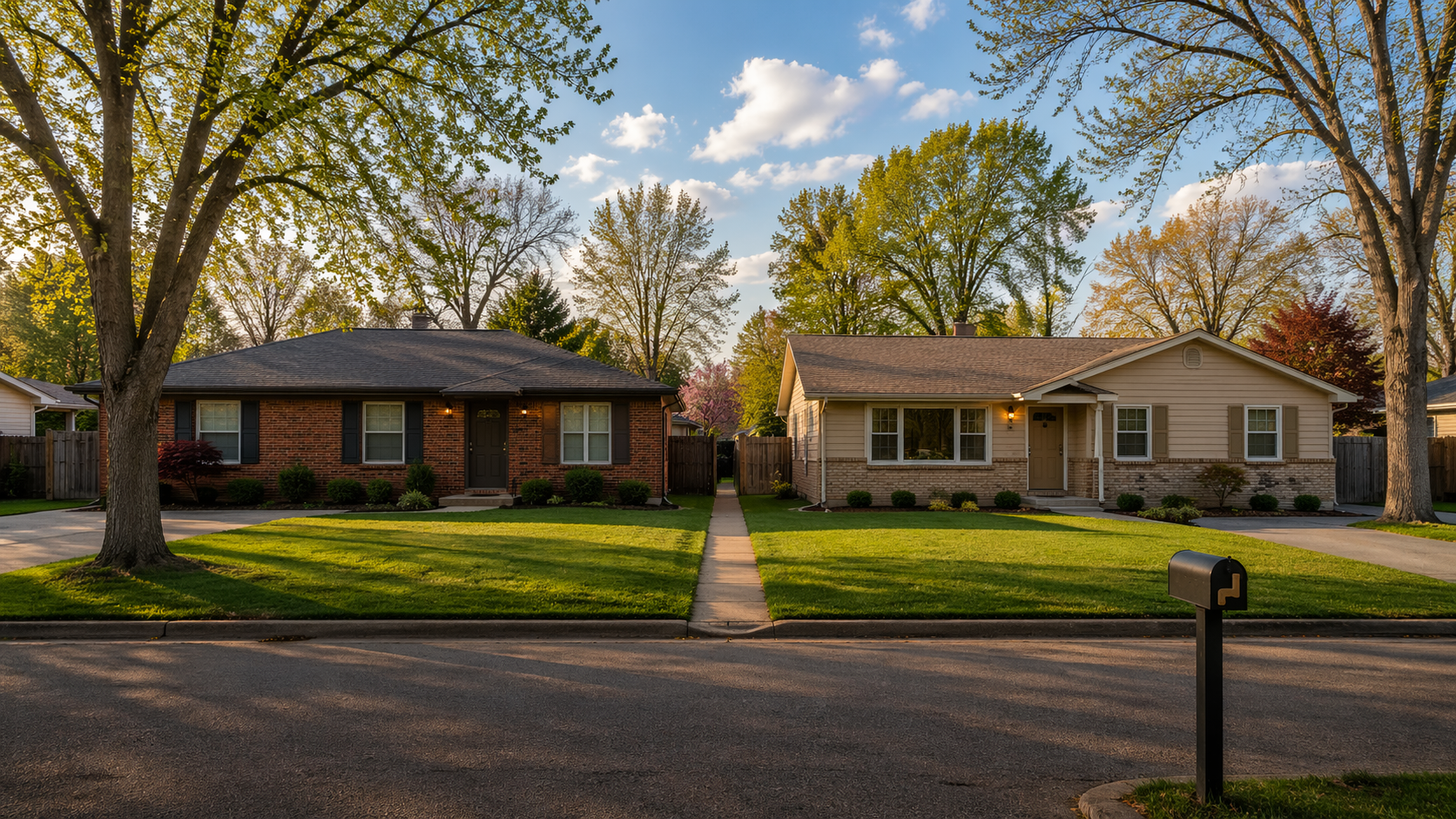
How to Choose Between Two Homes in Jonesboro
How do you decide between two Jonesboro homes when both feel right?
Compare them on five things that matter long after moving day: non-negotiables, total cost of ownership, condition, resale, and daily life fit. The best home in Jonesboro is the one that still fits you in year three, not just in showing number two.
Most buyers in Jonesboro do not expect to end up with two homes on their shortlist at the same time. Then it happens, and both feel like a real option. You start running the same loop in your head: square footage on one, yard on the other, kitchen here, commute there.
This post is the framework Trenton Hoggard and Tim Ray use with NEA Realtor Group buyers when two Jonesboro or Northeast Arkansas homes come down to the wire. It is designed to pull the decision out of your head, put it on paper, and get you to an offer with less second-guessing.
One quick context note on the local market. According to Redfin's March 2026 Jonesboro data, the median sale price sits near $215,000 with homes averaging about 77 days on market and prices down 1.6 percent year over year. Translation: inventory is loosening enough that some buyers now have real options, which is exactly why this "two homes, one decision" scenario is more common this spring than it was two years ago. If you want a deeper walk through what is on the market right now, start with our Jonesboro buyer resources.
Start with your non-negotiables, not your favorites
Before you compare the homes, compare them against your own list. Your gut is loud right now. Your list is not. Get the list back in front.
Write down three columns on one sheet of paper:
- Must-have: Things you will not compromise on. Bed count, bath count, a garage, a fenced yard, single-story, a home office, a specific neighborhood or side of town.
- Strongly want: Things you would trade money or timeline for, but could live without for a year.
- Nice-to-have: Things you would enjoy, but would not rank a home higher because of.
Now score each home against the list. If one home misses a must-have and the other does not, you already have an answer. The single biggest regret we see is buyers promoting a "strongly want" into a "must" because the other home happened to have it. That is not decision-making. That is feature FOMO.
If both homes clear every must-have, the decision moves to the next four filters.
Compare total cost of ownership, not just list price
The list price is the headline. It is almost never the real number.
Build a one-page cost sheet for each home with:
- Projected final sale price after negotiation (list is a starting point, not a finish line).
- Estimated principal and interest at current market rates. The Freddie Mac Primary Mortgage Market Survey updates rates weekly.
- Property taxes based on the Craighead County assessment for each home.
- Homeowners insurance estimate (age of roof and age of home drive this heavily in Northeast Arkansas).
- HOA dues, if any.
- Utility averages. A 2,400 square-foot all-electric home with a 20-year-old HVAC will run very differently than an updated 1,800 square-foot home with newer systems.
- Known near-term capital items: roof, HVAC, water heater, driveway, windows.
Two homes listed $10,000 apart can have a five-year total cost difference of $25,000 or more once you bake in the roof that has two years left, the insurance cost on a 1988 build, and the electric bill on an older heat pump. Compare those numbers, not the MLS prices.
If the cost picture is close, move to condition.
Look hard at condition and near-term work
Two homes that show well on a Saturday afternoon can have very different five-year work lists. Before you get attached, walk each home a second time with your head out of the aesthetics.
Look specifically at:
- Roof age and condition. Ask for the age. Look for cupping, granule loss, and any patching.
- HVAC. Age of the indoor and outdoor units. Check the sticker, not just the listing sheet.
- Water heater. 10 to 12 years is typical useful life.
- Plumbing. Polybutylene, galvanized, or any mix of materials is worth flagging.
- Electrical panel. Older panels with known issues cost real money and affect insurance.
- Windows and doors. Original single-pane windows on a 1970s Jonesboro home can be a $10,000 to $20,000 future line item.
- Grading and drainage. In parts of Craighead County, a flat backyard and a downhill neighbor behind you can turn into a wet basement or crawl space issue after a single spring storm.
If one home has a recent roof, an HVAC installed inside the last five years, and fresh windows, and the other has not been updated since the Bush administration, the "same" $220,000 price tag is not actually the same deal.
Your pre-offer walkthrough notes from this stage also become useful later if you go under contract and negotiate the inspection.
Think past move-in day: resale and five-year fit
Most Jonesboro buyers stay in a home longer than they expect. National Association of Realtors data shows the typical homeowner tenure has stretched well past ten years nationally, and we routinely see five to seven years locally before a next move.
The question is not "can I see myself in this house in June?" The question is "what is this house going to be worth to the next buyer when I leave, and does that version of me still like this house in year five?"
Ask:
- Is the floor plan broad appeal, or is it quirky in a way that narrows future buyers? Walk-through kitchens, 3-bedroom, 2-bath, two-car garage setups sell to the widest pool in Jonesboro.
- Is the lot something future buyers will want, or will they fight it? Busy road frontage, ditch adjacency, or a sharp corner lot can matter later.
- Is the location a direction Jonesboro is growing toward, or away from?
- Does the home have at least one real differentiator (updated kitchen, covered patio, extra garage bay, true primary suite) that you will enjoy and that a future buyer will pay for?
A home you love that is hard to sell later is still hard to sell later. Build the resale lens in on the way in, not on the way out. Our team tracks neighborhood-level sell trends every week on the NEA Realtor Group weekly market updates, and those same trends point buyers toward the more resilient pocket when two homes are otherwise tied.
Test daily life, not the tour version
A showing is a highlight reel. Your daily life is a long, boring sequence of driveways, dishwashers, and Tuesday mornings. Pressure-test each home against the real routine.
Before you make a decision, we recommend buyers in Jonesboro and surrounding Northeast Arkansas towns do a few cheap, fast checks:
- Drive the commute at the actual time. A 7-minute drive on a Sunday is not the same as a 7:45 a.m. drive to work, clinic, or St. Bernards.
- Visit at night. Lighting, street noise, and neighbor patterns tell the truth after dark.
- Walk the block. How are the surrounding homes kept up? Do you feel good walking it?
- Check your daily errands. Grocery, gas, gym, coffee, hardware store. Look at the real distance, not just the map.
- Test cell service. Some older neighborhoods in NEA still have dead zones that never show up on any listing.
When buyers regret a home six months in, it is almost never the paint color or the kitchen backsplash. It is the commute, the lot they talked themselves into, or the noise they only heard after they slept there.
When you are still tied: how to break the tie
Sometimes both homes really are close. In that case, use a short set of tie-breakers in this order.
1. Which home has the better price position on the street?
In Jonesboro and NEA, comps typically need to pull from the last 90 to 180 days because of lower transaction volume, so a tight comp read matters. If one home is priced below the best recent sales on the block and the other is priced above, the math tells you which one likely appraises cleaner and resells easier.
2. Which home's seller is more motivated?
Days on market, price history, estate or relocation language in the listing, a vacant home, two recent price changes. Motivation translates to negotiation room on price, repairs, and closing costs.
3. Which home has the less risky inspection profile?
If both homes are similar age but one has a visible moisture stain near the back door, guess which one is more likely to blow up your deal three weeks in.
4. Which home would hurt more to lose?
This is the last question, not the first. If after all of the above you still cannot separate them, the one you will be more upset to see go under contract tomorrow morning is usually the right one. Write the offer on that one.
Common traps to avoid
- Anchoring on one feature. A pool, an oversized garage, or a finished bonus room can quietly rewrite your whole list. Check the feature against your "must-have" column before you let it drive.
- Comparing a renovated home to an unrenovated home at the same price. They are not the same price. Add the renovation budget to the unrenovated home before you compare them.
- Falling for furniture. Staging is designed to sell. Mentally strip the rooms to empty before you judge the space.
- Waiting too long. Even in a balanced Jonesboro market, a well-priced home in an active price band can go under contract in a week. You do not need to rush, but you do need to decide.
Frequently Asked Questions
Q: How long can I take to decide between two homes in Jonesboro right now?
With Jonesboro averaging about 77 days on market per recent Redfin data, there is usually more breathing room than a national headline suggests. That said, well-priced homes under $250,000 still move quickly. We typically tell buyers to decide within 24 to 72 hours of their second showing while the details are fresh and before another buyer writes.
Q: Should I write offers on both homes and take the better response?
No. A real offer is a signed contract subject only to contingencies, and writing parallel offers you do not intend to close is a fast way to burn earnest money, damage your credibility with listing agents, and get yourself in legal gray area. Pick one, write strong, and use the other as your honest back-up.
Q: What if the inspection changes which home looks better?
That is exactly what the inspection is for. If Home A goes under contract and the inspection reveals a problem you did not expect, you can negotiate repairs, credits, or a price adjustment, or you can walk and revisit Home B if it is still available. The framework above is for choosing where to put your first offer. The inspection is the reality check on that choice.
Q: Does a seller know I am choosing between their home and another one?
Usually not, and that is by design. Your agent's job is to represent you, protect your position, and keep your alternatives confidential. That leverage is part of why you want someone in your corner when two strong options are in play.
For perspective, NEA Realtor Group holds dozens of 5-star reviews and is the #1 real estate team in the Northeast Arkansas MLS by production, so we have walked this two-home decision alongside a lot of local buyers. If you are weighing two and want a second set of eyes on the comps, condition, and offer strategy, we are happy to help.
Weighing two Jonesboro homes? Let's walk through them together.
Trenton Hoggard and Tim Ray, NEA Realtor Group, work with Jonesboro and Northeast Arkansas buyers every week on exactly this decision. We will run the comps, flag the condition risks, and help you put the strongest offer on the right home. Call or text us at 870-273-0633.
Connect with NEA Realtor Group
:format(webp):quality(80)/u.realgeeks.media/neahomesearch/team_sidebar.jpg)
:format(webp):quality(80)/u.realgeeks.media/contentcodes2/arrow.png)
:format(webp):quality(80)/u.realgeeks.media/neahomesearch/Market-Report-3.png)