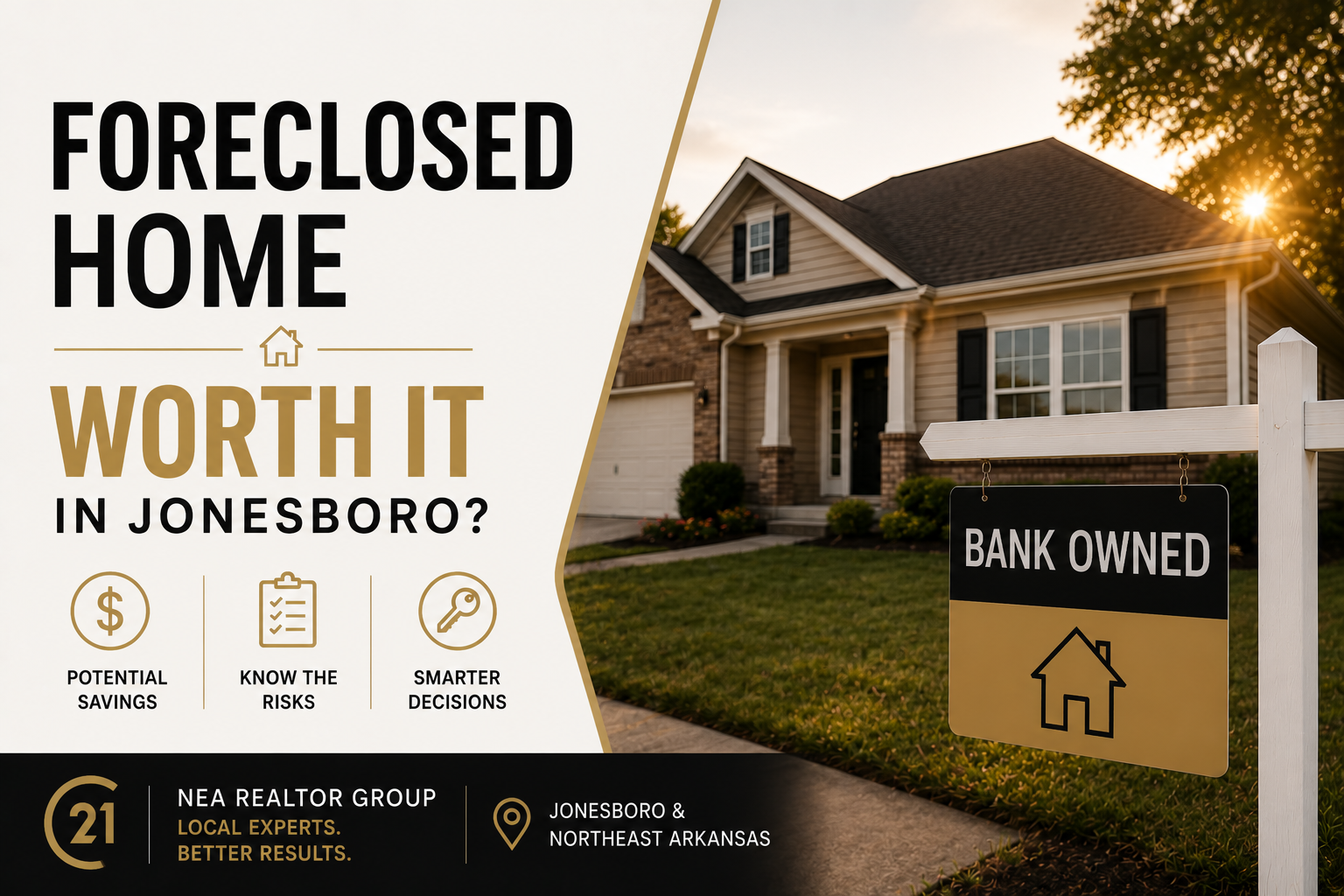
Is Buying a Foreclosed Home in Jonesboro Worth It?
Is buying a foreclosed home in Jonesboro worth the savings and the risk?
Bank-owned homes often sell below market value, and that discount can be real in Jonesboro. But as-is condition and financing hurdles mean it is not the right move for every buyer.
Foreclosure activity just hit its highest point in years nationally, and if you have been house hunting around Jonesboro, you may have noticed a bank-owned listing mixed in with the usual inventory. Trenton Hoggard and Tim Ray field the "is this a good deal or a trap" question every time foreclosure headlines pick up, and the honest answer is that it depends on the property and on you.
A foreclosed home can save you real money in Northeast Arkansas. It can also cost you more than you saved if you buy the wrong one for the wrong reasons.
Here is what actually changes when the home you are considering came from a bank instead of a homeowner, and how to decide whether it is worth pursuing.
What "Foreclosure" Actually Means for a Jonesboro Buyer
The word gets used loosely, but a foreclosed home can mean a few different things depending on where it sits in the process.
- Pre-foreclosure: The homeowner is behind on payments but still owns the home. This sometimes leads to a short sale, where the lender agrees to accept less than what's owed.
- Auction sale: The property is sold at a courthouse sale, typically to cash buyers only, with no inspection period and no guarantee of clear title. This route is rare for a typical owner-occupant buyer.
- REO (bank-owned): The lender took the home back and now owns it outright. Most REO homes get listed for sale through an agent, on the MLS, just like any other Jonesboro listing.
When most buyers say they want to "buy a foreclosure," they mean an REO listing. It shows up in a normal home search, you tour it and make an offer like any other house, and the seller just happens to be a bank instead of a family.
Why Foreclosures Are Suddenly Back in the Conversation
This is not a 2008-style story, but the numbers are moving. According to a July 2026 report from Realtor.com, based on data from ATTOM, there were more than 227,000 U.S. properties with foreclosure filings in the first half of 2026, up 21% from the same period a year earlier.
Put in context, that is still only about 0.16% of all homes nationally, far below the levels seen after the 2008 financial crisis, when foreclosure activity ran five to seven times higher than today. The average foreclosure is also moving faster through the process, about 563 days in the first half of 2026, the shortest timeline since 2013.
The National Association of Realtors reported that distressed sales, meaning foreclosures and short sales combined, made up about 2% of existing home sales nationally in June 2026, up slightly from the month before but still a small slice of the overall market. Mortgage rates have not moved much either. Freddie Mac's most recent survey put the 30-year fixed rate at 6.49% as of July 9, 2026, which keeps financing math roughly where it has been for months.
Read together, the honest summary is that foreclosure activity is normalizing back toward pre-pandemic patterns rather than signaling a crash. Locally, that has meant a handful more bank-owned listings showing up around Jonesboro and more buyers asking whether one is worth pursuing.
The Real Discount, and the Real Risk
The same Realtor.com analysis found that REO properties accounted for about 1.3% of all active listings nationally in April 2026, and the median REO home sold for 27.2% less than its estimated value. That is a meaningful discount.
It comes with a catch. Despite drawing more online interest than typical listings, REO homes linger on the market about 11 days longer on average, largely because they are sold as-is and often need work.
In Arkansas, a bank seller is not required to complete the same seller disclosures a typical homeowner provides. What you see, and what your inspector finds, is what you get. That makes a few steps non-negotiable:
- Budget for a full professional inspection. In Northeast Arkansas, plan on $500 to $1,000 for a standard single-family home, more if it is larger or you add radon, sewer scope, or well and septic testing.
- Have a title company run a full title search. Banks do not always clear every lien before selling, and unresolved liens can follow the property to you.
- Ask how long the home sat vacant. A house that went unattended through a winter or two is more likely to have plumbing, roof, or foundation surprises.
- Get a real repair estimate before you fall in love with the price. A steep discount on paper can disappear fast once a contractor walks the home.
- Expect a slower response from the seller. A bank asset manager, not a homeowner, approves offers and repair requests, and that chain of approval can add days or weeks to negotiations that would otherwise move quickly.
How Buying a Foreclosure Is Different From a Normal Jonesboro Purchase
The offer and closing process looks familiar on the surface, but a few pieces work differently with a bank as the seller.
Financing has its own rules
FHA, USDA, and VA loans all require the home to meet minimum property condition standards at appraisal. A foreclosure with a failing roof, missing HVAC system, or safety hazards may not qualify for a standard loan until repairs happen first. That is where a renovation loan, one that rolls purchase and repair costs into a single mortgage, can make an otherwise unfinanceable home workable. We covered how that works in more detail in our guide to buying a fixer-upper in Jonesboro.
The bank writes its own rules on earnest money
In Northeast Arkansas, the majority of home purchases do not include any earnest money at all, and when buyers do put earnest money down, $1,000 is the most common figure. Banks selling foreclosures tend not to follow that local custom. Expect the bank's own purchase addendum to set its own earnest money requirement and its own tight deadlines, often non-negotiable. Read that addendum closely before you sign.
The termite letter still applies
Arkansas requires a termite letter for nearly every financed purchase in Jonesboro, foreclosure or not. We break down exactly when it is required, and the narrow exceptions, in our termite letter guide for Jonesboro buyers.
Pricing still needs a real comp check
A bank's asking price is not always tied to current market conditions. Pull recent comps off a realistic 90 to 180 day Jonesboro window, the range we typically use given our lower sales volume, before deciding what the home is actually worth to you.
Should You Pursue One, or Stick With a Traditional Listing?
A foreclosure tends to make sense if you have cash or renovation financing lined up, some flexibility on your move-in timeline, and the stomach for repair work. Investors and buyers on investment properties are often the best fit for exactly this reason.
It tends to make less sense if you are working with a firm move date, relying on standard financing without room for repairs, or hoping for a turnkey first home. In those cases, a traditionally listed home in the same price range in Jonesboro may get you to closing with far less stress.
Before you chase the discount, walk the property with an agent and, ideally, a contractor. Run the real repair numbers against the savings, then compare that total to what a similar move-in ready home would actually cost you.
It also helps to think about your own timeline honestly. Renovation loans and bank-owned closings both tend to move slower than a standard purchase, since there are extra inspections, contractor bids, or bank approvals layered into the process. If you need to be in a home within a few weeks, a foreclosure is rarely the fastest path, even with a strong discount attached to it.
Frequently Asked Questions
Q: How do I find foreclosed or bank-owned homes for sale in Jonesboro?
Most REO homes are listed on the MLS just like any other home and show up in a normal search when you work with an agent. Courthouse auction properties are handled separately, require cash, and skip the inspection period entirely, so that route deserves extra caution.
Q: Can I use an FHA, USDA, or VA loan on a foreclosed home in Jonesboro?
Often, yes, but the home has to meet minimum property standards at appraisal. If it needs major repairs first, a renovation loan that rolls those costs into the mortgage is usually the better path.
Q: Do I still need a termite letter if I am buying a bank-owned home in Jonesboro?
Yes. Arkansas requires a termite letter for nearly every financed purchase, foreclosure or not. The only real exceptions are an in-house bank loan or a cash purchase.
For perspective, NEA Realtor Group carries 5-star reviews and stands as the #1 real estate team in the Northeast Arkansas MLS by production, and we walk buyers through exactly this kind of decision regularly.
Thinking About a Jonesboro Foreclosure?
Before you write an offer on a bank-owned home, let us walk it with you, pull the real comps, and help you weigh the discount against the repairs. Trenton Hoggard and Tim Ray with NEA Realtor Group are ready to help you decide if it is the right move.
Connect with NEA Realtor Group
:format(webp):quality(80)/u.realgeeks.media/neahomesearch/team_sidebar.jpg)
:format(webp):quality(80)/u.realgeeks.media/contentcodes2/arrow.png)
:format(webp):quality(80)/u.realgeeks.media/neahomesearch/Market-Report-3.png)