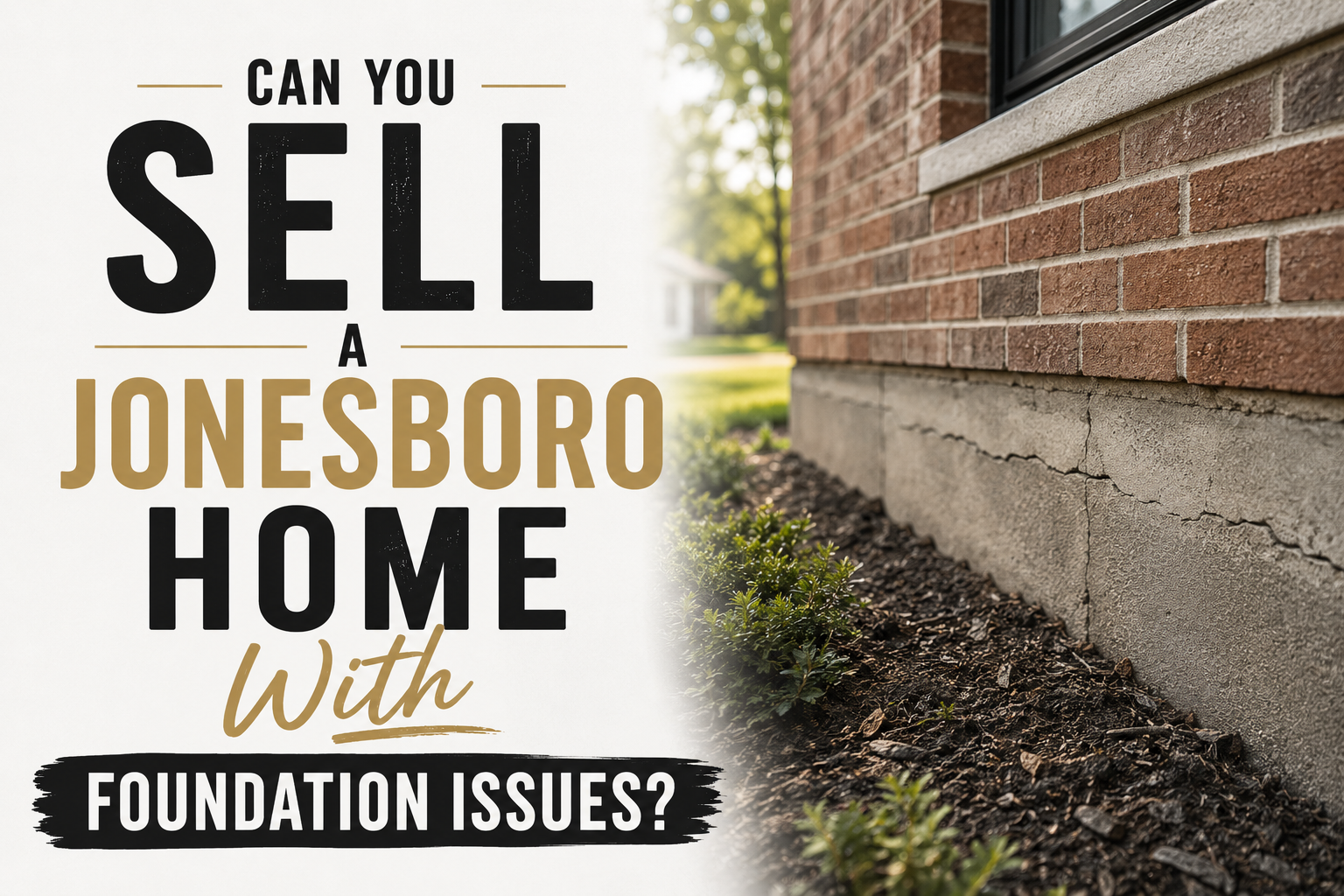
Can You Sell a Jonesboro Home With Foundation Issues?
Can you sell a house in Jonesboro that has foundation problems?
Yes. Homes with foundation issues sell in Northeast Arkansas regularly. What changes is your buyer pool, your pricing strategy, and how much documentation you need before you list.
A crack shows up in the drywall above a doorway. A door that used to close now sticks. Somebody mentions the word "foundation" and the whole idea of selling starts to feel complicated.
It is not as complicated as it feels. Trenton Hoggard and Tim Ray, who lead NEA Realtor Group, list homes with settling, cracked slabs, and repaired piers on a regular basis in Jonesboro. Those homes sell. They just sell differently than a house with no structural history, and the difference shows up in how you prepare before the sign goes in the yard, not in whether a buyer will show up at all.
Here is how to figure out what you are actually dealing with, what your real options are, and what Arkansas law expects you to say about it. If you are still early in the process, our home selling resources cover the broader steps that come before and after this decision.
First, Figure Out What You Actually Have
Not every crack is a foundation problem, and not every foundation problem is a structural one.
Most homes move a little as they age. Concrete cures and shrinks. Soil expands when it is wet and contracts when it dries. Some of what looks alarming is cosmetic and stable.
Signs that usually turn out to be minor:
- Hairline cracks in a slab or in mortar joints, especially vertical ones that have not moved in years
- Small drywall cracks at the corners of doors and windows
- Nail pops in ceilings
- Minor separation where a driveway or patio meets the house, since those slabs are usually poured separately
Signs that deserve a real evaluation:
- Horizontal or stair-step cracks in a brick or block wall, particularly wider than about a quarter inch
- Doors and windows that have gotten progressively harder to operate over months or years
- Floors that visibly slope or feel bouncy in one area
- Gaps opening between the top of a wall and the ceiling, or between baseboards and the floor
- Standing water, sagging joists, or crumbling piers in a crawlspace
- A brick veneer pulling away from the house at a corner
The distinction matters because the fix, the disclosure, and the price impact are completely different for each group. Guessing which group you are in is the single most expensive mistake sellers make here.
Why This Comes Up So Often in Northeast Arkansas
Foundation movement is not a sign that Jonesboro builders did something wrong. It is largely a soil story.
Much of Craighead County sits on clay-heavy soils that hold water and change volume with moisture. Crowley's Ridge, which runs right through the middle of Jonesboro, adds fine wind-deposited soils that behave differently again and are prone to erosion on slopes. A house on one side of town can have a completely different foundation history than a house two miles away.
Add the seasonal swing we get here, wet springs followed by dry late summers, and soil under a slab expands and contracts on a cycle. Over decades, that movement shows up in the structure above it.
Two practical implications for sellers:
- Local buyers and local inspectors are not shocked by settling. They have seen it. That works in your favor.
- Drainage is often the underlying cause, and correcting drainage is usually far cheaper than correcting the structure. Gutters, downspout extensions, and regrading soil away from the house are the first things a good contractor will look at.
Get a Structural Engineer's Report Before You Decide Anything
This is the step sellers most often skip, and skipping it costs money.
A foundation repair company will give you a free estimate. That estimate is a bid to do work, not an independent diagnosis. A licensed structural engineer, by contrast, gets paid for an opinion and has nothing to sell you afterward.
An engineer's report gives you three things a repair bid cannot:
- A written determination of whether the movement is active or has stabilized
- A specific scope of what actually needs to be done, which lets you compare contractor bids on equal terms instead of comparing sales pitches
- A document you can hand to a nervous buyer, their agent, and their lender
That last point is worth more than most sellers expect. Buyers do not walk away from problems. They walk away from unknowns. A report that says the movement stopped in 2014 and the house is structurally sound converts a deal-killer into a line item.
A home inspection is a separate thing and serves a different purpose. In Northeast Arkansas, plan on roughly $500 to $1,000 for a standard single-family inspection, with the higher end for larger homes, crawlspaces, or add-on services. Some sellers order one before listing so nothing surprises them later, and our guide on whether a pre-listing inspection is worth it walks through that trade-off.
Repair It, Credit It, or Price It In
Once you know the scope, you have three real paths. There is no universally correct answer, and the right one depends on your timeline, your cash position, and how much equity you have.
Option 1: Repair before listing
This produces the cleanest sale and the widest buyer pool. You list as a normal home, with a repair invoice and a transferable warranty in hand.
Repair costs vary enormously by scope. Correcting drainage and injecting a few cracks sits at the low end. Full underpinning with piers along a wall runs into five figures nationally. We will not quote you a number, because the only figure that means anything is a written bid on your specific house from a local contractor, and Northeast Arkansas bids are not reliably cheaper than national averages.
Repairing first tends to make sense when the work is well defined, you have the cash or can pay from closing proceeds, and the repair cost is meaningfully less than the discount buyers would demand otherwise.
Option 2: Sell as-is with a credit or concession
Here you disclose the condition, provide the engineer's report and contractor bids up front, price accordingly, and let the buyer handle the work after closing.
This works well when you cannot front the repair cost, when you want to move quickly, or when the buyer wants control over which contractor does the work and what product gets installed.
The catch is that a credit has to survive the buyer's lender, and lenders cap seller-paid concessions by loan type. Your listing agent should confirm what is allowed before you agree to a number.
Option 3: Price it in and target the right buyer
Some homes with structural issues are best sold at a price that reflects the condition, aimed at cash buyers, investors, or renovation-minded buyers who are not relying on a conventional appraisal.
This is the fastest, simplest path, and it is also the most expensive one in terms of net proceeds. Nationally, homes carrying unaddressed structural problems commonly trade at a meaningful discount to comparable sound homes, and the discount frequently exceeds what the repair would have cost. Run the math both ways before you assume as-is is easier.
What Arkansas Expects You to Disclose
Arkansas is a buyer-beware state. There is no state statute forcing a residential seller to complete a disclosure form, which surprises a lot of people who have sold homes elsewhere.
That is not a license to stay quiet, and treating it that way is how sellers end up in litigation after closing.
- Actively concealing a known defect, painting over a crack you know is structural, or interfering with a buyer's inspection can create fraud liability regardless of caveat emptor
- Arkansas Real Estate Commission rules require licensed agents to make reasonable efforts to learn material facts about a property, so your agent is not permitted to look the other way either
- Most Arkansas transactions use a property disclosure form by custom even though it is not statutorily mandated, and once you fill one out, it needs to be accurate
Our practical advice is the same every time: disclose the condition, disclose any repairs, and hand over the paperwork. A documented, disclosed, repaired foundation is a normal listing. An undisclosed one that a buyer's inspector finds on day eight is a renegotiation at best. For a fuller picture of what belongs on the form, see what Jonesboro sellers need to disclose before listing.
How Foundation Problems Affect Your Buyer's Loan
This is where a structural issue quietly narrows your buyer pool, and it is the part most sellers do not see coming.
Government-backed loans carry property condition standards. FHA requires that a home be safe, secure, and structurally sound, with a foundation free of substantial damage. VA and USDA apply comparable standards. If an appraiser flags active structural damage, the lender can require the repair before closing, not after.
That matters a lot in Northeast Arkansas, where USDA and FHA financing are common and plenty of property outside Jonesboro city limits qualifies for USDA. A house that cannot pass those standards is effectively limited to conventional, portfolio, or cash buyers.
A few things that help:
- A completed repair with an engineer's letter confirming the work is generally the strongest position, since it takes the question off the appraiser's desk
- A transferable warranty from the repair contractor reassures both the buyer and the underwriter
- If you are selling as-is, expect fewer offers with government financing and plan your pricing and timeline around that reality rather than being surprised by it in week three
One local note that cuts the other way: in Northeast Arkansas, the majority of deals close without any earnest money at all. When buyers do put earnest money down, $1,000 is the most common amount, with higher figures up to roughly $5,000 generally reserved for luxury purchases. So a buyer walking after inspection usually is not forfeiting much, which is one more reason to get ahead of the disclosure rather than hoping it does not come up.
Pricing and Marketing the Home
Pricing a house with a structural history is harder than pricing a typical listing, because true comparable sales are thin.
In the Jonesboro market, sales volume is low enough that a useful comparative market analysis often has to reach back 90 to 180 days rather than the 60 or 90 days a larger metro would use. Narrowing that further to homes with disclosed foundation repairs can leave you with very few sales to work from, so the analysis leans more on adjustment and judgment than on a tidy set of matches.
Context helps too. Nationally, the market has stayed tight and slow rather than falling apart. The National Association of Realtors reported existing-home sales down 1.7% in July 2026 with a median price of $434,100 and a 4.6-month supply, and Freddie Mac put the 30-year fixed rate at 6.67% as of August 13, 2026. Buyers financing at those rates are careful about anything that adds cost after closing, which is exactly why documentation does so much work for you.
On the marketing side, transparency outperforms strategy. Put the engineer's report and repair invoices in the listing file so a buyer's agent can review them before writing an offer. NEA Realtor Group also runs a dedicated direct mail campaign for every listing, which matters more than usual on a home like this, since the right buyer is often someone with cash or renovation experience who is not refreshing a search app every morning. If you want to see how current Jonesboro conditions are trending overall, Redfin's Jonesboro market page is a reasonable place to start.
Frequently Asked Questions
Q: Do I have to disclose foundation repairs that were done years ago?
Arkansas does not require a statutory disclosure form, but concealing a known material defect can create fraud liability, and most transactions here use a disclosure form by custom. Disclosing a completed, warrantied repair with documentation is usually an advantage rather than a liability, because it answers the question before a buyer has to ask it.
Q: Will a foundation issue stop a buyer from getting FHA or USDA financing?
It can. FHA, VA, and USDA all require that a home be structurally sound, and an appraiser who flags active damage can trigger a lender-required repair before closing. Completing the repair and providing an engineer's letter is generally the most reliable way to keep those buyers in play.
Q: Should I repair the foundation before listing or offer a credit instead?
Compare the written repair bid against the discount buyers are likely to demand for the same condition. When the repair costs less than the expected discount and you can fund it, repairing usually nets more. When cash is tight or you need speed, a disclosed credit with documentation attached is a reasonable alternative.
With 5-star reviews and the distinction of being the #1 real estate team in the Northeast Arkansas MLS by production, NEA Realtor Group has listed and sold plenty of homes with structural history, and we will tell you straight whether a repair is worth making before you list or whether your money is better kept in your pocket.
Ready to Take the Next Step?
If you have a crack, a sticking door, or an old repair invoice you are not sure what to do with, let us take a look before you spend anything. Trenton Hoggard and Tim Ray with NEA Realtor Group can walk your home in Jonesboro or anywhere in Northeast Arkansas and tell you what it means for your sale.
Connect with NEA Realtor Group