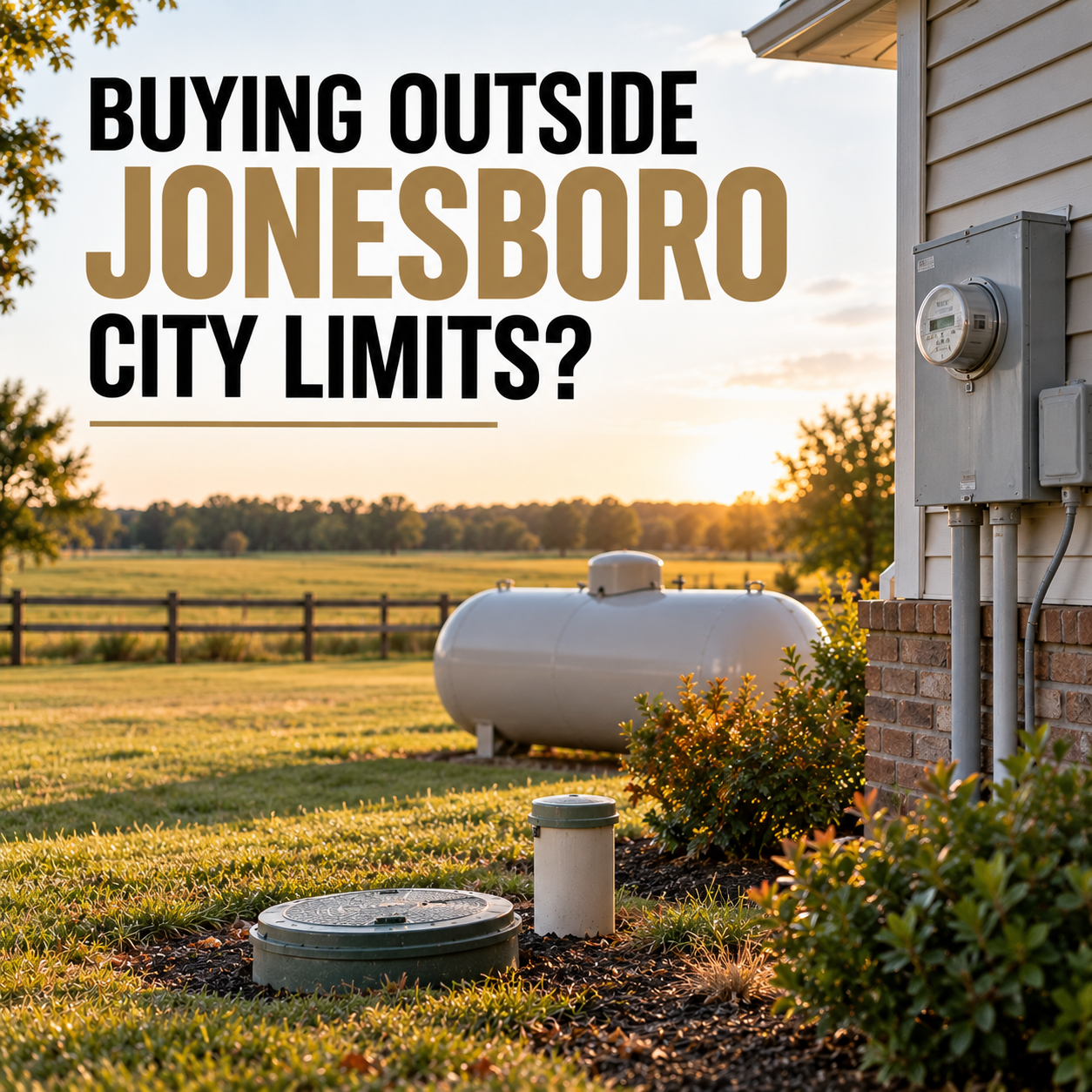
Buying Outside Jonesboro City Limits: What to Check
What should you check before buying a home outside Jonesboro city limits?
Water source, septic permit, heat source, fire protection distance, flood zone, and internet service. All six change what the house costs you every month, and all six can be verified before your inspection deadline runs out.
You found more house for the money about eight minutes past the edge of town. Bigger lot, quieter road, better shop building, and a price that made the in-town comparables look silly.
That math is usually real. Buyers who cross the city limit line in Craighead County genuinely do get more square footage and more land per dollar.
What changes is not the price. What changes is the list of things nobody is going to hand you. Inside the city, water, sewer, gas, trash, and fire service arrive without a conversation. Outside it, every one of those is a separate arrangement with a separate provider, and a few of them affect your loan and your insurance. Trenton Hoggard and Tim Ray walk buyers through this every season, and the pattern is always the same: the county house is a good buy, but only after somebody actually checks. If you are still early in the process, our guide to buying a home covers the steps that come before this one.
Here is the list we work through, in the order it matters.
Start With the Water
Outside city limits, your water comes from one of two places, and they are not equivalent.
- A rural water association or public water authority. Most improved county properties around Jonesboro, Brookland, Bono, and Valley View are on one of these. You have a meter, a monthly bill, and a membership rather than a city account.
- A private well. Less common on newer county subdivisions, very common on older homes and acreage tracts.
If it is rural water, ask three questions before your inspection deadline: Is the meter already set and active at this address? Is there a membership or tap fee that transfers, and what does the association charge to put the account in your name? And is there an outstanding balance tied to the meter?
A meter that was pulled after a vacancy is the one that surprises people. Getting it reset is usually routine, but it is not always same-week, and you do not want to discover it the afternoon before closing.
If it is a well, you are now responsible for the pump, the pressure tank, the wiring, and the water quality. Have it tested. A well is a fine way to get water and a bad thing to inherit blind.
Septic Systems Leave a Paper Trail
There is no municipal sewer past the city limit. The house is on an onsite wastewater system, which almost always means a septic tank and a field line.
Arkansas regulates these at the state level. The Arkansas Department of Health onsite wastewater program reviews permit applications and works through environmental specialists in each county health department, and installers and designated representatives are licensed through that program.
What that means for you as a buyer is simple: there should be a record.
- Ask the seller for the original permit and the system layout if they have it.
- Ask how many bedrooms the system was permitted for. A three-bedroom system under a house that has since been converted to four bedrooms is a real problem, and it is the kind of thing that surfaces at an appraisal or an insurance inspection.
- Ask when it was last pumped, and by whom.
- Get the system inspected separately. A standard home inspection does not evaluate a septic field.
We wrote a fuller walkthrough of this in our post on well and septic inspections for Northeast Arkansas buyers, and it is worth reading before you write the offer rather than after.
One practical note on cost. A standard single-family home inspection in this market generally runs $500 to $1,000. Once you add a septic evaluation, a well test, a crawlspace, or a larger home, plan on $800 to $1,200 and up. That is money well spent out here, and it is not the place to shop for the cheapest number.
Heat, Propane, and the Bill You Have Not Seen Yet
Natural gas lines generally stop where the city services stop. County homes are usually all-electric, propane, or some combination.
If there is a propane tank in the yard, find out whether it is owned or leased before closing. This one catches buyers constantly.
- Owned tank. It conveys with the house and you can buy gas from whoever gives you the best price.
- Leased tank. It belongs to the supplier, you sign their agreement, and you generally buy gas from them. If the seller had a leftover balance of propane in the tank, whether you pay for it is negotiable and should be handled in the contract, not in the driveway on moving day.
Also ask the seller for twelve months of electric usage. A large county house with an older heat pump and a shop building on the same meter does not cost what a 1,600 square foot home in town costs to run, and the difference is worth knowing while you still have a financing contingency.
Your electric service may come from a cooperative rather than a city utility, which means a membership and a deposit rather than a city account transfer. Neither is difficult. Both take a phone call you should make in the first week of the contract, not the last.
Fire Protection Changes Your Insurance Quote
This is the one buyers skip, and it is the one most likely to change your monthly payment.
Insurers price a home partly on how far it sits from a responding fire department and from a usable water source such as a hydrant or a draft site. A county address served by a volunteer department several miles out does not rate the same as a home two blocks from a station inside Jonesboro.
We are not going to publish a dollar range for that difference, because it varies too much by carrier, by address, and by the specific fire district. What we will tell you is to get a real quote at the actual address, not an estimate based on the in-town house you looked at last month.
Do it in the first few days of the contract. If the number comes back higher than your lender's original estimate, your escrowed payment moves, and you want to know that while you still have contingencies rather than at the closing table. Our post on getting homeowners insurance lined up before closing covers the timing in more detail, and the Insurance Information Institute's coverage guidelines are a reasonable place to sanity-check what you are actually buying.
While you are on the phone, ask whether the property sits in a fire district with annual dues, and whether those are billed separately or collected with the property taxes.
Pull the Flood Map Yourself
Northeast Arkansas is flat, farmed, and drained. Ditches, laterals, and bottomland are part of the landscape, and mapped flood zones are more common outside the city grid than inside it.
You can look this up in about two minutes at the FEMA Flood Map Service Center using the property address. If the home sits in a special flood hazard area and you are financing it, your lender will require flood insurance, and that is a separate policy from your homeowners coverage.
A flood zone is not automatically a reason to walk. Plenty of good Northeast Arkansas homes sit in one. It is a reason to price that policy before you remove contingencies, and in some cases a reason to ask about an elevation certificate.
Internet Is a Contract-Period Question
If anyone in the household works from home, treat this as a condition of the house rather than a detail to sort out after you move.
Start with the FCC National Broadband Map, which shows reported service by location. Then call the providers it lists and give them the exact address. Reported coverage and an actual serviceable drop at your specific meter pole are not always the same thing, and the phone call is the only way to close that gap.
Ask two questions: can you install at this address, and is there an installation charge for running new line. In the county, that second answer occasionally has a comma in it.
Address, Mail, and the Services the County Does Not Provide
A few small things that are easy to handle early and annoying to handle late:
- The 911 address. Confirm the address on the contract matches what the county has assigned and what shows on the tax records. Older rural properties sometimes carry a route address and a newer assigned address, and lenders and insurers want them to agree.
- Mail. Delivery may be to a cluster box or a roadside box rather than to the house. Worth knowing.
- Trash. Curbside pickup is not automatic outside the city. You may be arranging a private hauler or hauling to a drop-off site.
- Road maintenance. Find out whether the road is county-maintained or private. It affects winter access, delivery, and sometimes financing.
- Boundaries. Fence lines and deed lines disagree more often out here than they do on a platted city lot. Our post on whether you need a survey lays out when it is worth ordering one.
One piece of good news: most county properties have no homeowners association at all. And where there is one in this market, dues typically run $100 to $300 per year, not per month. National guides quote monthly figures that simply do not describe Jonesboro.
The Financing Upside Most Buyers Miss
Here is the part that makes the whole checklist worth working through.
Properties outside city limits are frequently in an eligible area for USDA Rural Development financing, which is a zero down payment loan for qualifying buyers and properties. You can check any specific address on the USDA income and property eligibility site, and the program terms are laid out on the USDA Single Family Housing Guaranteed Loan Program page.
Eligibility has two halves. The property has to sit in a designated area, and your household income has to fall under the limit for the county. Plenty of buyers assume they earn too much and never check. Check.
With the 30-year fixed averaging 6.71% in the Freddie Mac Primary Mortgage Market Survey for the week of September 3, 2026, up from 6.66% the week before, the difference between putting money down and putting none down is not a small consideration. A USDA-eligible county property can be the cheapest realistic path to ownership in this market.
Two cautions. USDA appraisals hold the property to condition standards, so a home with an active roof leak or a failing septic system can be flagged. And USDA files can move on a different timeline than conventional files, which matters when you are setting a closing date.
What the Appraisal Does Differently Out Here
County properties appraise differently than subdivision homes, and it is worth setting expectations before you write the offer.
Jonesboro is not a high-volume market. Over the three months ending August 2026, Redfin put the Jonesboro median sale price at $234,845, up 2.1% year over year, with 309 homes sold in August and a median of 54 days on market, improved from 66 days a year earlier. Those are healthy numbers, and they still represent a market thin enough that a 30-day comparable window tells you almost nothing.
For pricing here we generally pull comparable sales from the last 90 to 180 days. On acreage, on homes with large shop buildings, and on older rural properties, that window often has to stretch further still, simply because there are not enough recent sales of anything similar.
Practically, that means two things. Value opinions on unique county properties carry a wider range than they do on a tract home, and appraisals out here take longer, because the appraiser has to drive further and work harder to find support. Build that into your contract dates.
Two Things That Do Not Change
A couple of local realities apply the same whether you buy in town or ten miles out.
The termite letter. In Arkansas, plan on a wood-destroying insect report for almost any financed purchase in the Jonesboro area. The common national framing, that it is only required on VA and USDA files or when an appraiser flags something, does not describe this market. The realistic exceptions here are an in-house portfolio loan at a local bank setting its own rules, or a cash purchase with no lender involved.
Earnest money. The large majority of transactions in Northeast Arkansas do not include any earnest money at all. When buyers do put it down, $1,000 is the most common figure, and the highest we typically see is around $5,000, generally on luxury properties. Those are observed patterns and not rules, and any individual deal can be negotiated differently. The point for you is that in a market where a deposit often is not holding the deal together, your contingency dates and your deadlines are doing the real work of protecting you. Miss one and you have given something up.
A Practical Order of Operations
If you are under contract right now on something past the city limit, work it in this order:
- Days 1 to 3. Pull the flood map. Call for an insurance quote at the actual address. Check USDA eligibility if you have not already.
- Days 1 to 5. Schedule the home inspection, and schedule the septic and well evaluations at the same time so they land before your deadline.
- Days 1 to 7. Confirm the water meter status, the propane tank ownership, the electric provider, and internet serviceability.
- Ask the seller for the septic permit, twelve months of utility history, and any well records.
- Confirm road maintenance responsibility and the 911 address.
None of this is difficult. It is just a different list than the one a city purchase runs on, and nobody hands it to you.
Frequently Asked Questions
Q: Is it harder to get a loan on a home outside Jonesboro city limits?
Not generally, and in many cases it opens a door, since properties in eligible areas may qualify for zero down payment USDA financing. What can complicate a file is the property itself rather than the location: a failing septic system, an unpermitted addition, a shared or private road with no maintenance agreement, or acreage large enough that comparable sales are scarce.
Q: Will my homeowners insurance cost more outside the city?
Often yes, because carriers weigh distance to a responding fire department and to a water supply. The size of the difference depends on the carrier, the specific address, and the fire district, so the only reliable answer is a real quote at the actual address. Get one in the first few days of your contract, before your escrow estimate is locked in.
Q: Who is responsible for the septic system after closing?
You are. Once you close, the tank, the field lines, and the maintenance are yours. That is why the permit records, the bedroom count the system was sized for, and a separate septic evaluation matter more than almost anything else on a county home inspection.
Q: Can I still get city water and sewer if the house is just outside the limits?
Sometimes for water, rarely for sewer. Some properties just past the line are served by a city system or by a rural association that buys from one. Sewer extensions are a much larger undertaking and are not something to assume. Verify what is actually connected at the address rather than what could theoretically be connected.
For perspective on who you are working with: NEA Realtor Group, led by Trenton Hoggard and Tim Ray, holds 5-star reviews and is the #1 real estate team in the Northeast Arkansas MLS by production.
For broader context on where the national market sits, sales and inventory trends are tracked in the National Association of Realtors housing statistics.
Looking at Something Past the City Limit?
Send us the address and we will tell you what it is on for water and sewer, whether it looks USDA eligible, and what we would check first. No pressure either way. NEA Realtor Group serves Jonesboro and all of Northeast Arkansas.
Connect with NEA Realtor Group